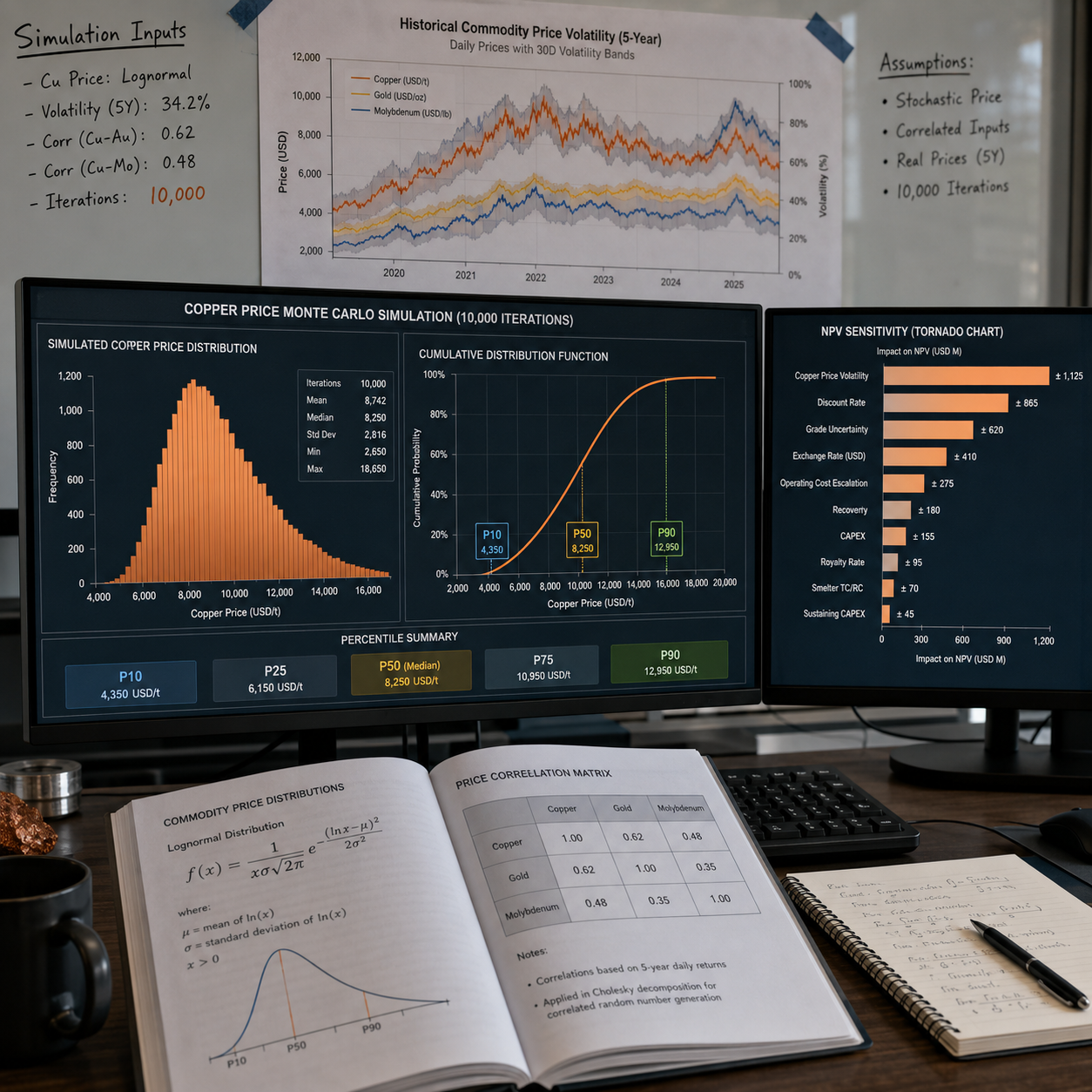
A feasibility study conducts a thorough evaluation of the feasibility of a project, which significantly depends on the prediction of cost and revenue. In industries such as mining and agriculture, one of the key factors of unfeasibility is the risk of losses connected with fluctuating prices on commodities. The assessment of the risks can be carried out through the Monte Carlo simulation approach, which involves running multiple computations with random input values to analyze the range of results in terms of the probabilities.
The first thing to do when designing such simulations is constructing a proper financial deterministic model. This implies an evaluation of basic cash flows including operating costs, capital expenditure, and production. Next, it is important to consider which of these factors are the main sources of uncertainty in order to properly account for them. Although there are risks associated with operating costs, commodity price changes have always played a dominant role in projects’ value changes. Identifying these specific variables for which the random sampling will take place is vital (Kamel et al., 2023).
The next step involves assigning proper probability distributions or stochastic processes to individual price components. In some cases, the simple normal distribution may be enough, while commodities show complicated stochastic behavior such as mean reversion or even geometric Brownian motion. The use of a mean-reverting model calibrated with the help of the historical time-series will prevent the simulation from generating completely unreasonable values of rising forever price of commodity in question (Brande et al., 2023).
One more issue which is quite often ignored in building the model and yet important is dealing with correlations between different stochastic variables. It should be noted that commodity prices are connected by various correlations. For example, the price of output metal and energy cost of input materials may show the same behavior. It will distort all project’s variance estimation greatly because these two variables can be considered completely independent within the framework of the simulation.
After conducting an analysis of prices’ distributions and correlation, the simulation is performed several times. In each such trial, there is random choice of the variables considering their specified distribution and the calculation of NPV and IRR of the project. As a result, the financial measures turn into distributions. The outcome is not an exact NPV, but the probability distribution that shows how likely to be the positive return on investment compared to capital loss probabilities (Ronyastra et al., 2024).
As a final point, however, the proper design of the Monte Carlo simulation itself means little compared to the strategic information that can be derived from it. Analysts need to analyze probability distributions to establish their value at risk and the level at which they become nonviable. Using such risk assessment, stakeholders can then craft their hedging policies to reduce risks. In this way, organizations make sound decisions amid uncertainty and protect their capital investment based on statistics.
References
Brande, M. d. R., Santos, D. F. L., Fialho, N. S., Proença, D. C., Ojeda, P. G., Godói, F. C. M., Roubach, R., & Bueno, G. W. (2023). Economic and financial risks of commercial tilapia cage culture in a neotropical reservoir. Heliyon, 9(6), e16336. https://doi.org/10.1016/j.heliyon.2023.e16336
Kamel, A., Elwageeh, M., Bonduà, S., & Elkarmoty, M. (2023). Evaluation of mining projects subjected to economic uncertainties using the Monte Carlo simulation and the binomial tree method: Case study in a phosphate mine in Egypt. Resources Policy, 80, 103266. https://doi.org/10.1016/j.resourpol.2022.103266
Ronyastra, I. M., Saw, L. H., & Low, F. S. (2024). Monte Carlo simulation-based financial risk identification for industrial estate as post-mining land usage in Indonesia. Resources Policy, 89, 104639. https://doi.org/10.1016/j.resourpol.2024.104639