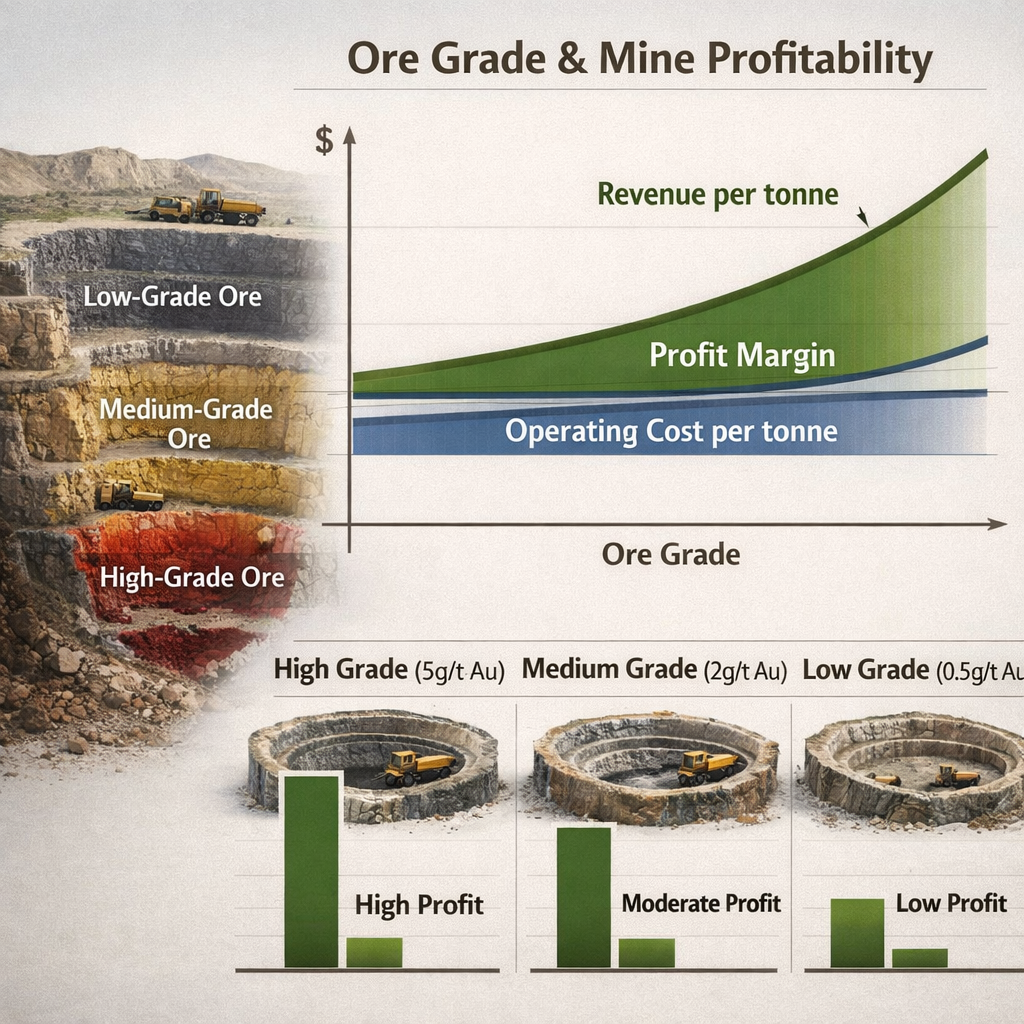
The quality of a mineral deposit, specifically its ore grade, serves as the primary heartbeat of a mining operation’s financial health. In an era where global deposits are steadily deteriorating in quality, the correlation between mineral concentration and profit margins has shifted from a technical observation to a critical pillar of resource management (Calzada Olvera & Iizuka, 2023).
At its core, ore grade dictates a project’s Net Present Value (NPV) by defining the ratio of “pay metal” to waste. High-grade deposits are inherently more lucrative because they yield more product for every ton of earth moved. In contrast, as grades drop, a mine must process exponentially larger volumes of rock to maintain the same output. This creates a compounding financial burden: larger volumes demand more energy for comminution (the crushing and grinding of stone) and higher chemical consumption during processing, which thin out profit margins (Calzada Olvera & Iizuka, 2023).
Beyond simple volume, grade influences the very physics of production. In iron ore mining, for instance, the concentration of the metal dictates the efficiency of downstream smelting; higher-grade ores require significantly less energy to process, whereas lower-grade variants necessitate additional limestone and generate excess slag, further driving up costs (Abuntori et al., 2021). Furthermore, erratic grade distribution introduces geological uncertainty. Without sophisticated predictive modeling, this variability can lead to inefficient extraction sequences that compromise a mine’s long-term stability (Abuntori et al., 2021).
To navigate these challenges, operators often use cutoff grade strategies as a financial throttle. By raising or lowering the minimum grade acceptable for processing, firms can shield themselves from market volatility, balancing immediate cash flow needs with the ultimate lifespan of the mine (Calzada Olvera & Iizuka, 2023). In the end, the ability to accurately forecast and manage these grades is the defining factor between a resilient venture and a failing one.
References
Abuntori, C. A., Al-Hassan, S., Mireku-Gyimah, D., & Ziggah, Y. Y. (2021). Evaluating the performance of extreme learning machine technique for ore grade estimation. Journal of Sustainable Mining, 20(2), 56–71. https://doi.org/10.46873/2300-3960.1062
Calzada Olvera, B., & Iizuka, M. (2023). The mining sector: profit-seeking strategies, innovation patterns, and commodity prices. Industrial and Corporate Change, 33(4), 986–1010. https://doi.org/10.1093/icc/dtad020