Most people picture the same thing: a massive empty hole left behind after mining ends.
That image misses the point entirely.
An open pit at closure isn’t a leftover. It’s a decision. One of the most deliberate and technically demanding decisions in the entire mine lifecycle.
I found myself thinking about this through the lens of Diavik Diamond Mine. It’s a clean example of how closure isn’t about filling space—it’s about managing long-term behavior.
During operations, everything is geared toward extraction. Efficiency, production rates, cost per tonne.
At closure, that logic flips.
Now the question becomes: How will this site behave 50, 100, even 200 years from now—without us?
You’re no longer designing for performance under control.
You’re designing for performance without control.
That changes everything.
There’s no single template for what an open pit becomes. The outcome depends on a few core realities:
- Hydrogeology: groundwater flow, connectivity, and pressure regimes
- Pit geometry: depth, slope angles, wall stability
- Geochemistry: potential for acid generation or contaminant release
- Climate and recharge: how water enters and leaves the system
What this really means is that every pit has multiple possible futures, and none of them are perfect.
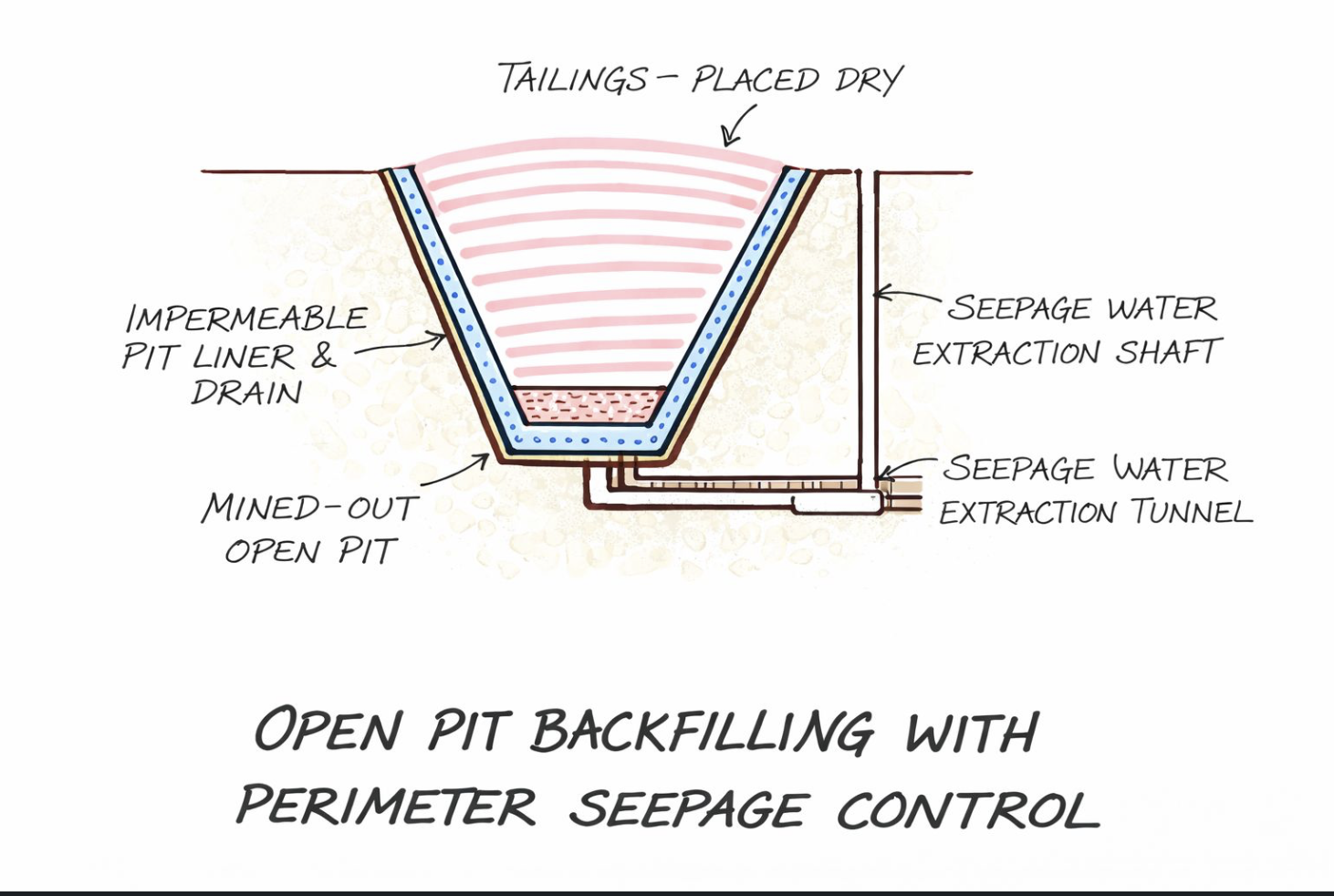
1. Groundwater-sensitive systems → Controlled containment
When seepage poses a risk, the pit can be converted into a lined containment system.
The idea is simple in theory: isolate the material from the surrounding groundwater.
In practice, it’s a long-term barrier design problem—one that has to perform for decades without maintenance.
2. Deep pits with water → Managed pit lakes
Some pits are allowed to fill with water, forming pit lakes.
But this isn’t passive flooding. Water levels are controlled, often through crest discharge structures, to maintain slope stability and avoid uncontrolled overflow.
Water chemistry becomes the central challenge here.
3. Wide, shallow pits → Engineered landforms
Where feasible, pits can be reshaped into stable landforms by backfilling them with tailings. When Drainage is everything. If water is not managed correctly, erosion and instability will undo the entire design.
4. Lake-connected pits → Natural re-integration
At sites like Diavik Diamond Mine, the approach is different.
The pits were originally isolated from the lake using dikes. At closure, those dikes are removed, allowing the lake to reclaim the system.
It looks simple from the outside. It’s not.
You’re reconnecting two systems that have evolved separately for years.
Closure is often described as the end of mining. That framing doesn’t hold up.
It’s the only phase designed to last indefinitely.
And that shifts the objective toward a different kind of engineering:
- Stability without ongoing intervention
- Water quality that holds decades into the future
- Integration with surrounding ecosystems
- Performance under uncertainty—when conditions change, and no one is there to adjust
Here’s the uncomfortable part.
Closure is still too often treated as something that happens at the end. A downstream exercise.
But the hardest problem in mining isn’t extraction.
It’s this: Can the system you leave behind behave predictably after you’re gone?
That question doesn’t belong at closure.
It belongs at the very beginning.
Reference
Diavik Diamond Mines (2012) Inc. (2015). Water Licence Renewal – Technical Session – Information Request 10 – Attachment 4 – Part 3: A418 Dam Safety Review (Apr 9, 2015). Mackenzie Valley Land and Water Board.