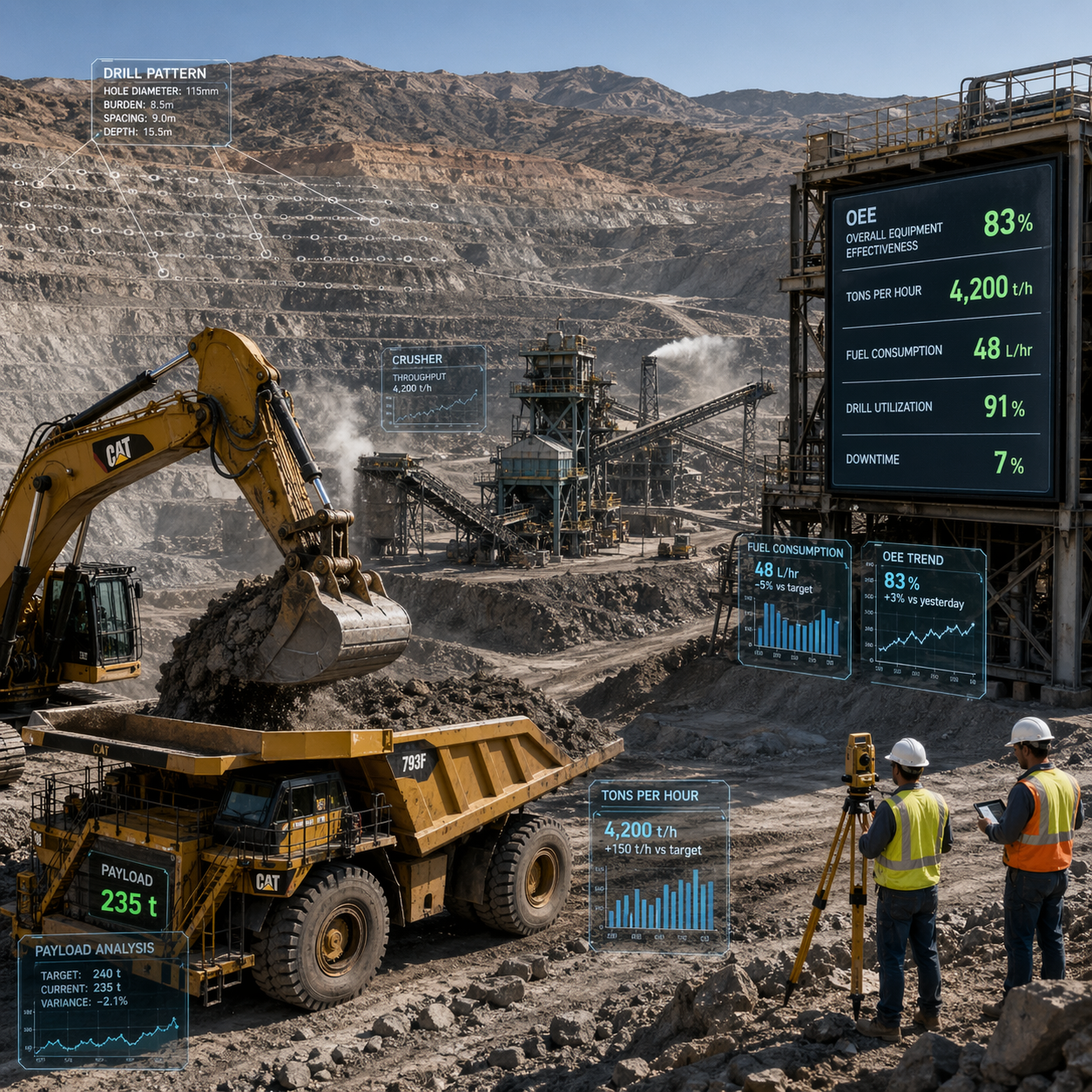
Operational efficiency in the mining industry is a multifaceted concept that balances production volume, resource utilization, and safety. Because mining is an asset-intensive sector, Key Performance Indicators (KPIs) act as critical diagnostic tools that allow management to monitor the health of geological, mechanical, and human systems.
Core operational KPIs in mining
Research by Gackowiec et al. (2020) emphasizes that mining KPIs must bridge the gap between high-level financial goals and shift-level technical execution. These indicators are typically categorized into production, equipment reliability, and safety.
Equipment availability and utilization
One of the most fundamental measures of efficiency is Mechanical Availability, which calculates the percentage of time a piece of equipment (like a haul truck or excavator) is capable of performing its function. However, availability alone is insufficient; Utilization of Availability must also be tracked to measure how effectively that available time is actually used for production versus standing idle (Dougall, 2015).
Production throughput and plan attainment
Operational success is often defined by the ability to meet geological forecasts.
- Plan attainment: this KPI measures the variance between the planned tonnes of ore versus the actual tonnes moved.
- Drilling and blasting efficiency: specific metrics such as “meters drilled per man-shift” or “cubic meters of ore per shot” are used to evaluate the primary stages of the extraction cycle.
Reliability metrics: MTBF and MTTR
To maintain a continuous flow of material, mines track Mean Time Between Failures (MTBF) and Mean Time To Repair (MTTR). A high MTBF suggests robust preventive maintenance, while a low MTTR indicates an efficient technical response team. According to Kang et al. (2016), these maintenance KPIs are intrinsically linked to the overall throughput of the production system.
Cost and safety indicators
Efficiency is also a matter of economic and human cost.
- Cost per Tonne: this provides a granular view of operational expenses (fuel, labor, and maintenance) relative to output.
- Safety metrics: the Total Recordable Injury Frequency Rate (TRIFR) is a critical lagging indicator. Operational efficiency can never be divorced from safety; a highly productive mine that suffers frequent accidents is ultimately inefficient due to the resulting shutdowns and legal liabilities.
References
Dougall, A. (2015). Identification of key performance areas in the southern African surface mining delivery environment. SAIMM.
Gackowiec, P., Podobińska-Staniec, M., Brzychczy, E., Kühlbach, C., & Özver, T. (2020). Review of Key Performance Indicators for Process Monitoring in the Mining Industry. Energies, 13(19). https://doi.org/10.3390/en13195169
Kang, N., Zhao, C., Li, J., & Horst, J. (2016). A Hierarchical structure of key performance indicators for operation management and continuous improvement in production systems. International Journal of Production Research, 54, 1–18. https://doi.org/10.1080/00207543.2015.1136082