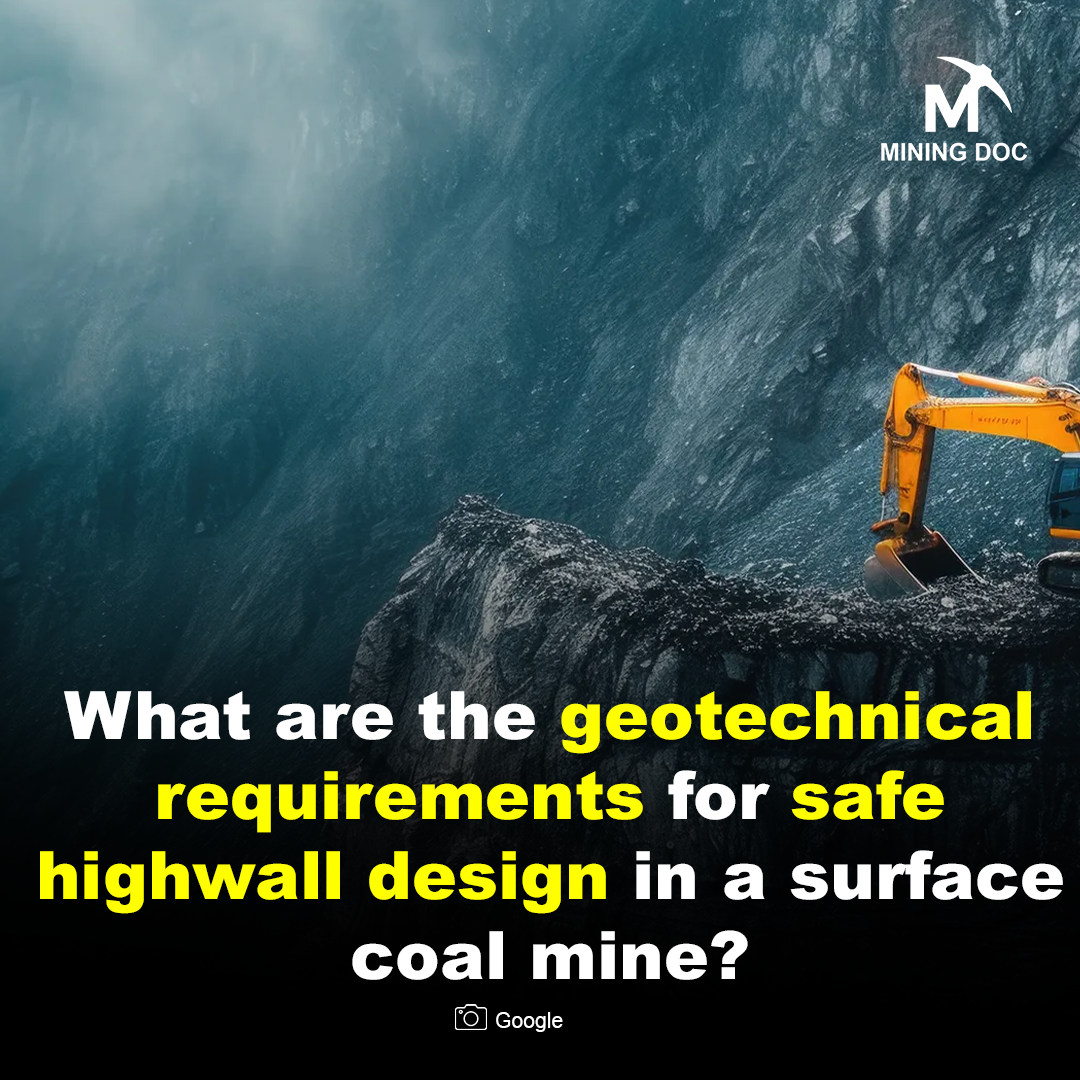
Safe highwall design in surface coal mines depends on thorough geotechnical evaluation to minimize the risk of slope instability, rockfalls, and failures that could endanger personnel and equipment. This involves detailed site investigations to identify geological zones, differentiate weak or weathered overburden from stronger rock interburden, and conduct laboratory testing to determine shear strength, rock quality designation (RQD), and joint orientations (R.J. Butcher,2001).
Highwall geometries must be designed to achieve stability factors greater than 1.3–1.6 through slope stability analyses such as limit equilibrium or finite element methods. Typical designs limit overall wall heights to about 20–60 m, with bench heights of 10–15 m, face angles of 60–75° in hard rock, and buffer slopes of 60–70° for blasted highwalls. Wall orientation is also selected to align with favorable joint patterns in order to reduce the risk of planar and wedge failures(R. Karl Zipf et al.,2005).
Structural mapping, borehole logging, and monitoring systems such as inclinometers and piezometers are essential for guiding highwall design. These assessments consider factors including fracture spacing (with spacing below 2 m considered high risk), groundwater conditions, and blast-induced damage that can weaken rock cohesion. Standard control measures include proactive battering, with initial slopes of 70–80° later flattened to 55–65°, as well as rockfall catchment berms typically 3–5 m high.
Regular geotechnical audits ensure that designs remain suitable as mining advances. Web and barrier pillar widths are determined according to overburden depth (for example, up to 76 m maximum cover), while pillar stability factors are maintained above 1.3. Surface coal mines in South Africa commonly apply geotechnical domain models to optimize mining direction and select the most appropriate mining methods.
References:
R.J. Butcher.(2001). A geotechnical rationale for the design of South African open cast coal mine highwalls.
Karl Zipf, Jr., NIOSH, Pittsburgh, PA.(2005). GROUND CONTROL DESIGN FOR HIGHWALL MINING.