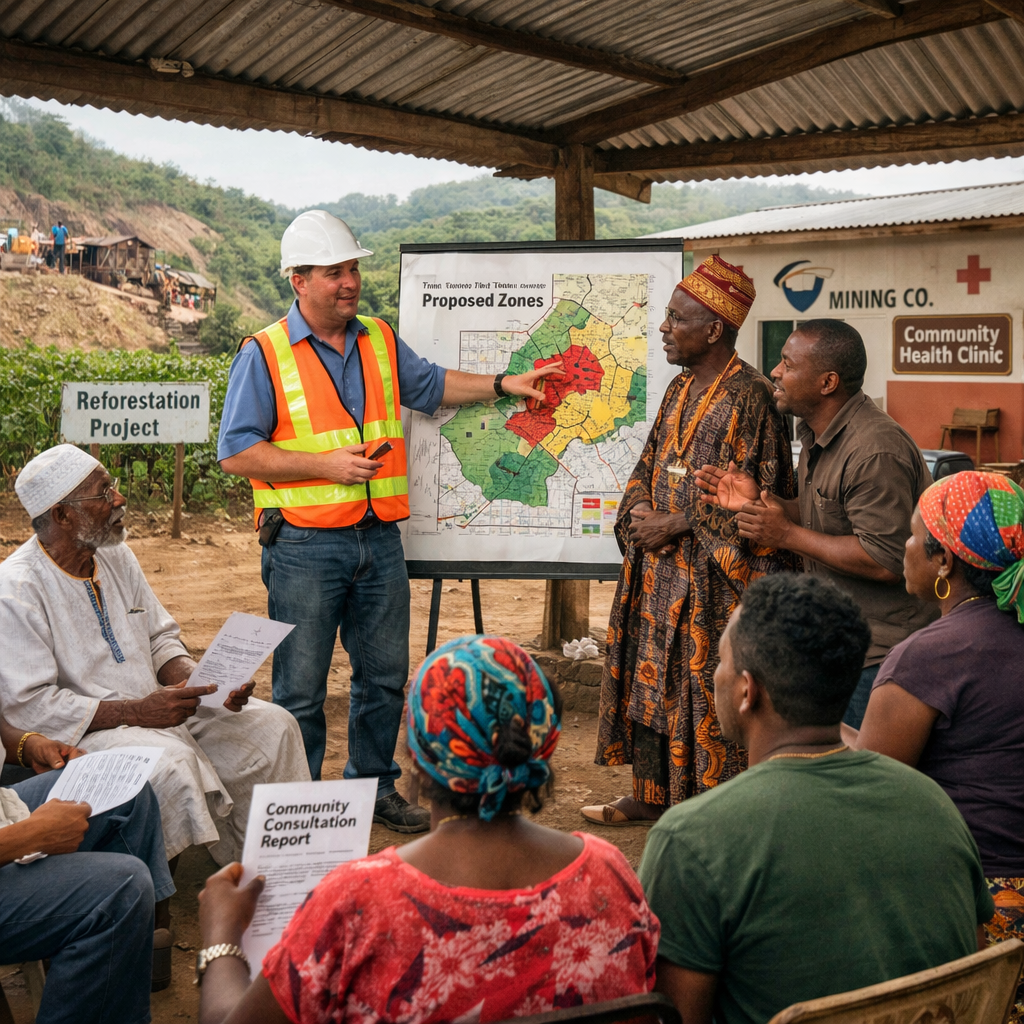
The social licence is acquired by building up and maintaining the trust, approval, and acceptance of the mining company among host communities through sustained interaction, rather than by obtaining a legal permit from the government. Social licence can best be understood as an approach focused on developing an ongoing relationship through legitimacy and credibility.
To start with, companies need to engage with the community in a sustainable way. As verified resources explain, acceptance by local communities is dependent on the company’s interactions with them, while social licences are established via sustainable relations rather than just consultation sessions. This means that interactions should be done from the outset of the company’s activities – during exploration, construction and operation phases.
Companies need to be upfront about what kind of project they have, what kind of threats or impacts it poses to communities, and how much they can actually benefit from it. When companies provide information regarding potential effects in terms of environment, society, and economics in a straightforward manner, communities are more inclined to accept the project, especially because exaggeration is not appreciated either.
Third, businesses secure social licence by respecting local rights, cultures, land use, and means of subsistence. Mining community literature suggests that support is contingent upon whether firms respect local residents, preserve cultural heritage sites, and refrain from disrupting existing economic activities without compensation. Typically, these include access arrangements, conflict resolution channels, and consideration for vulnerable groups like agriculturalists, women, and indigenous populations.
Fourth, communities demand concrete and sustainable gains, not mere assurances. Mining community literature suggests that firms win social licence by helping with local development initiatives in the form of employment creation, procurement practices, skill development programs, infrastructure development, and social investments in areas prioritized by communities. Effective partnerships are those where the terms are jointly developed by both parties because such an arrangement facilitates shared gains and avoids paternalism.
Finally, corporations need to exhibit a consistent track record of environmental and social responsibility. Social licences can be fragile and easy to lose if a corporation pollutes the environment, creates hazardous conditions, pays unfairly, or violates its agreements. This is the reason why corporations need to engage in good monitoring, corporate disclosure, grievance mechanisms, and taking corrective actions if any issue arises, because trust comes from actions, not from words.
Lastly, social licences are an ongoing process. The existing literature indicates that corporations that demonstrate compliance with legal obligations and voluntary commitments, as well as engage in participatory decision-making and adaptive management, stand better chances at maintaining their community support across the entire life cycle of a mine. In layman’s terms, corporations gain social licenses to operate because they can prove that their projects are fair, valuable, and trustworthy.