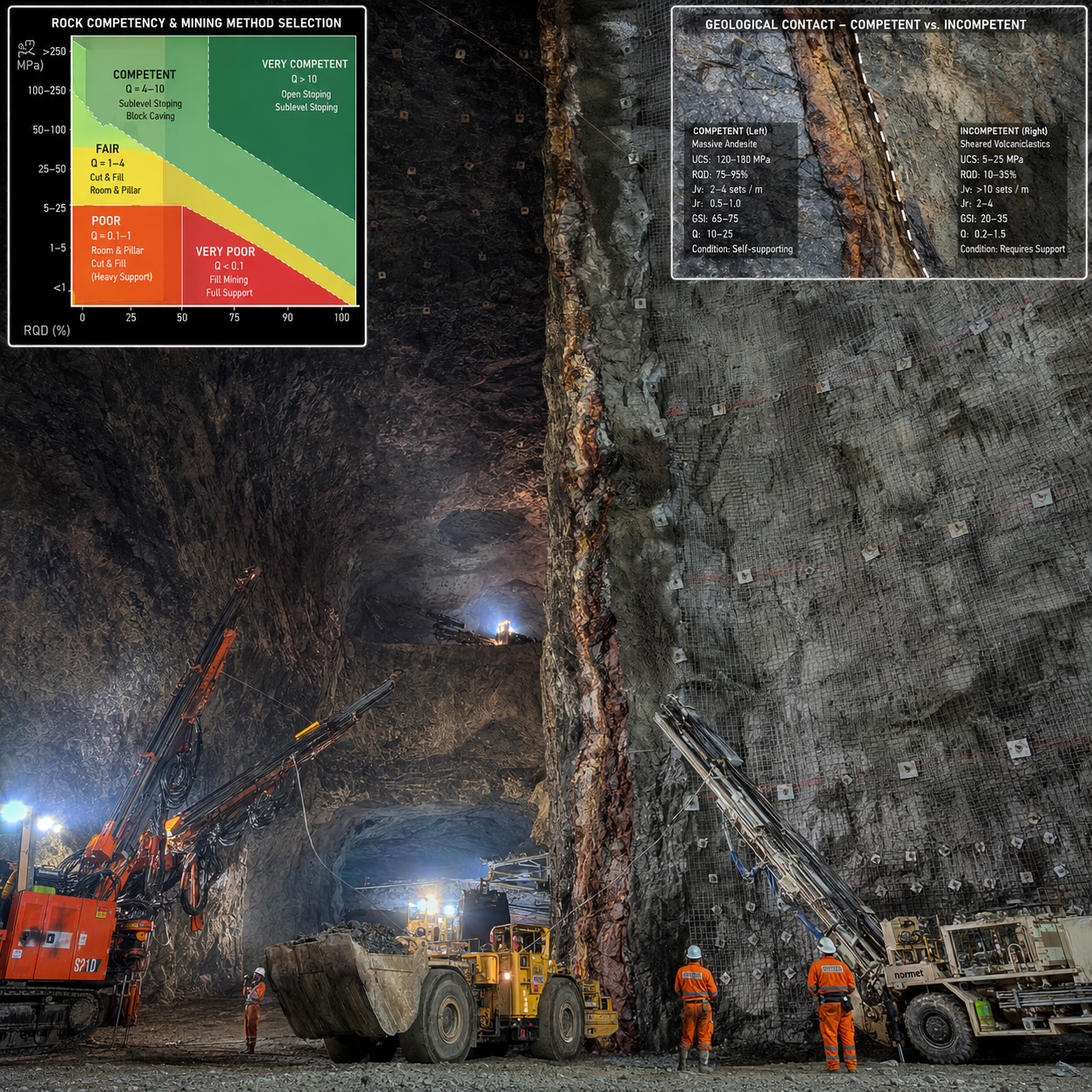
Popular systems used in mining geotechnics for the classification of rock masses include Rock Mass Rating (RMR), Q-SYSTEM, Geological Strength Index (GSI), Rock Quality Designation (RQD), Mining RQD (QR), modified Rock Mass Classification (mRMC), the Modified RMR (MRMR) and Modified Block RMR (MBR) systems for mining environments, and the Stability Graphs for Stopes; these systems were designed specifically for certain types of applications and are usually used in conjunction or for mining.
Rock Mass Rating (RMR) system (Bieniawski) considers such aspects as intact rock strength, RQD, joint spacing, joint conditions, and ground water to generate an overall RMR index that corresponds to stand-up time, recommended support, and effective Mohr-Coulomb parameters; variations of the RMR, namely MRMR, and MBR systems were modified for mining applications in order to reflect effects of blasting, increased stress, and caving and are regularly applied for tunnels and underground mining support design.
The Q system, developed by Barton et al., integrates six variables – RQD, number of joints (Jn), roughness of joint surfaces (Jr), alteration of joints (Ja), water in joints (Jw), and the stress reduction factor (SRF) into a multiplicative Q factor that is commonly used for tunnelling and chamber support, as well as for stability graph approach to stope design.
Geological Strength Index (GSI), proposed by Hoek, is a visual charting approach that estimates the degradation in rock mass strength from intact rock to a jointed mass in terms of structural and surface descriptions; GSI is commonly used for deriving Hoek-Brown rock mass parameters for numerical analysis and transforming classifications to engineering parameters rather than prescriptive support systems.
RQD does not form a complete classification system but is one of the key parameters that form many other classifications, particularly RMR and Q; it measures the percentage of intact core in drilling samples and significantly impacts the classification categories.
Since every method has its own advantages and limitations, professionals often merge or modify them; hence, RMR and Q are still the most widely adopted empirical methods in civil engineering and mining practices, GSI is chosen in case of deriving numerical parameters for Hoek-Brown equations, while modifications of the method specifically for mining (such as MRMR, Stability Graph, CHN-BQ, etc.) are employed wherever blasting, stresses, caving, or mining geometry alters rock mass behavior.