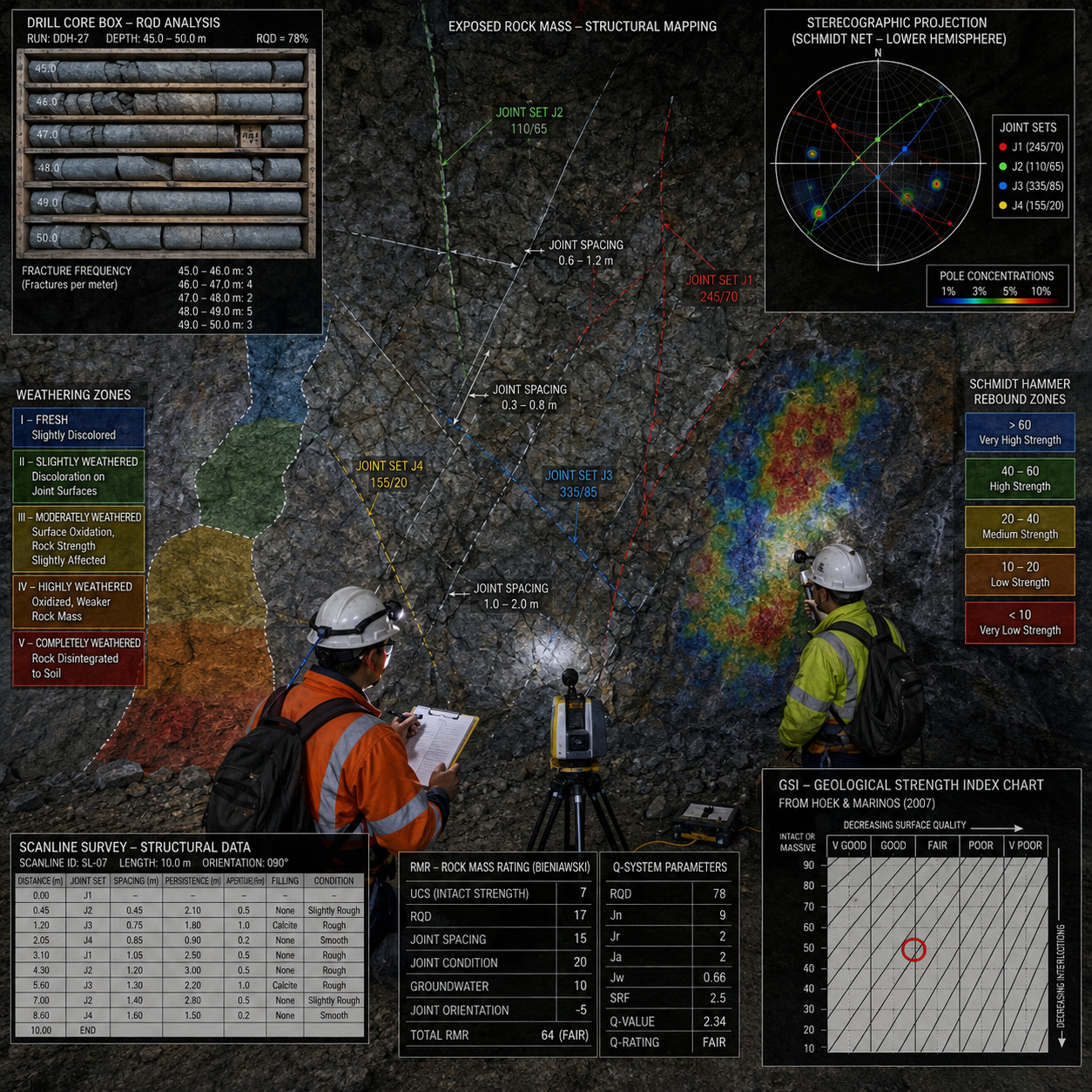
The competency of the rock formation is one of the foremost geotechnical criteria that influence the choice of underground mining methods because of the way it affects the behavior of rock masses near excavations.
When there is good rock competency and massive character, with few structural weaknesses, it is possible to adopt large unsupported openings and bulk mining operations (like longhole stoping, large span room and pillar mining, or even block cave mining) due to the ability of the rock mass to accommodate the loads. This allows for a reduction in permanent support requirements, a reduced risk of instability while exposing the openings for a short period, and greater advances and mechanization, thereby increasing efficiency and reducing costs.
However, in the case of weak or soft rock (poor uniaxial compressive strength, widespread fractures, high plasticity), there is a need to consider yielding, deformation behavior, and increased requirements for support; hence, techniques that offer some form of control of ground movement, including cut-and-fill, shrinkage, or techniques utilizing closely spaced pillars and heavy backfilling, are better options since they permit sequential removal, small dimensions of openings, and ground support immediately following excavation or backfilling. Poor rock can result in extensive movement or pillar yielding when approached as if it were hard rock, thus the necessity to adopt suitable methods is paramount.
The competency of rocks is also related to the structure of the rock (such as joints, faults, and foliations), along with the in-situ stresses. Therefore, the selection of the tunnelling method needs to consider not only the strength of the intact rock but also its competency due to jointing. A competent intact rock mass that is heavily jointed with a poor joint orientation can be weak enough to necessitate the use of support and small span methods even with a high UCS.
The consequences of rock mass competency to the choice of operational method are as follows: kind and distance of support used (rock bolting, shotcreting, use of wire mesh and/or steel sets), sequence of extraction, type and quantity of backfilling material (cemented or waste), size of pillars and their recoverability, and dimensions of stopes, which all tend to be higher as competency lowers and consequently raise the cost of mining operations. For example, highly selective and low-support methods, such as sub-level or large room and long hole stoping, become uneconomic or even dangerous in incompetent rocks.
Since rock competency varies from one location to another even within the same orebody, the process of selecting an appropriate mining method involves successive stages of geotechnical analysis, classification, and sensitivity analysis (numerical modelling in 2D and 3D), where comparisons of the effectiveness of various mining methods are made according to safety, dilution, and recovery criteria. This process ultimately leads to determining whether the orebody will be mined using unsupported mining techniques, supported mining methods, or cave mining that embraces large-scale rock movements.