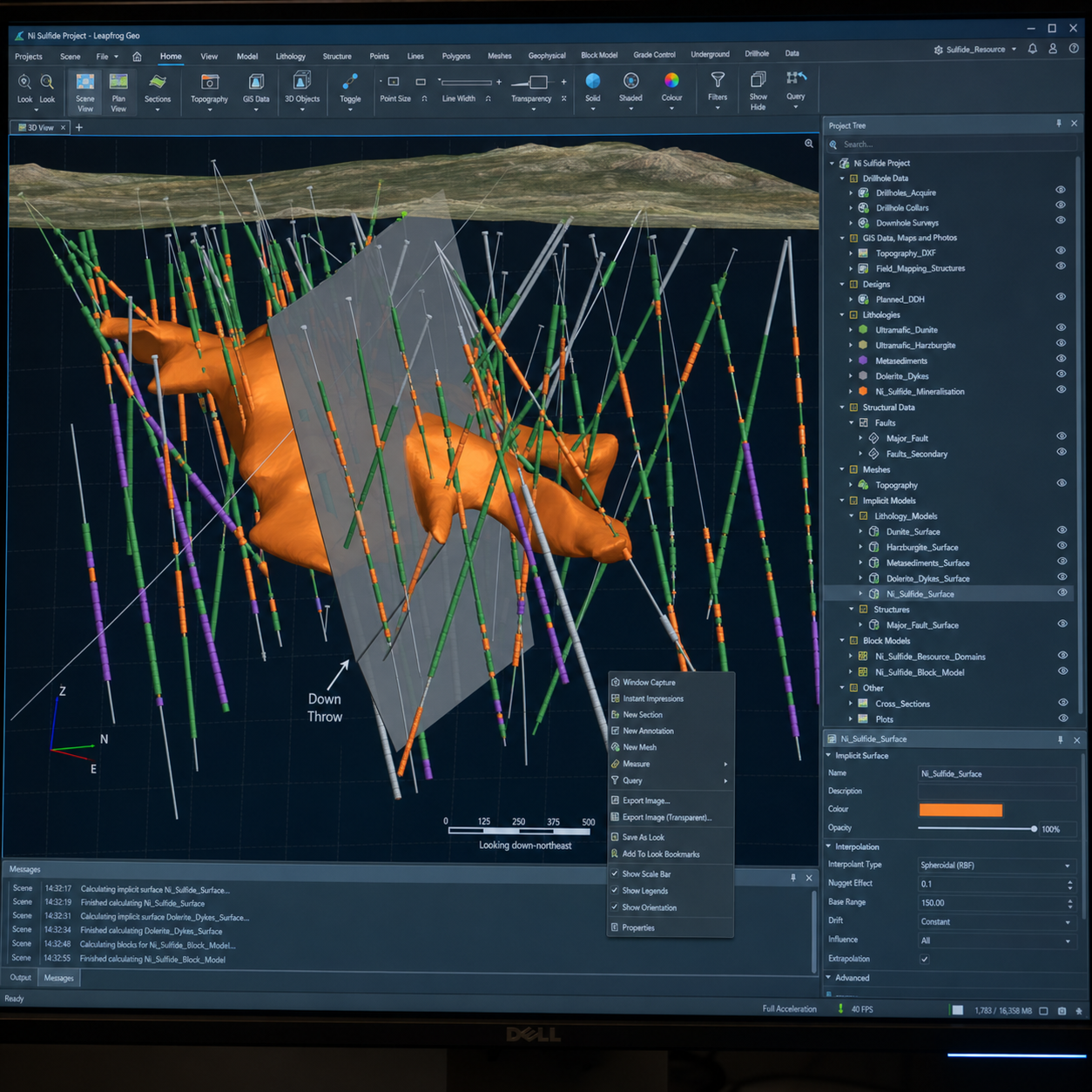
The creation of a 3D geological model entails creation of geological model based on a combination of data sets, including surface geology, boreholes, geophysics, and terrain information. The process is iterative as geologists interpret various geologic concepts through hypotheses testing until they come up with a subsurface model where boundaries and volumes fit perfectly.
In the first place, the geologists compile and clean all the available data. Geological maps, borehole information, cross section, terrain models, aeromagnetic, gravimetric, and seismic data are typical sources of data used in this case while other sources could be geochemical and geochronology. The reason why several data sets are employed in model creation is to improve chances of getting a true subsurface depiction.
The next step is geological framework modeling. As described by the British Geological Survey, it can be achieved using cross-section, surface interpolation, statistical, or mixed approaches. The cross-section method uses boreholes and maps to help create sections, the interpolation method lets geologists choose boundaries based on information and then creates surfaces between them with computer modeling, while statistical modeling lets software predict what lies between control points, sometimes even resulting in voxel modeling.
The model then undergoes verification through comparison with data. This is essential since 3D modeling is not an exercise for visualization purposes alone but is a way to prove or disprove assumptions regarding geology, including crustal structure, basin geometry, fault zones, hydrological systems, and resource assessment, among others. Besides, many institutions also use 3D models for risk assessment, resource quantification, geohazard evaluation, and public presentations of information.
Various software families are popularly employed in industry. For example, the BGS gives instances where GSI3D software is used for cross-section modeling, Gocad, Isatis, and Move for surface interpolation, and Petrel, SKUA, Isatis, and Gocad software for statistical modeling. Others, depending on the application, are GeoModeller, Surpac, 3DMove, and Voxel Analyst for geological surveys, mining and oil and gas respectively, and geostatistics respectively.
It is common to use data transfer and visualization software too. According to geological survey agencies, for instance, FME is the preferred software for data transfer from one software system to another while some surveys have specialized 3D visualizations to evaluate models along with other geoscientific information. When selecting software in the mining and exploration sector, the main factors to consider include data type, modeling technique, interoperability, and preference for either structural geology, resource estimation, or basin-scale interpretation.