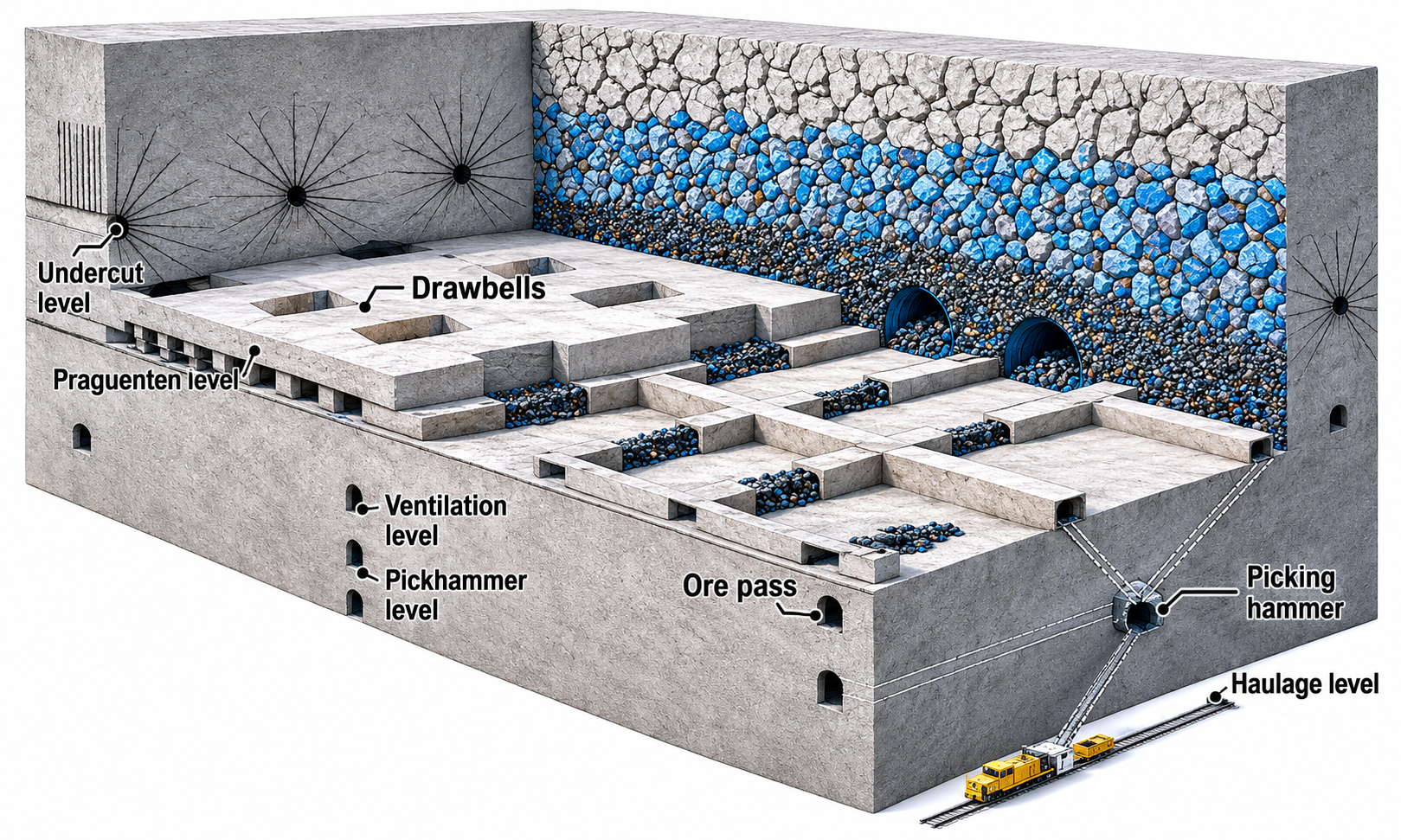
Block caving is a mining process that utilizes the self-collapse of an ore body through undercutting the ore body. The process needs to be assessed in terms of the “caving potential” and “cave propagation.” The first describes the capacity of the rock mass to break up, while the latter describes the process of cave extension upward. Both caveability and propagation need to be assessed with the use of the Discrete Element Modeling (DEM). It represents an algorithm of simulating the physical behavior of rock masses through assembling them from separate particles.
The process of predicting caveability is complicated by the inability of most empirical techniques to provide necessary accuracy in modern-day operations. The use of DEM allows creating computer models considering the presence of pre-existing faults within the rock mass (Suzuki Morales & Suorineni, 2017). Thus, it offers an effective alternative to physical modeling enabling planners to simulate the interactions of particles at the microscopic level.
In terms of assessing the cave potential of a rock formation using the DEM approach, one should consider the natural stresses of the formation under investigation, i.e., the initial conditions. In this context, after undercutting the ore body created using DEM, the stress distribution is assessed to understand how few conditions would result in self-sustained failure. If such conditions would not result in adequate fracturing, the model would assess whether the pre-conditioning step is required for creating favorable conditions for further caving, such as hydrofracturing (Elmo et al., 2022).
The process of caving having been proven through observations, the DEM technique is used to model the growth of caves over time. The software determines the sequential failure of the bonds between the discrete elements, showing the way tensile cracks originate from joint surfaces and propagate. This gives insight into failure processes, allowing for prediction of vertical cave development and rock stabilization.
Apart from predicting collapse, DEM is highly beneficial for simulating the gravity-induced movement of the broken ore after the process of collapse. DEM simulation on a large scale is useful for establishing proper spacing between the drawpoints as it can model the phenomena of secondary fragmentation and percolation of the particles in the draw column (Hancock et al., 2010). In addition, the application of DEM has been proven successful in assessing hazards in the form of lethal air blasts due to the rapid compression of air below the collapsing rock mass (Galindo-Torres et al., 2018).
In summary, the implementation of DEM to block caving offers a mechanical view of mass mining underground. The accurate simulation of caving tendency and cave propagation helps to reduce uncertainty, which cannot be determined only through empirical approaches.
References
Elmo, D., Rogers, S., Veltin, K., & Lett, J. (2022). An effective numerical method to understand different aspects of cave preconditioning. Caving 2022: Fifth International Conference on Block and Sublevel Caving, 1337–1350. https://doi.org/10.36487/acg_repo/2205_93
Galindo-Torres, S. A., Palma, S., Quintero, S., Scheuermann, A., Zhang, X., Krabbenhoft, K., Ruest, M., & Finn, D. (2018). An airblast hazard simulation engine for block caving sites. International Journal of Rock Mechanics and Mining Sciences, 107, 31–38. https://doi.org/10.1016/j.ijrmms.2018.04.034
Hancock, W., Weatherley, D., & Chitombo, G. (2010). Large-scale simulations of gravity flow in block caving. Proceedings of the Second International Symposium on Block and Sublevel Caving, 553–566. https://doi.org/10.36487/acg_rep/1002_38_hancock
Suzuki Morales, K., & Suorineni, F. (2017). Using numerical modelling to represent parameters affecting cave mining. Proceedings of the First International Conference on Underground Mining Technology, 295–307. https://doi.org/10.36487/acg_rep/1710_23_suzuki_morales