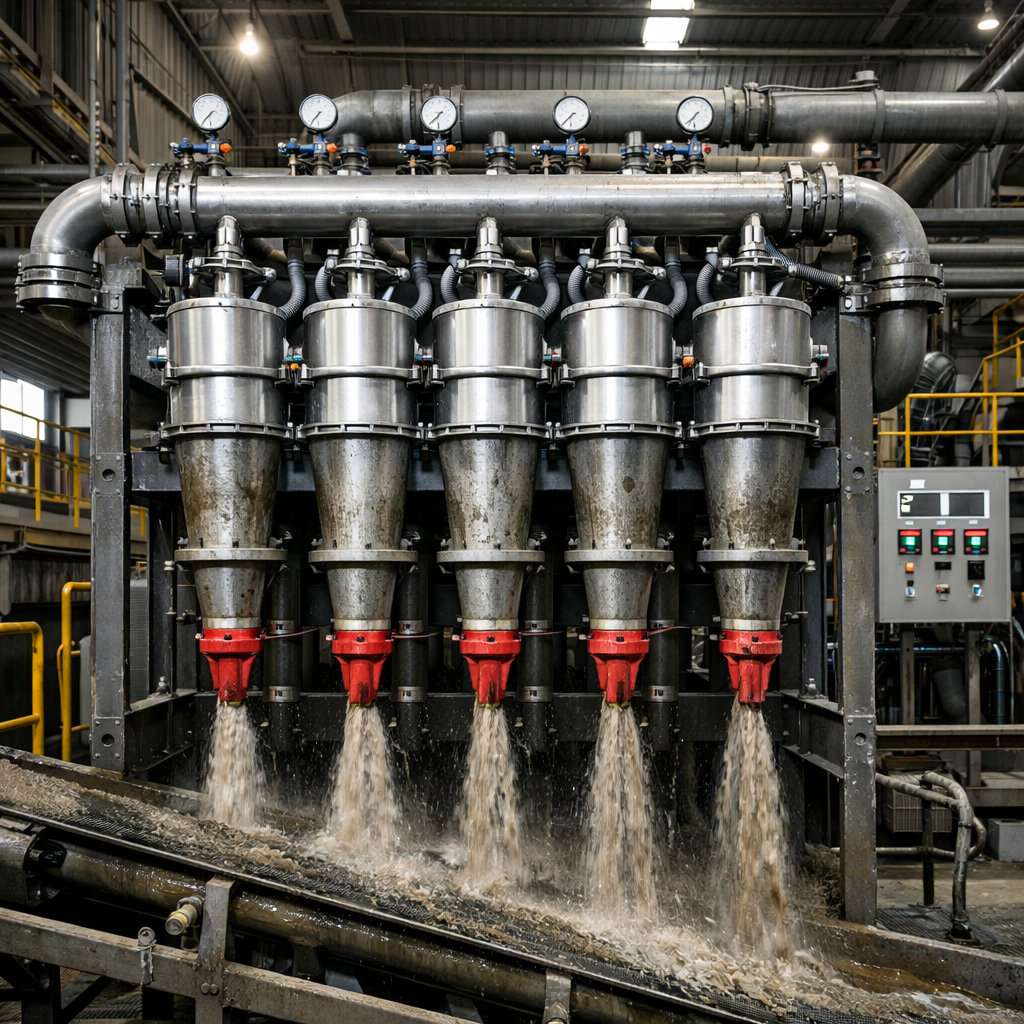
Classification in closed-circuit grinding becomes the ultimate tool of controlling the particle size reduction process that balances out the mill production rate and final particle size. Hydrocyclones become the main classifier in continuous grinding operations and help to systematically feed the mill back with the material too coarse for processing while allowing the particles that are finely ground to move into downstream processes.
Hydrocyclone cluster design and size become critical for the metallurgical efficiency of the process. Under-designing the cluster will result in a premature capacity bottleneck, whereas oversized design fails to provide the necessary hydrodynamics of the system for accurate classification. Finding the right cluster design means assessing the interplay of fluid mechanics, comminution mechanics, and mass balance procedures. Designed properly, the cluster helps to avoid overgrinding the ore while keeping the hydrodynamic environment stable (Wills & Finch, 2016).
The technical baseline is determined through the definition of various parameters that are relevant for the wet classification process. The hydrocyclone is a fixed separation apparatus, which works based on pressure-induced centrifugal forces to classify the particulate suspensions according to their size and specific gravity.
The closed-circuit grinding represents the case where this classifier works in combination with the mill recycling the undersize particles until the desired product size is obtained. The most important parameter of the efficiency of the classification process is the cut size (d50) that stands for the specific particle size, having an equal probability of entering the overflow and underflow streams. The cluster configuration represents the parallel installation of various cyclones surrounding the common distributing manifold.
The setting up of cyclone circuit is dependent on proper quantification of process design parameters, mainly the volume feed rate, slurry pulp density, and size distribution of particles. The volume flow rate will determine the necessary cross-sectional area for classification, while the solids concentration will have a major impact on the viscosity and settling properties of the fluid medium.
High slurry pulp densities, while being beneficial from a mill water balance perspective, will significantly reduce the terminal velocity of entrained particles, making the cut size coarse and reducing the selectivity. It is important for process engineers to concurrently ensure that these fluid dynamics considerations coincide with the desired product size (P80), where the overflow particle size distribution will meet the requirements of liberation for subsequent flotation and/or leaching operations.
The sizing and selection process of methods tie together process needs with mechanical geometry, laying down the physical configuration of the hydrocyclone array. The basic choice is the selection of the inside diameter of the cyclones themselves; smaller diameters produce greater centrifugal acceleration naturally, leading to smaller cut sizes but limiting volume.
For a total flow rate through the system, engineers need only divide the total volume of the feed by the volume of a single selected cyclone at a given pressure drop. An essential piece is the feed manifold, which can be calculated so as to eliminate any biases in the flow of the fluid, so that all active cyclones get the same pressure distribution.
Dynamic control needs to be built into the cluster geometry. Throughput changes will always occur in industrial grinding circuits due to differences in ore hardness and mill liner wear. These temporary situations need to be addressed using a cluster that allows for automatic backup units to be switched on to ensure pressure drop remains unchanged without downtime. Adjustment of the classification behavior is done by setting up geometrical settings for the apex and the vortex finder diameters, where the apex determines the underflow density while the vortex finder determines the air core stability. This can be determined by current modeling approaches and computational fluid dynamics. Recent innovations in the multiphase classifier include dual vortex finders (Mainza et al., 2004).
The process of creating the classification cluster involves making compromises and taking into account hydrodynamic problems that could undermine the integrity of the circuit. One of the widespread practical difficulties is the fish-hook problem, defined as the bypass of very fine particles into the coarse underflow as a result of fluid entrainment into the conical boundary layer.
Due to the prolonged work with abrasive slurries, the degradation of the cone apex will lead to short-circuiting, which results in the dilution of the circulating load with unclassified fines and thus constrains the feed rate of the classifier (Furuya et al., 1971). The other extreme in terms of the spigots can cause the roping problem that will destroy the air core and make it impossible for coarse particles to pass into the underflow.
The process of choosing the best cluster configuration is based on the integration of kinetic mill science, rheological data, and geometry. This process cannot be simply reduced to the separation of the volume flow but implies correlation of properties of individual cyclones and economic requirements for the entire comminution circuit. Further development of mineral processing will include more and more interconnection of sensors and physical configuration of the cluster, thus turning static schemes into dynamic systems. In conditions of decreasing ore quality and growing cost of grinding, the accuracy of classification in closed circuits will continue to be the key factor. Finally, well-balanced hydrocyclone cluster protects the comminution ability, energy, and size distribution.
References
Furuya, M., Nakajima, Y., & Tanaka, T. (1971). Theoretical analysis of closed-circuit grinding system based on comminution kinetics. Industrial & Engineering Chemistry Process Design and Development, 10(4), 447–456. https://doi.org/10.1021/i260040a004
Mainza, A., Powell, M. S., & Knopjes, B. (2004). Differential classification of dense material in a three-product cyclone. Minerals Engineering, 17(5), 573–579. https://doi.org/10.1016/j.mineng.2004.01.023
Wills, B. A., & Finch, J. A. (2016). Wills’ mineral processing technology: An introduction to the practical aspects of ore treatment and mineral recovery (8th ed.). Butterworth-Heinemann.