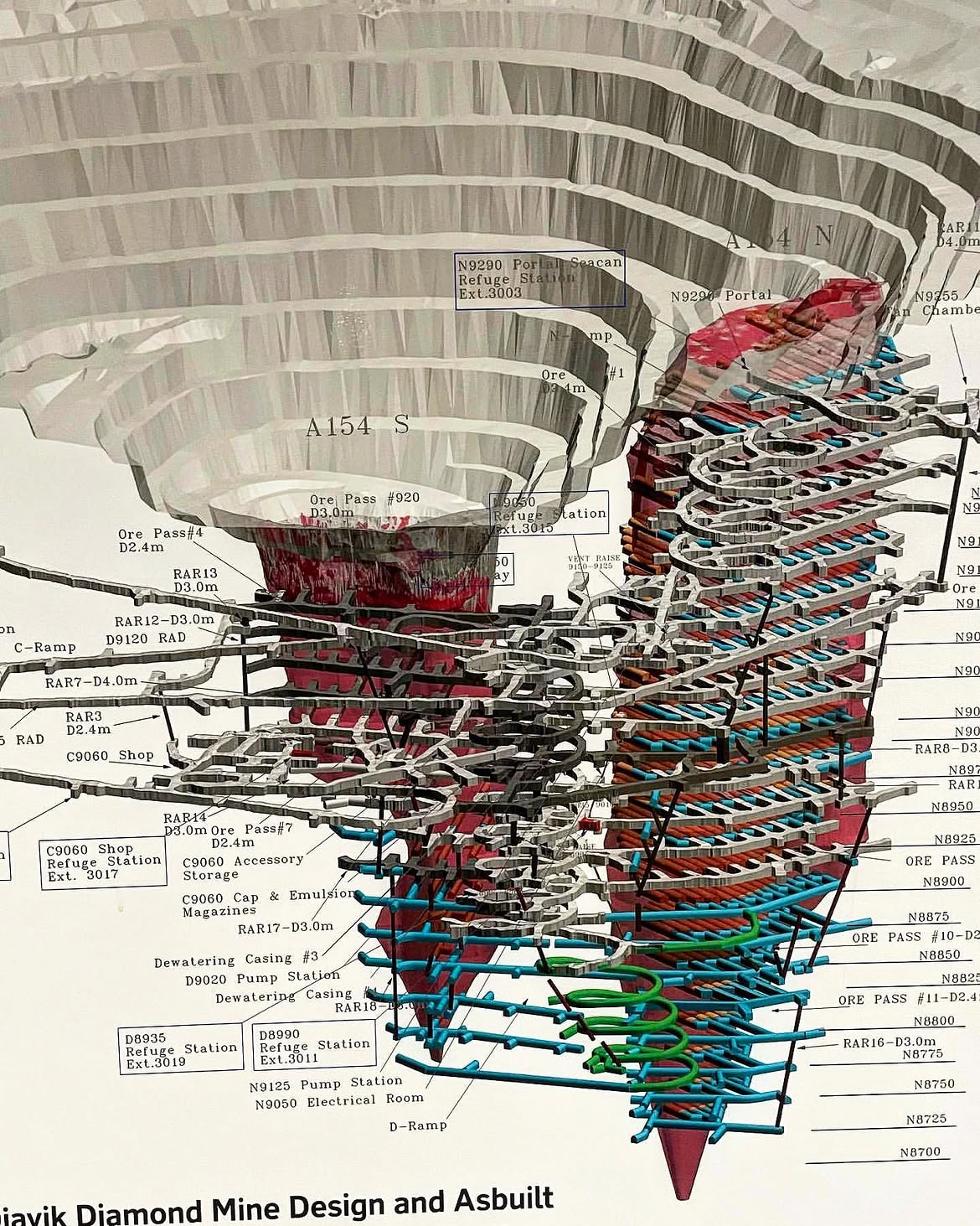
The transformation from open-pit to underground mining is a sophisticated engineering technique characterized by several challenges and associated risks. The difference between the two lies in the source of mineral extraction, where the former entails excavation from the ground surface, whereas the latter uses shafts and tunnels to reach the underground deposits. This transition is the period during which both techniques are employed concurrently. This transition process poses various technical risks that compromise safety and the economic feasibility of mining (Rakhmangulov et al., 2022).
One of the most significant technical risks associated with this transitional period is slope stability. The increase in depth of the pits and excavations underground disturbs the preexisting stress state of the rock mass and hence triggers instability of pit walls and rockfalls (Eberhardt et al., 2007).
Structural safety of the crown pillar is just as important. The crown pillar is the unexcavated rock structure that exists between the bottom of the open-pit and the underground workings. This structure ensures the isolation of the two environments so as to avoid the possibility of uncontrolled caving. Mining processes affect the shape of the pillar, and it makes the system vulnerable to unraveling and plug failures (Hamman et al., 2020).
Hydrogeological hazards pose another problem during the transition. Interactions between surface water accumulation in the pit and the underground aquifers may lead to catastrophic flooding of the underground mine. Changes in pore pressures of groundwater are inevitably coupled with rock deformation; hence the need for effective dewatering (Konieczna-Fuławka et al., 2023).
The operational and infrastructural integration processes carry considerable risks as well. During the transition process, the operation has to coordinate its activities both with the existing surface infrastructure and the emerging underground infrastructure. It includes such problems as reconfiguration of complex ventilation systems, ensuring high quality of ground support within highly fractured rocks and logistics of ore movement.
To conclude, any transition process to underground mining necessitates implementation in phases and effective risk management. Slope failures, crown pillar collapse, and unstable hydrogeology require sophisticated numerical simulation and monitoring techniques that will help in managing these risks effectively and safely extracting maximum resources (Hamman et al., 2020).
Image credits: ⚒Mining Engineering Education⚒ (Instagram)
References
Eberhardt, E., Stead, D., Elmo, D., et al. (2007). Transition from Surface to Underground Mining – Understanding Complex Rock Mass Interactions Through the Integration of Mapping, Monitoring and Numerical Modelling Data. Proceedings of the 2007 International Symposium on Rock Slope Stability in Open Pit Mining and Civil Engineering, 321–332. https://doi.org/10.36487/acg_repo/708_19
Hamman, E., Cowan, M., Venter, J., & de Souza, J. (2020). Considerations for open pit to underground transition interaction. Proceedings of the 2020 International Symposium on Slope Stability in Open Pit Mining and Civil Engineering, 1123–1138. https://doi.org/10.36487/acg_repo/2025_74
Konieczna-Fuławka, M., Szumny, M., Fuławka, K., et al. (2023). Challenges Related to the Transformation of Post-Mining Underground Workings into Underground Laboratories. Sustainability, 15(13), 10274. https://doi.org/10.3390/su151310274
Rakhmangulov, A., Burmistrov, K., & Osintsev, N. (2022). Selection of Open-Pit Mining and Technical System’s Sustainable Development Strategies Based on MCDM. Sustainability, 14(13), 8003. https://doi.org/10.3390/su14138003