The valuation of mining assets requires financial techniques that can take into consideration price cycles of commodities, technical uncertainties, and flexibility. While the widely used DCF methods still prevail in practice, the use of standard single discount rate DCF methods is often unable to reflect market realities and individual project risks. Professional rules, as represented by the CIM Guidance on Commodity Pricing of 2020 by the Canadian Institute of Mining, Metallurgy and Petroleum, provide standards for determining price assumptions for commodities and cut-off grades to provide realistic expectations of future economic feasibility.
According to the 2020 CIM Guidance, appropriate commodity prices play a vital role in Mineral Resource and Mineral Reserve estimates. It is the obligation of Qualified Persons (QPs) to provide a justification for the selected prices in the form of Technical Reports according to NI 43-101 requirements. Acceptable pricing methods include the use of long-term historical average, three-year trailing average, consensus forecast, contract pricing, and cash cost margin pricing.
Long-term historical average eliminates any pricing volatility of industrial mineral, though it might lag behind the market trends when there is a structural change. On the contrary, the three-year trailing average minimizes the impact of minor price increases but poses a challenge to resource evaluation since it will understate resource estimates in bull markets and overstate resource estimates in bear markets. The regulatory body requires only one base-case estimate for deposits; however, cut-off grade sensitivity can be included for educational purposes only.
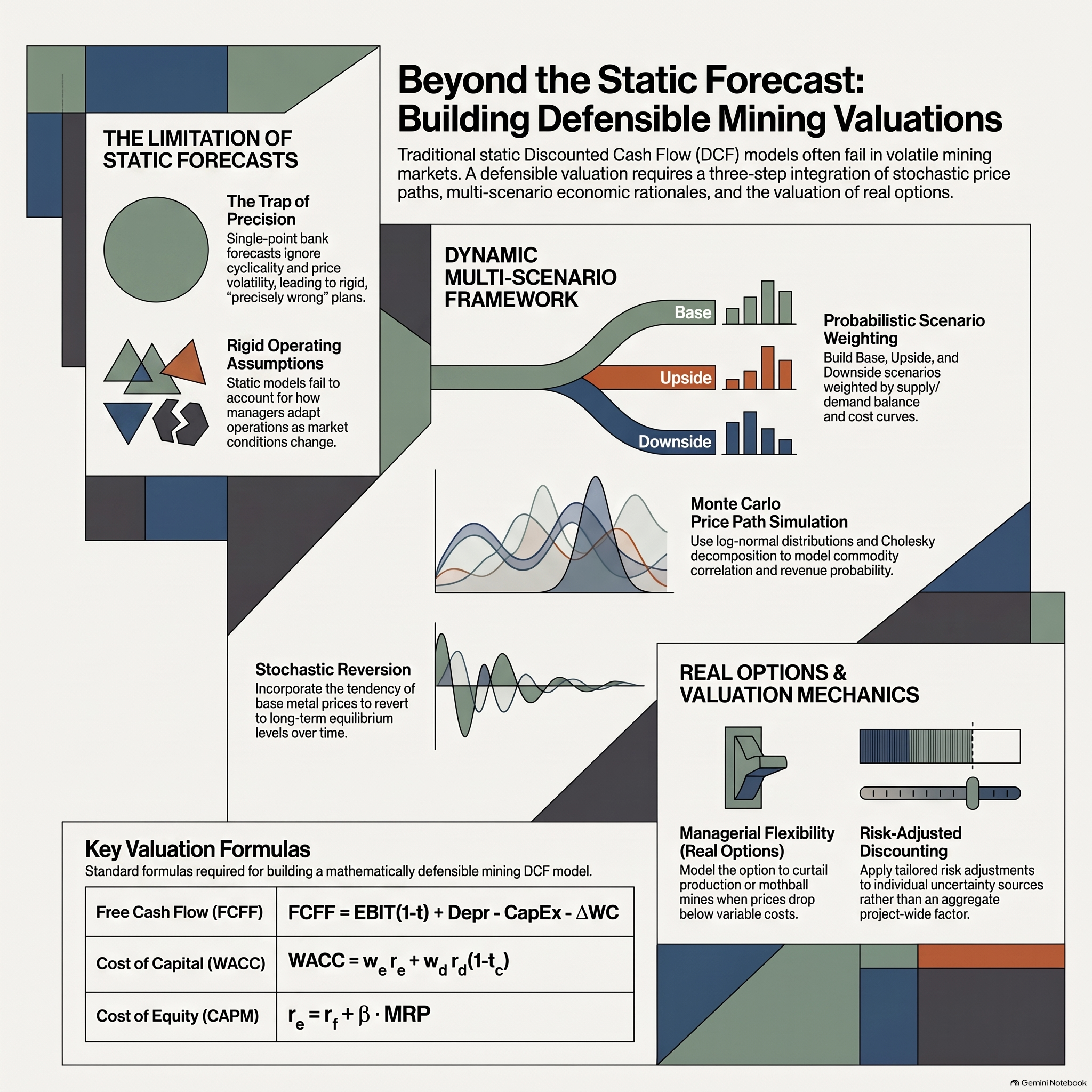
Conventional DCF valuations use a constant weighted average discount rate, which essentially assumes that the uncertainty in cash flows develops uniformly over the life of the project. Transient shocks to supply and demand conditions in commodity markets gradually dissipate, creating reversion of the forward price uncertainty towards long-term equilibriums. The constant discount rate systematically underweights long-term cash flows, thereby skewing mine design decisions towards shorter horizons and high initial capacity.
Furthermore, conventional DCF models have weaknesses when they are used for overly optimistic assumptions that do not include any downside risk. When such downside risks turn out to be temporary, cash flows need to be deflated without changing the cost of capital. When downside risks turn out to be permanent, then the discount rate needs to be increased by including the probability of the downside scenario into the cost of capital.
The problem with the DCF approach is addressed by the Market Based Valuation (MBV), which adjusts for the risks associated with market variables, such as the prices of metals, in the first place by using the data from financial markets. In the MBV approach, those uncertain elements of the project which are not correlated with macroeconomic risks, such as ore grade and continuity, are not included in the discount rate, since diversified investors do not demand any risk premium for non-diversifiable risk elements of an asset.
The real option approach adds another layer to MBV by incorporating the value of management’s operational flexibility. Natural resource investments have several embedded options, including the option to delay investment, shut down production, change the size of operations, or discontinue the operation altogether and recover the residual value of the project. Since undeveloped mineral reserves represent the call options on physical commodities, real options approach considers price variability as a value adding element.
A critical assessment of mineral resources calls for close coordination between reporting requirements, price determination processes, and risk profiles of mining ventures. Qualified Persons should be able to justify their commodity prices and cutoff grades based on the CIM guidelines. Besides applying the traditional discounted cash flow approach, combining normalized earnings, risk assessments based on market conditions, and real options can provide a more realistic evaluation of asset values during periods of volatile commodity prices. The use of such sophisticated valuation approaches prevents shortsighted investments, protects capital from any potential risks, and improves decision-making processes.