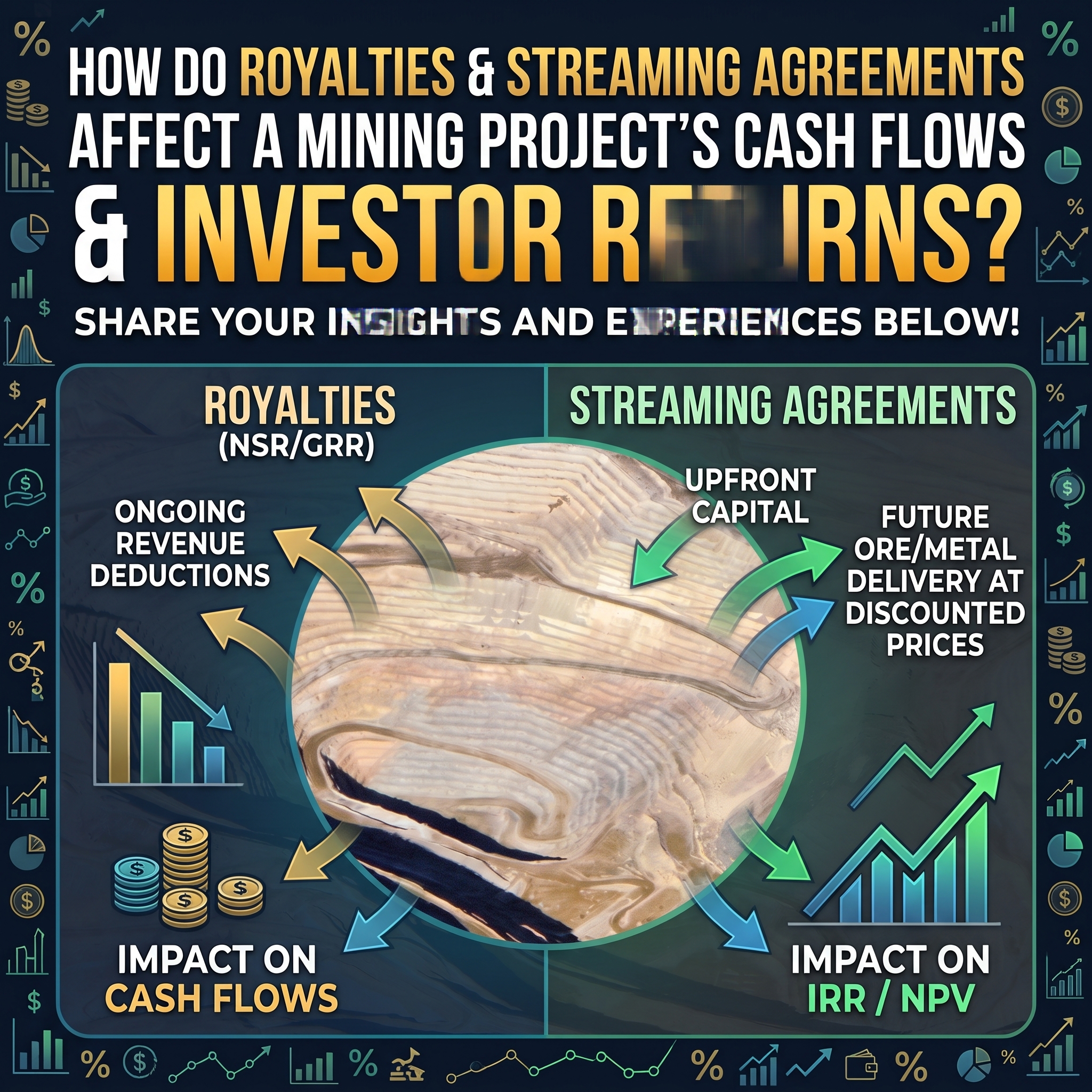


Capital requirements for new mine construction have expanded significantly across the global resources sector, yet traditional debt syndication and equity markets remain constrained. Alternative financing instruments have emerged as primary solutions for project developers seeking upfront capital without incurring immediate equity dilution. Project developers increasingly rely on royalties and metal streaming agreements to fund development. These contractual arrangements fundamentally alter long-term cash flow waterfalls, corporate balance sheets, and equity investor returns over the complete lifecycle of a mining asset.
Upfront capital injections provide vital liquidity during capital expenditure phases without imposing the fixed principal repayment schedules typical of commercial bank loans. However, this flexibility introduces substantial structural trade-offs within the project cash waterfall. Both royalties and streaming agreements command senior priority over net revenues, functioning essentially as top-line operating obligations. Operators must deliver physical metal or pay gross percentages before servicing senior bank debt, satisfying tax liabilities, or distributing profits to equity holders. When commodity prices collapse or operational costs escalate, these perpetual top-line payments compress operating margins. The project cash flow available for debt service diminishes, and free cash distributions to shareholders contract sharply during market downturns.
Equity preservation represents the primary commercial attraction for project developers at the construction stage. Project sponsors avoid issuing heavily discounted shares, which prevents ownership dilution and preserves per-share metrics for existing shareholders. Nevertheless, this protection carries a severe economic cost across the life of the mine. Royalties and metal streams transfer asset convexity directly to financiers. Financiers purchase future production at steep discounts to spot prices, which allows them to capture substantial windfalls during commodity booms. Furthermore, unhedged royalty claims automatically attach to unexpected ore discoveries, throughput expansions, and mine life extensions. Equity investors bear all exploration and sustaining capital expenditure while financiers harvest permanent, unencumbered upside.
Alternative financing structures introduce significant operational and balance sheet frictions. Senior commercial lenders frequently treat large streaming liabilities as structural claims akin to mezzanine obligations, which limits future project debt capacity. Intercreditor negotiations often grow contentious when financiers demand comprehensive asset mortgages, production security, and complex standstill covenants. From a mine planning perspective, royalties directly distort operational parameters. Planners must model royalty costs as operating expenditures, which raises the cut-off grade required for profitable extraction. Lower-grade mineralisation becomes uneconomic, sub-economic material is reclassified as waste, and total recoverable mineral reserves decline permanently.
Royalties and streaming agreements deliver indispensable non-dilutive capital when traditional debt and public equity markets are inaccessible. Even so, their enduring presence reshapes project economics, cash distributions, and shareholder returns long after initial capital is spent. Project developers must evaluate these instruments through comprehensive scenario modelling across different commodity price cycles rather than focusing solely on upfront cash. Effective risk management requires balanced contractual negotiations, including production caps, step-down rates, and clear property boundaries. Clear contractual thresholds allow mining companies to secure essential project funding while safeguarding asset convexity and long-term shareholder value.