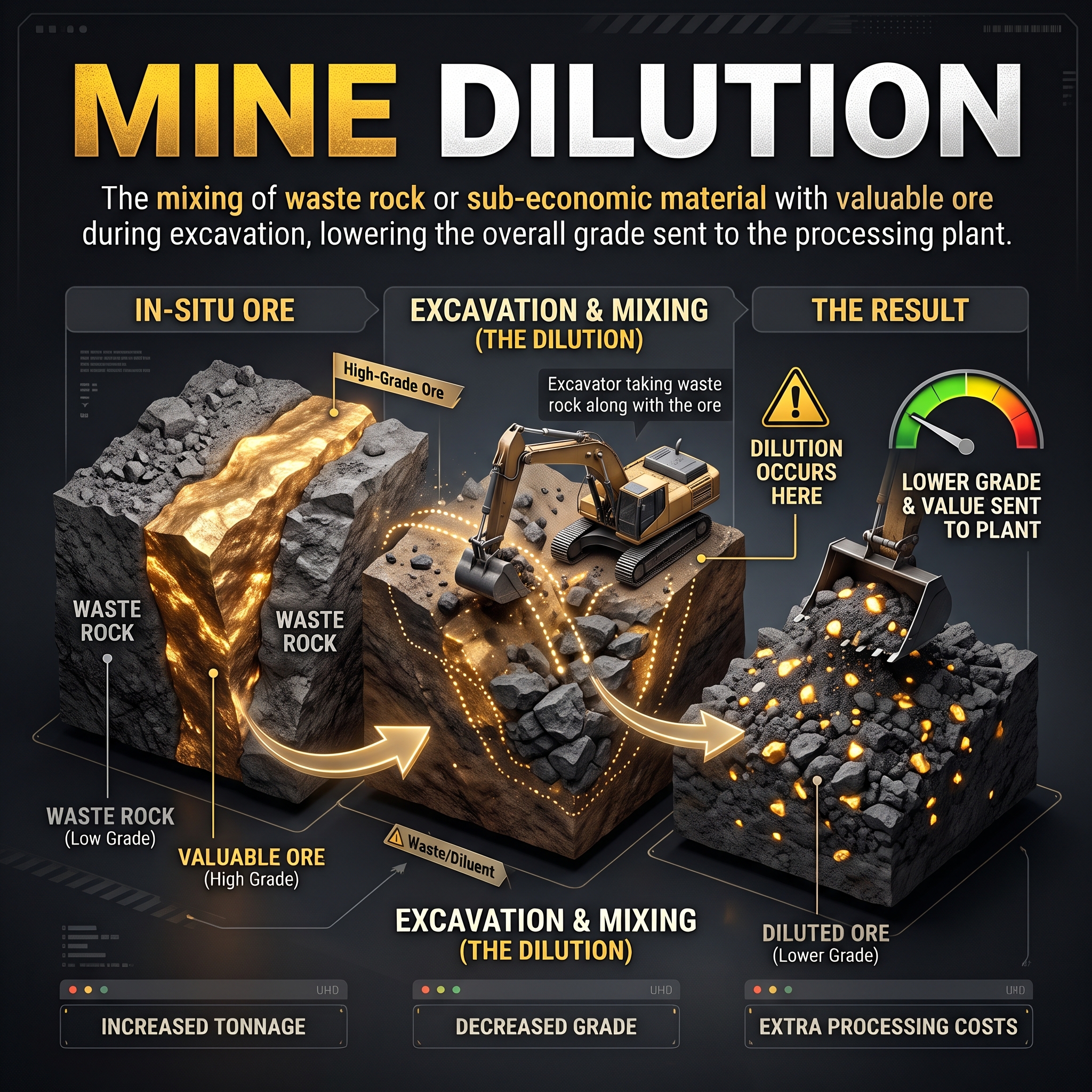


Mine dilution represents a primary technical and operational challenge that directly impacts the physical and economic performance of mineral extraction operations. Clear definitions of core concepts clarify how operational decisions influence overall project performance.
Mine dilution refers to waste rock or sub-economic material that mixes with economic ore during excavation, lowering the average grade sent to the processing plant. Ore recovery measures the proportion of in-situ mineralized material or contained metal within a deposit that is successfully extracted during mining operations.
The term processing efficiency defines the operational performance of a metallurgical plant in treating feed material and extracting target minerals, evaluated through mill throughput, unit energy consumption, reagent usage, and metal recovery rates. Profitability reflects the financial return of a mining project, evaluated using key metrics such as profit margins, All-In Sustaining Costs, Net Present Value, and Internal Rate of Return.
The extraction of mineralized deposits requires a careful trade-off between maximizing ore recovery and minimizing waste ingress. Increased extraction volume raises overall ore recovery, often reaching eighty to ninety percent in sublevel caving operations. However, additional draw progressively introduces waste rock into the ore stream, causing diminishing economic returns. Waste material occupies critical loading, haulage, and handling capacity, directly displacing valuable ore that would otherwise enter the extraction circuit. High dilution levels also force operators to abandon drawpoints prematurely when extracted material drops below economic cut-off thresholds, leaving valuable ore unrecovered in the cave.
Unwanted waste rock in the feed material directly reduces the head grade entering the mill. The treatment of low-grade feed material consumes crushing energy, grinding power, and chemical reagents on non-economic rock without generating incremental revenue. This extra tonnage directly inflates unit processing costs per ton of target metal recovered. Suppressed feed grades frequently impair metallurgical recovery rates within flotation and leaching circuits. Furthermore, dilution forces adjustments to economic cut-off grades, ultimately reducing the total proportion of the mineral resource that can be processed efficiently.
Operational cash flows suffer when mines incur expenses for drilling, blasting, loading, transporting, and milling unviable waste rock. Severe dilution can reduce marginal ore grades below economic cut-off limits, reclassifying previously viable ore blocks as waste. The inclusion of non-economic material ties up mill capacity and extends the life of mine without increasing total metal sales. This delay in cash flow realization severely reduces asset valuation metrics. Quantitative economic studies demonstrate that a ten percent dilution factor can cause up to a twenty-one percent reduction in project Net Present Value and an eight-point-six percent drop in Internal Rate of Return.
Operational dilution cascades across the entire mining value chain by lowering feed grades, inflating unit costs, and eroding asset valuation. Effective waste control demands rigorous draw management, short-term plan optimization, and cave flow simulation modeling. Strategic efforts to delay dilution entry allow operations to maximize resource recovery while protecting long-term project profitability.