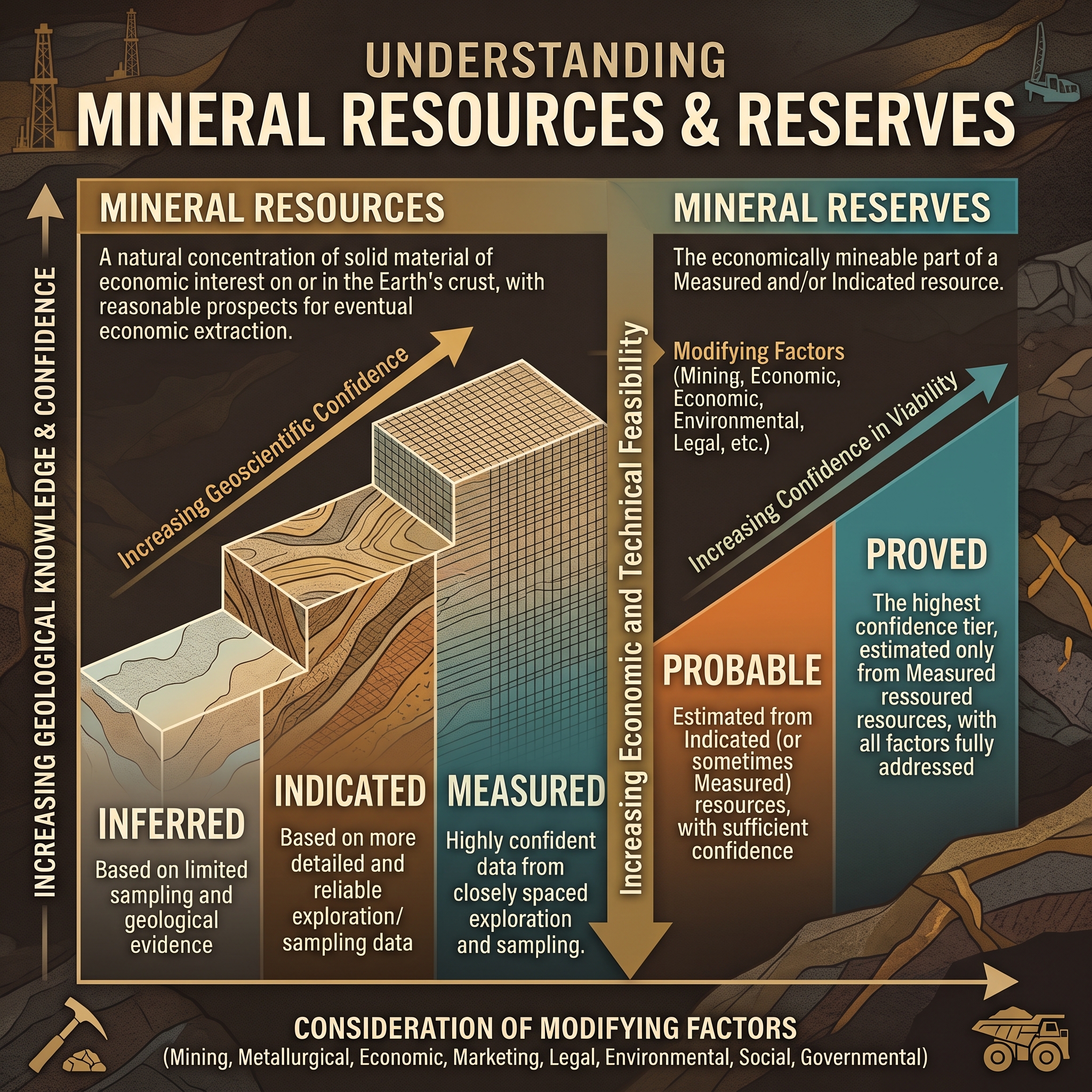
Mineral evaluation projects hinge on the precise classification of subsurface mineral deposits to guide investment decisions and technical planning. Industry reporting standards establish a clear distinction between a mineral resource and a mineral reserve. A mineral resource represents a concentration or occurrence of solid material of economic interest in or on the Earth’s crust in such form, grade, quality, and quantity that reasonable prospects for eventual economic extraction exist. Geologists categorize these resources into Inferred, Indicated, and Measured levels based on increasing geoscientific confidence. Conversely, a mineral reserve is the economically mineable part of a Measured or Indicated mineral resource. Reserves are sub-divided into Probable and Proved categories based on confidence in technical and economic parameters. Every reserve originates as a resource, yet only deposits that pass rigorous economic and operational scrutiny achieve reserve status.
Economic viability forms the primary boundary between resource and reserve classifications. Mineral resources require justifiable expectations of eventual extraction under assumed technical and market conditions, but they lack proven financial return. Mineral reserves demand concrete proof of profitability under realistic operational settings at the time of reporting. Preliminary technical assessments or scoping studies evaluate resources to test initial concepts. However, technical reporting rules prohibit the declaration of reserves from scoping studies alone. Reserves require comprehensive pre-feasibility or feasibility studies. These advanced engineering assessments incorporate detailed mine designs, production schedules, and economic models to justify capital allocation.
The application of modifying factors serves as the conversion bridge that transforms mineral resources into mineral reserves. These factors encompass a broad spectrum of practical considerations, including mining methods, metallurgical recovery rates, infrastructure needs, product marketability, legal permissions, environmental permits, and social licenses. Mineral resources quantify in situ mineralization contained within bedrock, tailings, or stockpiles prior to accounting for extraction losses. Mineral reserves represent mineable production estimates at a specified reference point, typically where ore enters the processing plant. Reserve estimates explicitly incorporate operational losses, cut-off grades, and mining dilution to reflect real-world plant delivery.
Geological confidence dictates the allowable conversion routes from resource categories to reserve categories. Inferred mineral resources carry high geological uncertainty because limited sampling only implies structural continuity. Consequently, international standards strictly prohibit the conversion of Inferred resources into reserves. Indicated mineral resources possess sufficient sampling density to allow the application of modifying factors, permitting conversion to Probable mineral reserves. Measured mineral resources represent the highest level of geological confidence. Practitioners convert Measured resources into Proved mineral reserves when modifying factors show high certainty, or into Probable reserves if lingering uncertainties remain in legal, social, or economic parameters.
The distinction between mineral resources and mineral reserves provides the foundational framework for project governance and financial appraisal in the mining sector. Resources quantify natural mineral occurrences with potential commercial interest, whereas reserves represent engineered production assets backed by demonstrated economic viability. Reliance on resource figures without considering reserve constraints introduces substantial valuation risk for investors and corporate leadership. Rigorous application of modifying factors through pre-feasibility and feasibility studies ensures that capital moves toward projects with proven operational merit. Ultimately, the conversion of resources to reserves transforms geological potential into commercial reality.