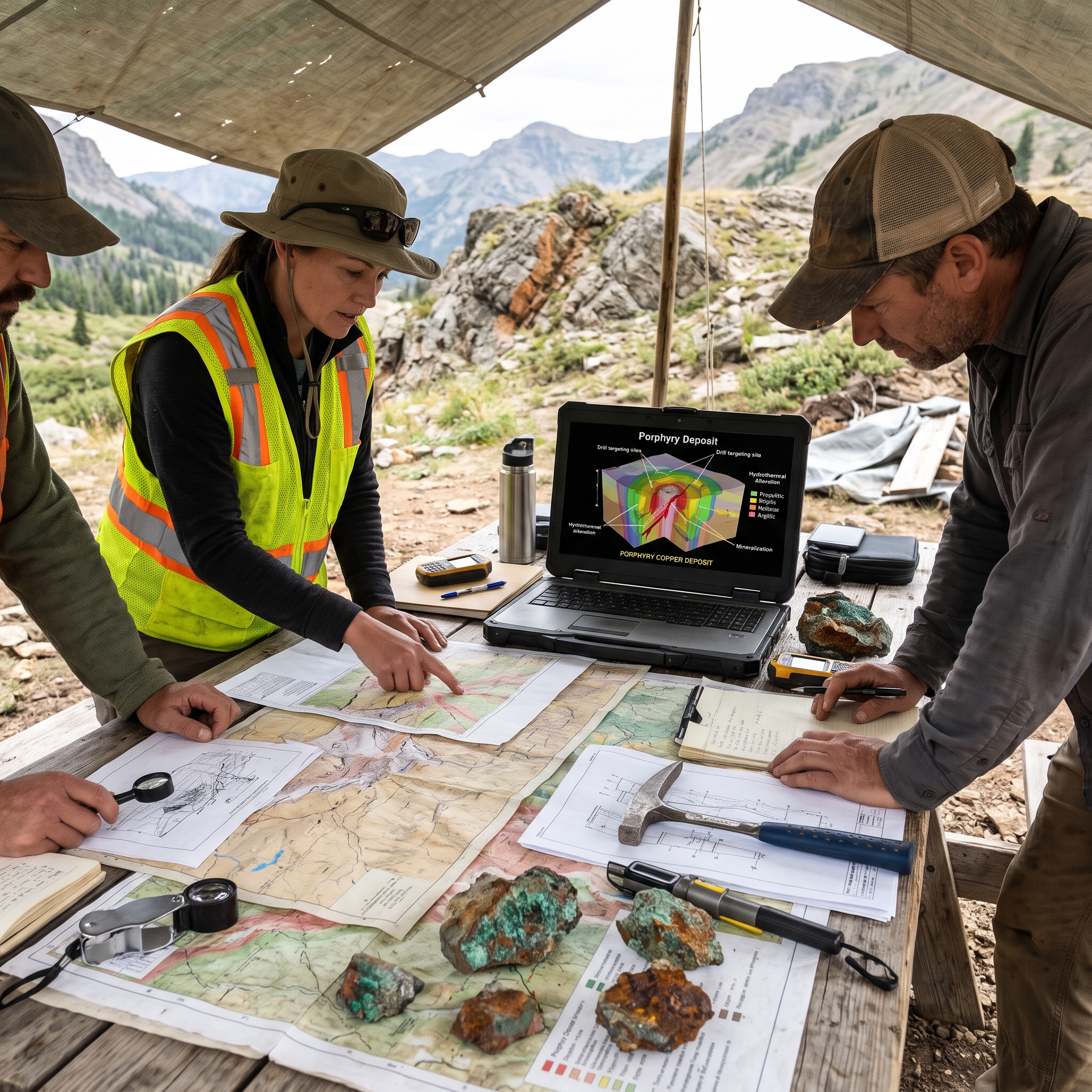
Porphyry deposits supply most of the global copper and molybdenum, yet economic targets are increasingly difficult to discover beneath cover or within eroded terrains. Economic mineralised cores typically occupy compact footprints of less than one square kilometre. In contrast, surrounding hydrothermal alteration envelopes extend across tens of square kilometres. These broad alteration haloes represent the most visible signatures of hydrothermal circulation. Hydrothermal alteration and mineralisation models provide the structural and geochemical framework necessary to locate high-grade cores within expansive alteration systems.
Hydrothermal fluids released by cooling magmas develop concentric, predictable alteration shells around intrusive centres. High-temperature potassic cores, marked by hydrothermal biotite, potassium feldspar, magnetite, and dense quartz vein stockworks, host primary copper-gold or copper-molybdenum sulphides. This inner domain grades outward and upward into phyllic alteration composed of quartz, sericite, and pervasive pyrite haloes. Distal margins transition into propylitic zones featuring chlorite, epidote, calcite, and actinolite. Superimposed intermediate and advanced argillic assemblages often overprint these roots during retrograde hydrothermal collapse or paleosurface erosion. Fault intersections and fracture systems frequently control fluid pathways and localize these intense overprints. Geologists map these broad architectural zones to eliminate barren ground and isolate prospective intrusive centres from regional terranes.
Subtle compositional shifts within alteration minerals deliver precise spatial vectors towards ore centres. Shortwave infrared spectroscopy detects variations in white mica crystal chemistry, particularly the Tschermak substitution. Aluminium-rich muscovite displaying absorption wavelengths near 2195 nanometres concentrates adjacent to high-temperature cores, while aluminium-poor phengite with wavelengths exceeding 2208 nanometres dominates distal peripheries. Propylitic haloes also exhibit systematic internal thermal gradients, shifting inward from distal chlorite to intermediate epidote and proximal actinolite sub-facies. Specific minerals such as prehnite establish annular haloes between four and eight kilometres away from deposits. Geochemical analysis of late-stage pyrite reveals complementary vectors; elemental ratios such as antimony to tellurium, cobalt to bismuth, and silver to nickel increase towards the deposit centre, whereas silver to cobalt rises toward the periphery. Sulfur isotopes in pyrite similarly record thermal decay and meteoric dilution, forming distinct isotopic haloes that direct step-out exploration.
Modern exploration workflows combine high-resolution imaging spectroscopy with machine learning to pinpoint viable drill targets. Airborne and spaceborne hyperspectral platforms capture diagnostic absorption features across exposed bedrock, generating quantitative abundance and compositional maps without destructive sampling. Automated spectral alteration scores classify mineralised and barren rock intervals across surface exposures and diamond drill core. Spatial evidence layers—including hyperspectral mineral maps, aeromagnetic data, structural lineaments, and multielement geochemical anomalies—feed into algorithms such as Random Forest, Artificial Neural Networks, and fuzzy logic models. These predictive frameworks reliably isolate high-potential ground. Data augmentation techniques further resolve sample imbalances during computational training. Machine learning models rank priority targets by predictive efficiency, reducing exploratory drilling expenditures and accelerating target appraisal in greenfield districts.
Hydrothermal alteration models serve as vital roadmaps in porphyry exploration. Concentric zoning defines the regional footprint, mineral chemistry vectors towards thermal centres, and predictive algorithms optimize drill-hole placement. Integrated exploration frameworks reduce discovery risks and empower explorers to locate the next generation of deep and concealed mineral deposits.