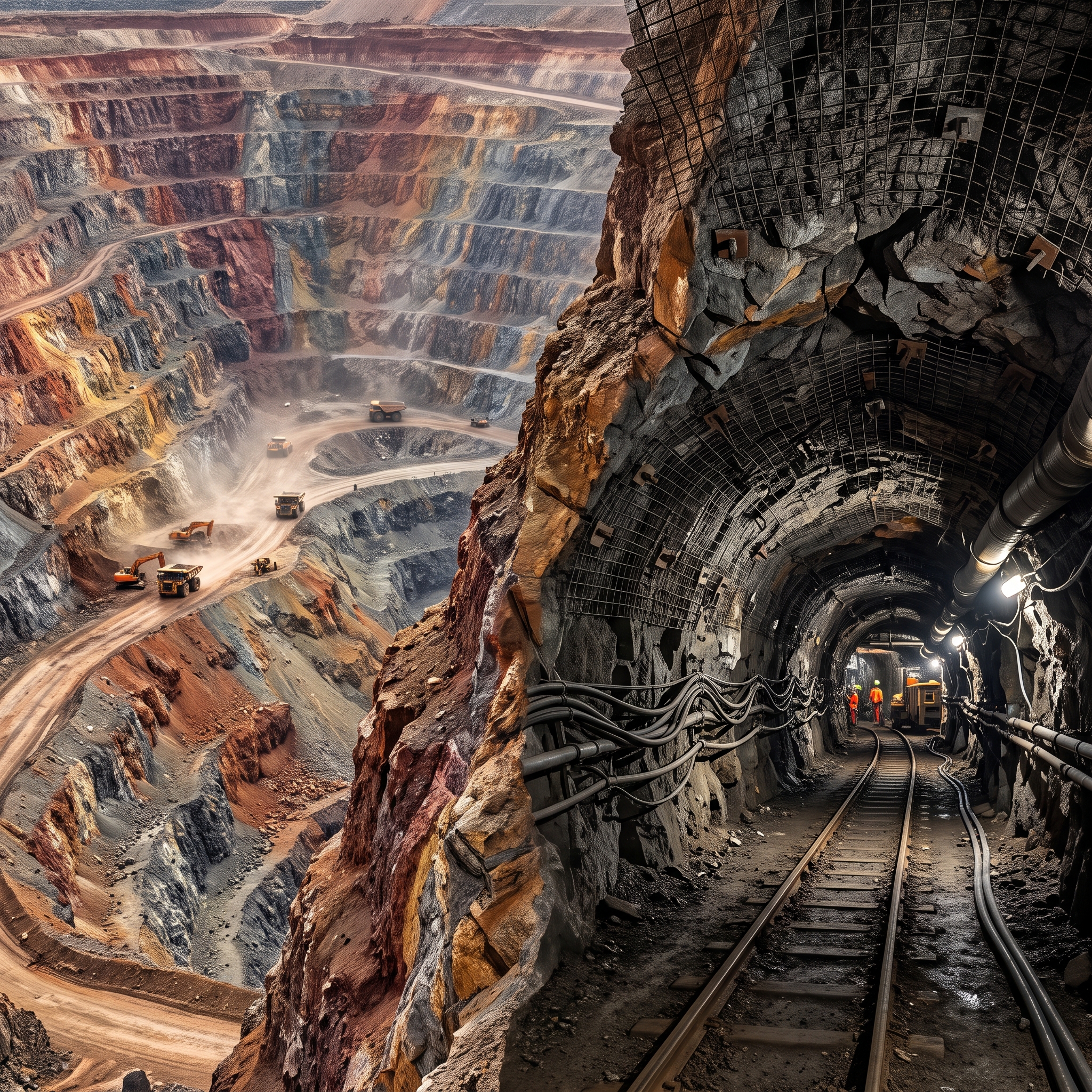


Natural ground conditions establish the foundational boundaries for every mineral extraction enterprise. Deposit geology, rock mass competency, and local stress fields determine which extraction techniques remain physically safe and economically viable. Structural geometry dictates whether surface or underground excavation is appropriate, while geotechnical variations govern production tempos, equipment selection, and worker safety. Mines achieve sustained efficiency only when engineering designs harmonize with natural geological constraints rather than imposing rigid extraction plans onto unforgiving rock formations.
Deposit geometry and spatial grade distribution dictate the primary choice between surface and underground extraction. Large, low-grade disseminated deposits require high-volume open-pit excavation to maintain economic viability, generating extensive waste rock footprints and high stripping requirements. Narrow, steeply dipping orebodies demand selective underground mining methods to isolate valuable mineralization while restricting waste dilution. Within underground environments, rock mass competence dictates whether bulk caving or supported stoping represents the optimal path. Geotechnical classification systems, such as the Mining Rock Mass Rating framework, evaluate the transition from intact rock to jointed blocks by assessing discontinuity frequency, joint roughness, and cemented infill. Rigorous evaluation of small-scale geological defects prevents costly forecasting errors regarding block cavability, fragmentation sizing, secondary blasting demands, and drawpoint maintenance.
Subsurface stress fields and structural discontinuities directly govern excavation stability and operational dilution. High horizontal tectonic stresses relative to vertical overburden generate intense stress concentrations across excavation boundaries, crown pillars, and rib supports. Deep extraction environments frequently experience severe shear failure across boundary pillars and tensile sloughing along unsupported stope walls. Discontinuities oriented sub-parallel to excavation faces trigger persistent unravelling, diluting run-of-mine ore grades and substantially increasing downstream milling expenditure. Engineers mitigate these failure modes through rigorous numerical modeling and stability graph analyses, adjusting stope strike lengths and increasing pillar widths. Integrated ground support systems, combining systematic rock reinforcement tendons with surface-retaining mesh and shotcrete, arrest detached blocks, preserve structural integrity, and maintain unobstructed haulage corridors.
Geotechnical uncertainties and groundwater regimes exert profound influence over day-to-day productivity and overall financial return. Open-pit operations continuously balance the economic benefit of steeper wall angles against the catastrophic risk of slope collapse. Steeper overall slope angles significantly lower waste stripping expenditure, yet unexpected wall failures disrupt haulage cycles and reduce equipment operating efficiency to seventy or eighty percent during cleanup phases. Severe slope movement near primary haulage ramps can sever access corridors, deferring metal production and sterilizing reserves. Concurrently, groundwater pore pressures reduce effective shear strength along critical geological faults and bedding planes. Extensive extraction also fractures overlying strata, establishing hydraulic connections between surface water bodies and underground voids, which amplifies mine dewatering requirements and long-term water management liabilities.
Geological conditions govern every facet of the mining lifecycle, from initial method selection to operational execution and cost management. Mismatches between mining methods and site-specific rock mass characteristics cause uncontrolled ground failures, excessive ore dilution, and compromised cash flows. Sustained operational efficiency requires proactive geotechnical characterization, responsive numerical modeling, and adaptable ground support regimes. A disciplined alignment of operational strategies with geological reality protects personnel, preserves infrastructure, and safeguards the economic longevity of the mineral asset.