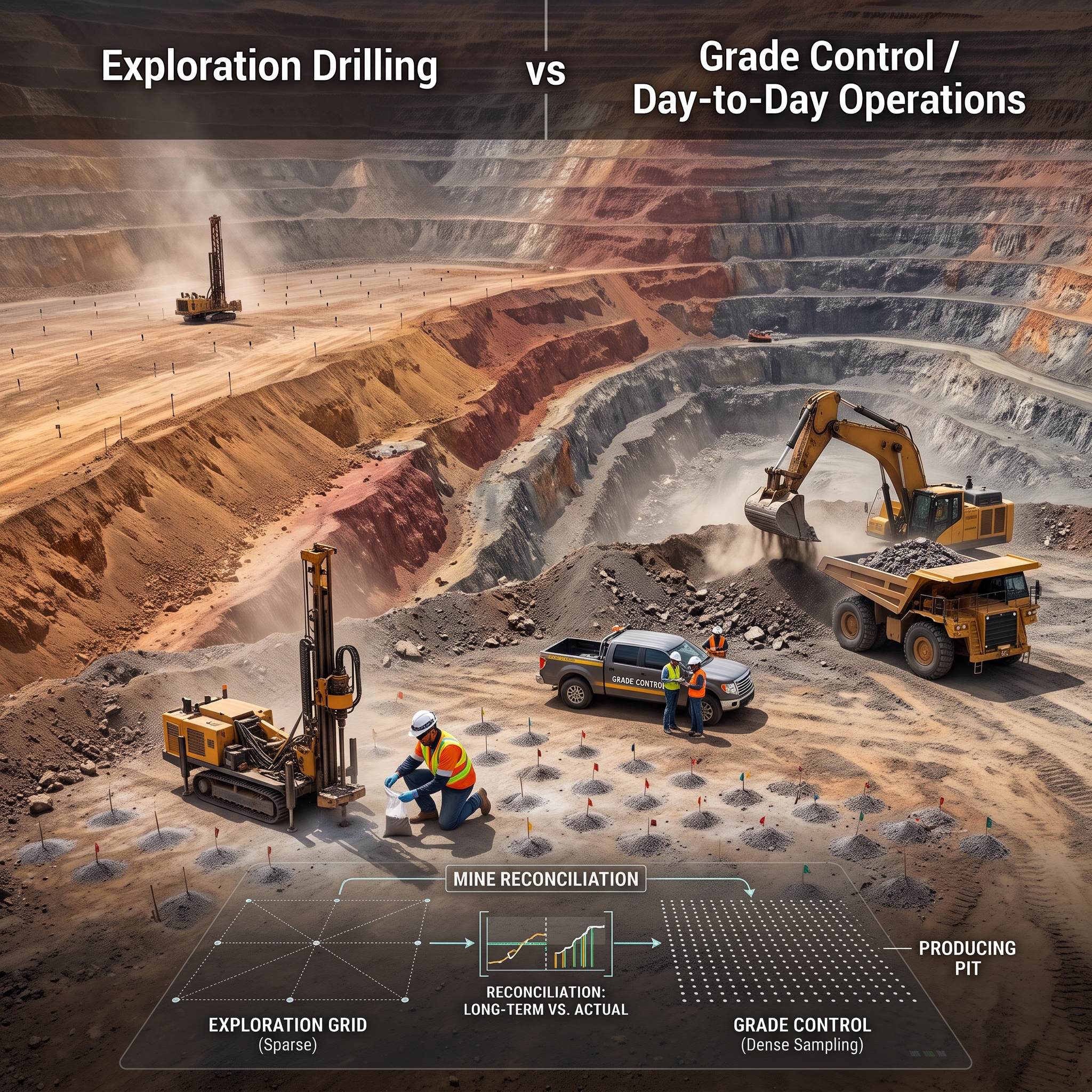


Resource models rely on exploration drilling grids that are often too widely spaced to capture localized geological complexities. Consequently, unexpected discrepancies arise between long-term metal expectations and the grades extracted during day-to-day operations. Mine reconciliation provides the diagnostic discipline needed to resolve these discrepancies. Rather than serving as a passive accounting audit, reconciliation functions as an active system that identifies and manages variances across the production chain. Grade control models serve as the vital link within this framework, translating sparse exploration data into actionable pit-floor decisions through dense sampling, support corrections, and disciplined material dispatch.
Mathematical reconciliation factors establish an objective foundation for variance analysis. Harry Parker formalized this methodology through three primary metrics: the F1 factor compares short-term grade control predictions against the long-term resource model, the F2 factor evaluates mill-received metal against grade control estimates, and the F3 factor measures total recovery against original reserve expectations. Alternative multi-factor systems further isolate mine dispatch and stockpile handling. These factors distinguish geological errors from operational execution problems, answering whether the orebody differed from projections or whether crews simply departed from the spatial mine plan. Operations must avoid arbitrary adjustments to bulk densities or moisture values, because artificial balancing obscures root causes.
Spatial analysis represents an indispensable pillar of reconciliation alongside traditional time-based reporting. While monthly or quarterly averages smooth out short-term volumetric swings, 3D spatial evaluations confirm whether excavation occurred strictly within planned boundary polygons. Dense blast-hole sampling provides the local resolution required to model selective mining units. Advanced geostatistical methods, particularly Localized Uniform Conditioning, correct for support effects and minimize conditional biases that otherwise distort recoverable metal estimates. Furthermore, predictive models must account for physical extraction mechanics, including blast-induced movement, rock swelling, minimum equipment selectivity, and unplanned dilution. Modern operations increasingly pair these geostatistical techniques with machine learning to refine ore-waste cut-offs dynamically.
Material tracking discrepancies often emerge long after blasting, especially during haulage, stockpiling, and crushing. The practice of blending multiple ore sources on run-of-mine pads frequently conceals local estimation errors, creating an informational void between the pit and the plant. Reliable reconciliation demands strict stockpile segregation and verified dispatch records. Success also requires the removal of organizational silos between exploration geologists, mine planners, and plant metallurgists. Isolated departments often prioritize gross tonnage targets over delivered feed quality, rewarding crews for volume even when metal recoveries decline. Digital continuum platforms eliminate these communication barriers by integrating survey data, fleet telemetry, and mill assay streams into a unified repository.
Effective grade control models transform reconciliation from a reactive historical record into a continuous operational feedback loop. When operations calibrate short-term parameters against physical plant recoveries, planning teams can update long-term assumptions before errors compound. This systematic feedback protects the mineral asset from destructive short-term practices, such as unplanned high-grading or out-of-sequence mining. Ultimately, disciplined grade reconciliation ensures that mineral resource estimates translate faithfully into marketable metal, safeguarding reserve longevity and maintaining corporate credibility.