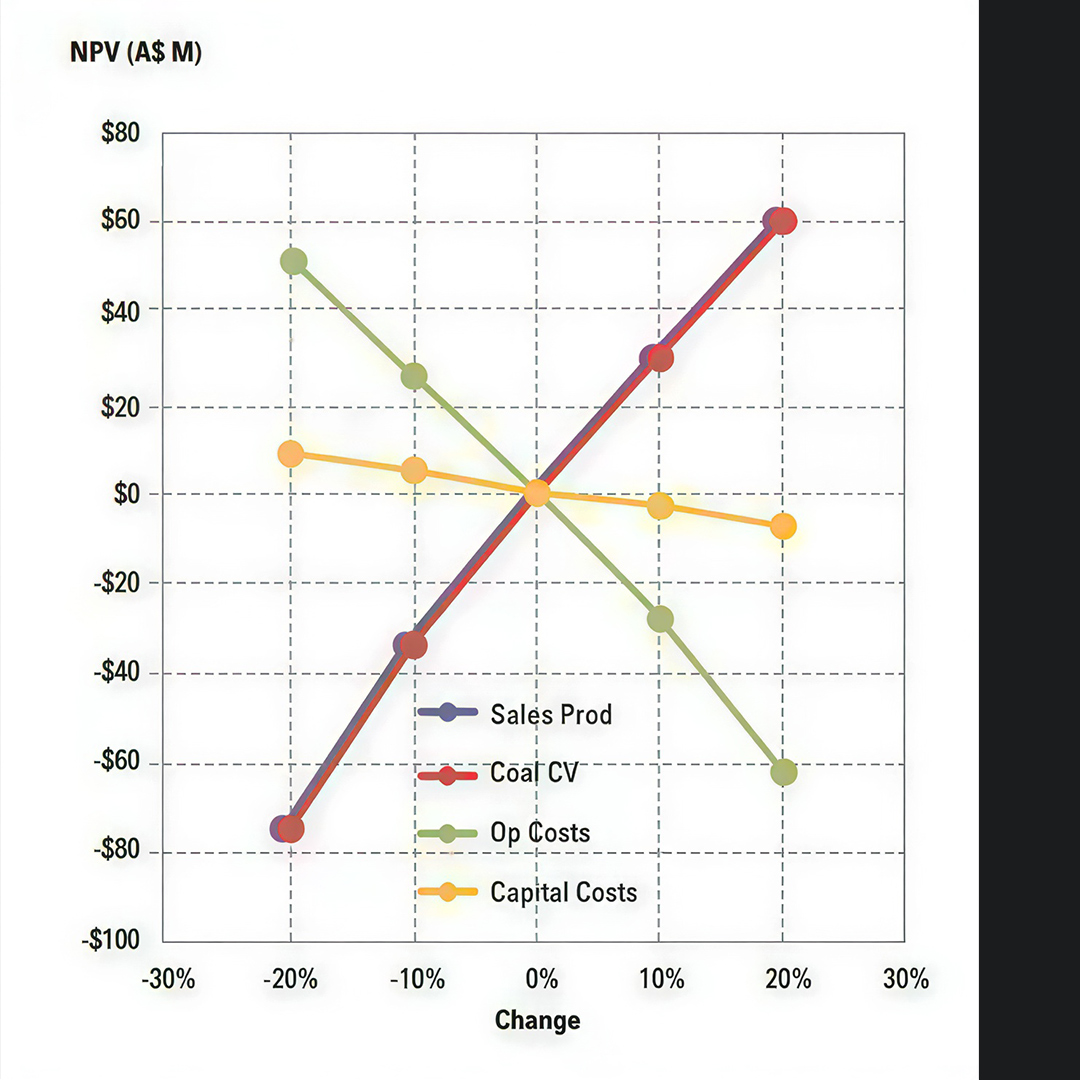
NPV of mining projects according to the DCF approach is evaluated using the basic scenarios of operations. However, because of the high levels of uncertainty, risk assessment tools that would better withstand it are needed. The sensitivity analysis is aimed at evaluating the impact of a minor change in some parameters on the performance of the project, whereas scenario analysis considers the changes in several parameters under distinct scenarios.
A proper sensitivity analysis involves altering each variable that has an impact on financial performance individually, keeping others constant (Fontes et al., 2020). This process requires adjusting variables by percentage and calculating elasticity indices based on the NPV (Fontes et al., 2020). This is usually done via graphs referred to as tornado diagrams, allowing senior management to understand which independent variables have the most significant impact on projects’ performance.
In contrast, scenario analysis changes its attention to inter-related operations and considers groups of related risks at the same time. The standard approach consists in building three consolidated scenarios: pessimistic, moderate, and optimistic scenarios (Matrokhina et al., 2023). The multi-variable approach allows assessing a project’s ability to perform under complex market situations like a simultaneous decline in metal prices and an increase in the cost of local energy.
Thus, the value drivers of a project can be isolated. According to financial models, commodity prices, metallurgical recoveries, and capital expenditures (CAPEX) account for most project benefits (Fontes et al., 2020). Identifying these value drivers allows for further engineering optimization to enhance profit margins through leverage effects under favorable market conditions.
Meanwhile, the two models reveal downside risk factors which could jeopardize the success of the venture, including geological grade variations, regulatory changes, and cost increases as a result of inflation (Shahabi et al., 2022). In order to establish when the project’s finances reach their critical state when losses will follow instead of returns, one must consider all of these risk factors in a worst-case scenario.
In conclusion, through sensitivity and scenario analysis, mining operations become not only more valuable but more adaptable. This allows companies to quantify uncertainty and distribute capital effectively to avoid any unnecessary risks (Fontes et al., 2020).
References
Fontes, M. P., Koppe, J. C., & Albuquerque, N. (2020). Comparison between traditional project appraisal methods and uncertainty analysis applied to mining planning. REM – International Engineering Journal, 73(2), 261-265. https://doi.org/10.1590/0370-44672019730108
Matrokhina, K., Trofimets, V., Mazakov, E., Makhovikov, A., & Khaykin, M. (2023). Development of methodology for scenario analysis of investment projects of enterprises of the mineral resource complex. Journal of Mining Institute, 259, 112-124. https://doi.org/10.31897/pmi.2023.3
Shahabi, R. S., Basiri, M. H., Qarahasanlou, A. N., Mottahedi, A., & Dehghani, F. (2022). Fuzzy MADM-Based Model for Prioritization of Investment Risk in Iran’s Mining Projects. International Journal of Fuzzy Systems, 24, 3189-3207. https://doi.org/10.1007/s40815-022-01331-x