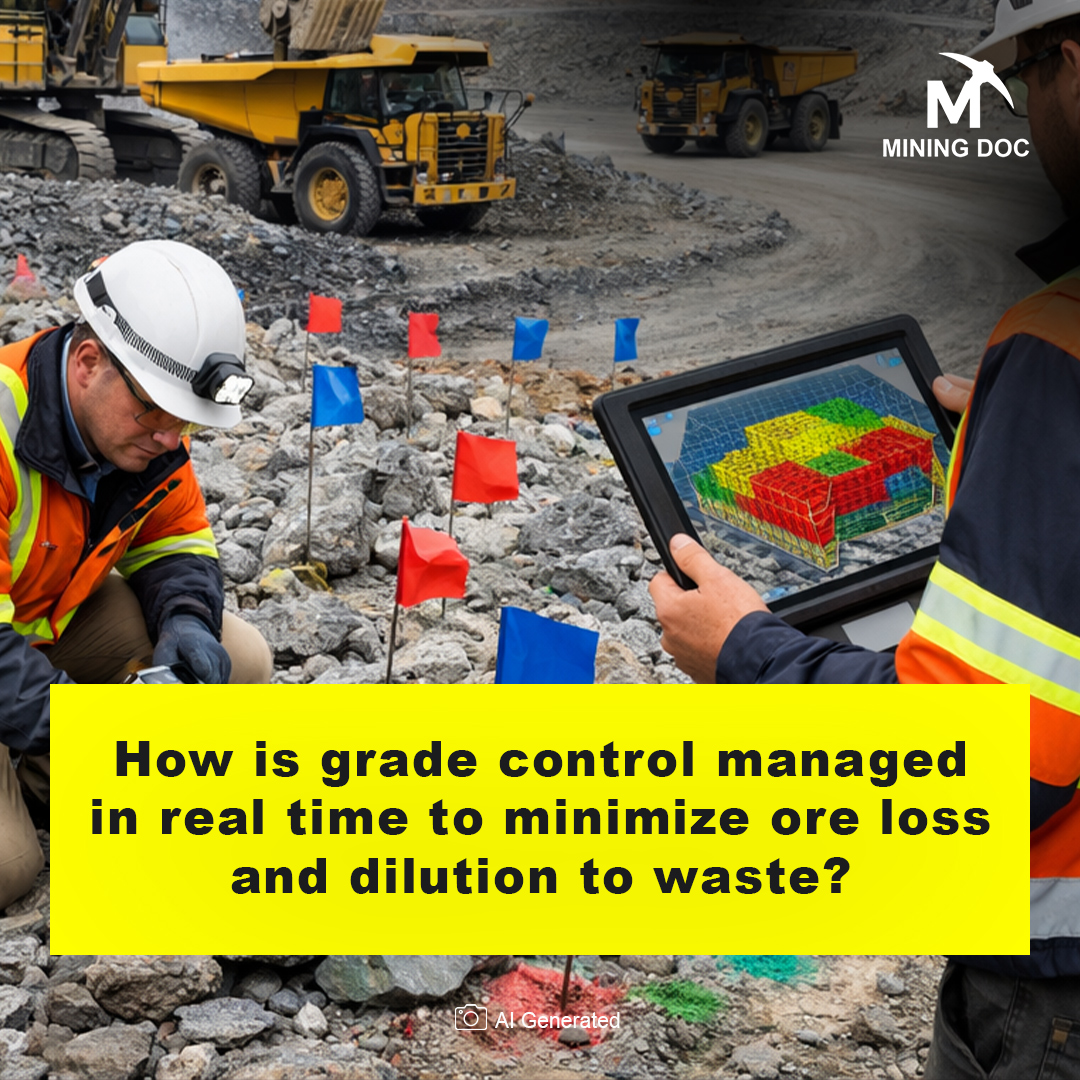
Grade control in real-time is conducted by means of integration of latest sensing technology, analysis of data, and updates of models to help detect ore boundaries and avoid misclassification. The latest systems use Prompt Gamma Neutron Activation Analysis (PGNAA) sensors that are mounted on the conveyor belt to get immediate elemental composition of the ore stream to help halt the off-spec ore from entering the processing facility. This data on elemental composition obtained in real-time is fed directly into the control system to help minimize grade misclassification up to 20%.
In essence, the success of the real-time grade control system depends on the use of an updated geological block model that uses frequent sampling together with accurate GPS technology to outline the ore-waste contact zones. As the drilling program continues, the geological model is always updated using drilling grids, which help in differentiating between the high-grade and the waste zones, thereby facilitating more accurate mining activities. With the dynamic nature of this model, there is an accurate differentiation between ore and waste blocks, which helps avoid both internal and external dilution.
Blast movement monitoring (BMM) is very important in the process of grade control, especially in porphyry or manto copper mines where blasting has the potential to displace a lot of ore. BMM involves a comprehensive approach to address ore displacement due to blasting, ensuring that the mining polygons contacts can be adjusted to accommodate this effect before mining commences. This concept has become globally acknowledged as a necessary one, and many mining sites believe that grade control is not complete without accounting for blast movement.
Through the application of selective mining methods coupled with an operator guided real time system, accurate ore extraction can be done without moving extra materials. The use of equipment with real time guidance systems for operators based on GPS makes it easy to follow plans in terms of boundary demarcation of ore and wastage. Teaching operators about grade controls will minimize misclassification while ensuring that selective mining is done on the ore zones where it is most productive using good strip ratios according to price levels.
The drill and blast technique is essential when it comes to dilution control due to the need for proper drilling and blasting in order to avoid overbreaks and unnecessary fragmentation of material to the adjacent waste zones. Good blast designs ensure minimal loss of ore while fragmenting optimally, and actions like cleaning ore contacts before blasting and fragment size evaluation will help in retaining ore quality. Proper mining design will also assist in retaining ore quality through geological factors among others.
Data analysis and decision automation form the final stage of the real-time grade control system. These processes involve the analysis of continuous data generated through sensors installed in conveyed flows to enable decision automation about the crushed rock prior to the expenditure of further costs to process it. Grade control is enabled with the help of these technologies, ensuring optimization of efficiency and production yields without treating waste rock unnecessarily. The use of real-time monitoring techniques in geology, mining, and processing will ensure grade consistency and cooperation towards profitability.