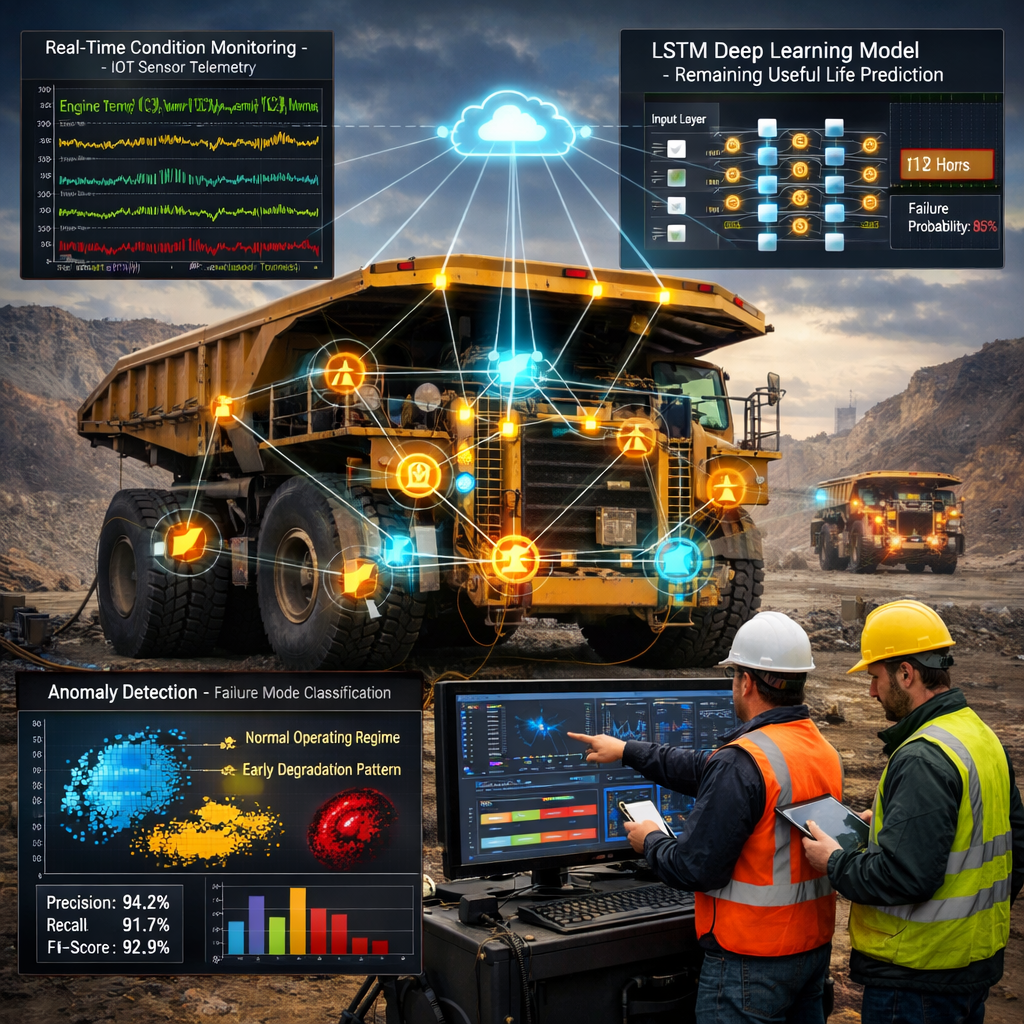
Machine learning is currently being utilized for predictive maintenance in mining through conversion of data streams from sensors and maintenance logs to early alerts regarding failure modes, which allows personnel to act before a failure occurs. This process essentially changes the maintenance strategy from time-based or corrective actions based on failures to proactive decisions based on the real-time condition of the asset.
The data collection process involves gathering data streams from sensors fitted on vital assets, such as haul trucks, crushers, conveyors, ball mills, gear boxes, pumps, and electric motors. The most used data types include vibrations, temperatures, pressures, electrical currents, oil conditions, and occasionally acoustics and vision-based data.
These models learn about how normal operations look like, and they detect deviations that point out to imbalances, misalignments, wearing of bearings, gear damage, lubrication issues, and overheating. According to the review on vibration-based condition monitoring, vibration deviations can be particularly effective when dealing with mining machinery because they operate in dusty environments, under heavy load, shocks, and high temperatures. It means that the model does not simply aim at identifying an emergency shutdown but detecting the signs that often lead to the problem.
The procedure normally involves using raw data collected from sensors along with feature extraction and employing supervised or unsupervised learning methods. According to the literature, methods such as FFT, wavelet analysis, envelope analysis, statistical analysis, regression, decision tree, anomaly detection, and deep learning have been used to identify patterns associated with future failures. More sophisticated approaches may help forecast the probability of failure and remaining useful life. Such information helps plan repairs and determine whether to make an emergency repair or schedule the repair for a future shutdown period.
Mining companies rely on these forecasts in order to establish automated work orders, prioritize assets, and manage spare parts as well as personnel schedules. One tangible effect in this context is that the system provides root-cause suggestions rather than simply alerts, meaning that operators understand if the fault lies in the bearings, gearbox, motor, or lubricating circuit. This aspect is particularly relevant within mining, where downtime is costly and impacts the entire production chain, not just the equipment itself.
Apart from the financial implications, the significance extends to safety. As noted by credible sources, such a technology leads to reduced incidents, minimizes emergency repair, and allows for some manual inspections to be eliminated altogether owing to the risks posed in the hard-to-reach zones within mines.
To conclude, the key constraint is that modeling accuracy relies on high-quality data, proper sensor placement, and adequate cases of failure or degradation. The literature also discusses obstacles such as the noise in mines, false alerts, amount of data, and the necessity to validate the model based on reality rather than simulations. Thus, the best predictive maintenance for mining would be a combination of machine learning and vibration monitoring along with maintenance expertise and regular model updates.