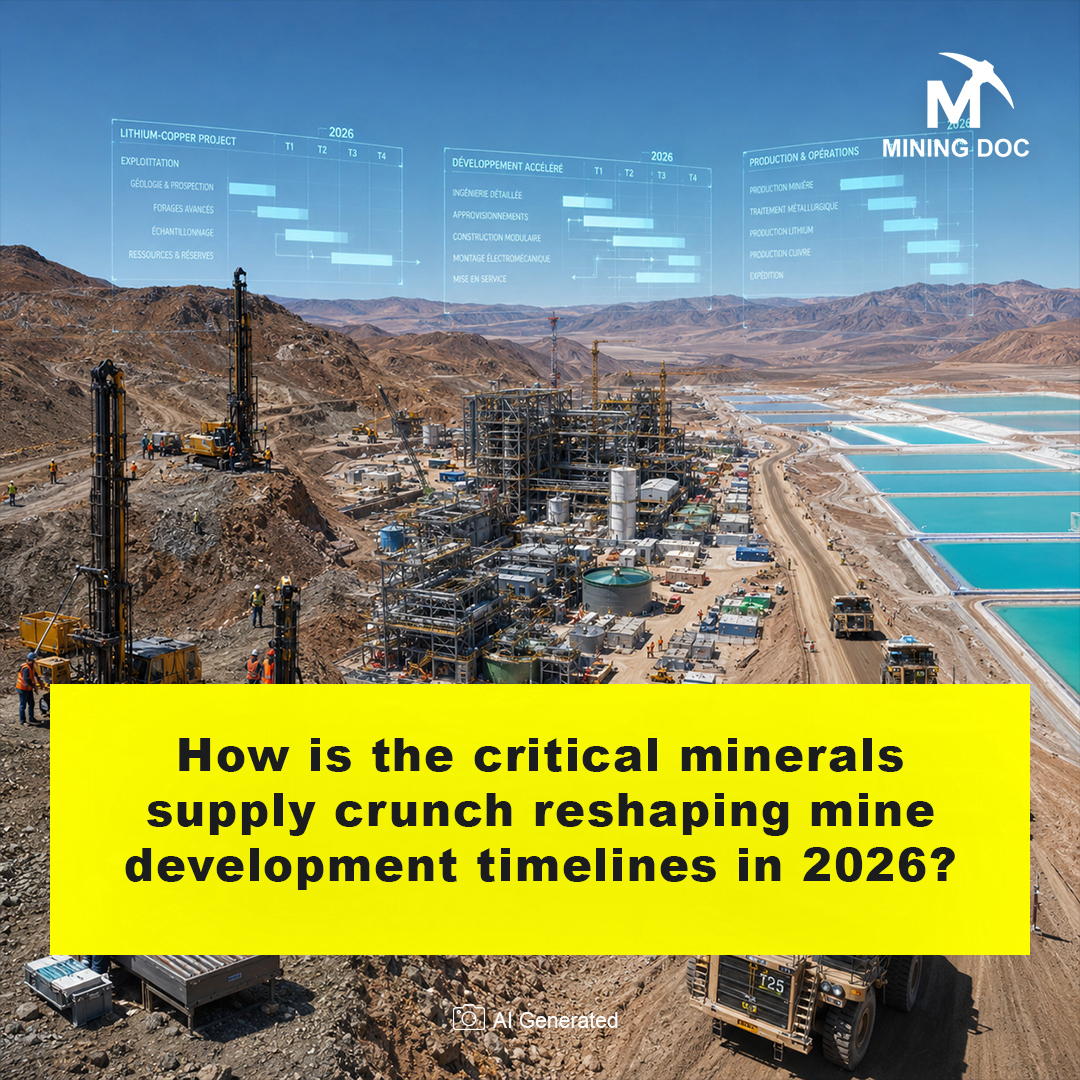
The switch to clean energy in the world has raised interest in critical minerals, which can be described as materials necessary for modern technological processes. The idea of a “supply crunch for critical minerals” represents the situation in which increasing demand for lithium or any other minerals is greater than the current capabilities for providing the material. In addition, the “timelines for mine development” are the time needed to move a project from its discovery to mining. Understanding these ideas is crucial when one faces the issues related to resources typical for 2026.
The world’s switch to renewable energy and the emergence of electric vehicles has created an increasing rate of mineral usage by 2026. Thus, new global value chains have been created, with vulnerabilities connected to location and politicization of trade. With countries acquiring critical resources for their own purposes, critical minerals chains’ security becomes one of the key concerns, as constant demand often coincides with distorted trade (Shiquan & Deyi, 2022). Industries face shortages, which prevent them from adopting green technologies.
Mining has traditionally been subject to long-term cycles with development periods usually extending for anywhere between 15 and 20 years. This creates a temporary limitation on transition mineral supply and blocks investments into projects needed (Krane & Idel, 2021). The length of the cycles is caused by detailed geological investigations, thorough environmental studies, and significant financing. With regard to the upcoming supply crunch expected in 2026, this becomes a crucial limiting factor as instant demand cannot be served by multi-decade cycles.
While strict regulation is usually blamed on delays, the actual case seems to be somewhat different. According to research, companies often seek to prolong their permits in order to delay building mines as much as possible, meaning that regulation is not the single issue that prevents the mines from starting the activity (Collard et al., 2024). In addition to this, financial issues, volatile prices, and technical problems may affect the development period too. Despite this, the current situation with the supply crunch requires certain changes.
However, to work around problems linked with timelines, public and private actors develop fresh solutions. For example, governments create stockpiles, while important projects undergo expedited processing through prioritized pipelines. At the same time, companies utilize additional supply routes understanding the fact that transition metals cannot be burned, as opposed to traditional fossil fuels; moreover, those are recyclable (Krane & Idel, 2021). This way, participants in economic activities avoid extracting the materials from the raw ore deposits and prevent long-term waiting times in building new mines.
To sum up, the problem of the shortage of critical minerals dramatically transforms the way the mining industry operates in 2026. The traditional timeframes for developing mines do not correspond to the demands of the global energy transition process. Therefore, it is possible to use the tools of process facilitation, technological development, and material recycling to decrease those timeframes as much as possible.
References
Collard, R., Dempsey, J., Al Bouchi, Y., & Bawaan, N. (2024). Does regulation delay mines? A timeline and economic benefit audit of British Columbia mines. FACETS, 9, 1–12. https://doi.org/10.1139/facets-2024-0083
Krane, J., & Idel, R. (2021). More transitions, less risk: How renewable energy reduces risks from mining, trade and political dependence. Energy Research & Social Science, 82, 102311. https://doi.org/10.1016/j.erss.2021.102311
Shiquan, D., & Deyi, X. (2022). The security of critical mineral supply chains. Mineral Economics, 36, 401–412. https://doi.org/10.1007/s13563-022-00340-4