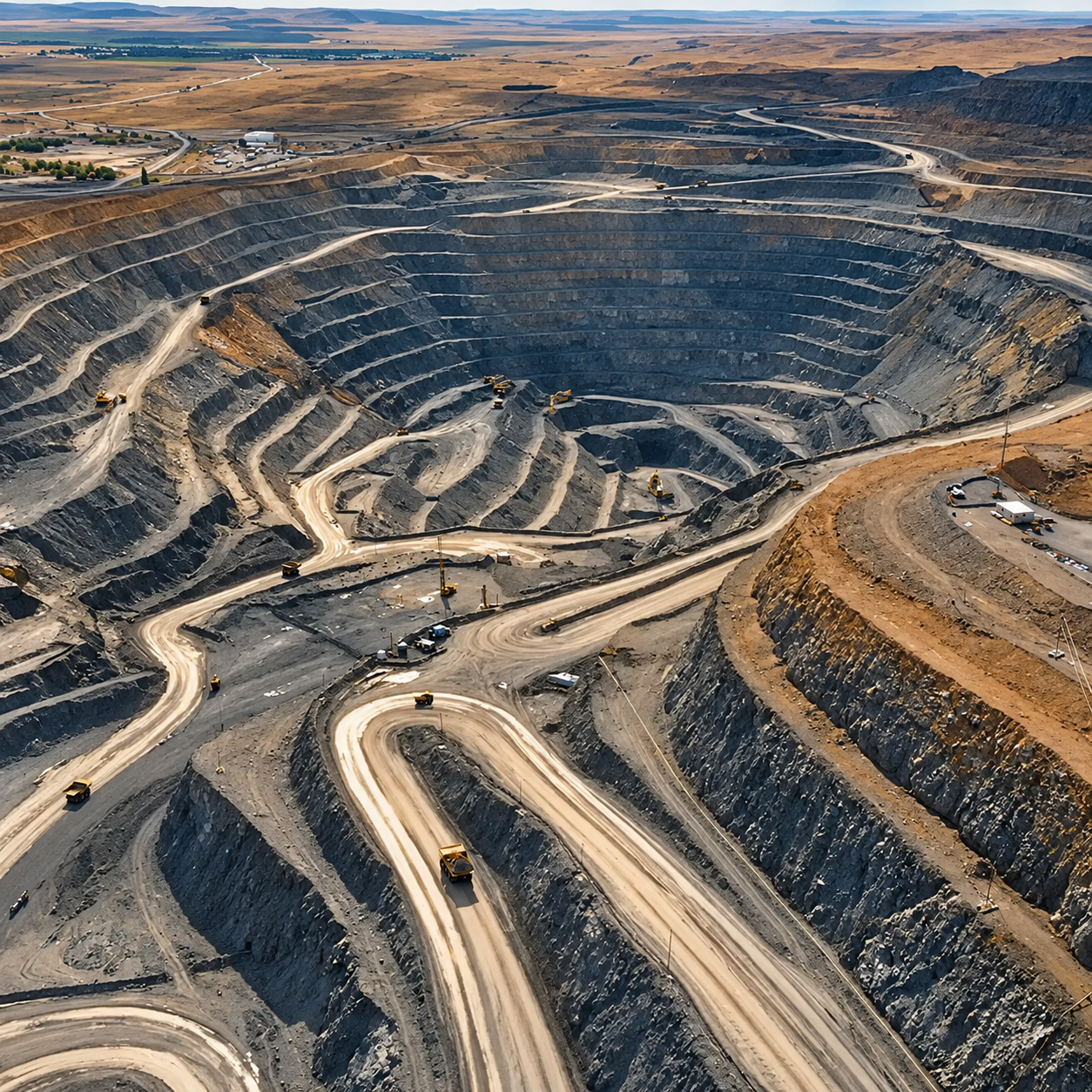
The Bakyrchik Mining Company, a member of Solidcore Resources Group, operates the Kyzyl gold project located in the Abai region of eastern Kazakhstan. Commercial operations began in 2018 at the Bakyrchik deposit, an asset historically recognized as one of the world’s most technically challenging gold deposits due to double refractory ore geology. Fine-grained gold locked within arsenopyrite and pyrite matrices resisted large-scale industrial extraction for nearly six decades following its initial geological discovery in the 1950s. Modern engineering solutions, automated digital monitoring, and targeted capital investment successfully unlocked the asset. In June 2026, the operation surpassed a major historic milestone by extracting more than 100 tonnes of gold contained in mined ore. This technical review summarizes the deposit geology, mining strategy, metallurgical flowsheet, and digital infrastructure that drive performance at the Bakyrchik enterprise.
The Kyzyl project encompasses the Bakyrchik and Bolshevik gold deposits situated along the 11.5-kilometre East-West striking Kyzyl Shear Zone. Dip angles range between 30° and 40° north, with mineralization extending to depths from 1 to 3.5 kilometres. Ore bodies feature JORC-compliant probable reserves estimated at 29.15 million tonnes with an average grade of 7.7 grams of gold per tonne, representing 7.3 million ounces of contained gold.
The operational strategy follows a two-phase life-of-mine plan. Phase One utilizes conventional open-pit mining incorporating drilling, blasting, and truck-and-shovel loading at a design capacity of 1.8 million tonnes of ore per annum. Phase Two involves a transition to underground extraction scheduled for 2028, deploying an underhand cut-and-fill mining method to extract deeper resources below the open pit at a planned capacity of 1.2 million tonnes per annum.
The processing facilities are based on a 1.8 mtpa capacity sulphide flotation plant, which has gold recoveries of 93.44% and 220,000 tonnes per year concentrate production. Processing of refractory ores requires a two-stream beneficiation process. Low-carbon concentrate undergoes POX treatment at the Amur Hydrometallurgical Plant where gold gets transformed into 95%-96% gold-containing alloy before being refined in Kazakhstan. High carbon concentrate is processed at the Kazakhmys Corporation LLP. The company is constructing the new hydrometallurgical plant in Pavlodar region of Kazakhstan which will be the first Central Asian facility for processing refractory concentrate, where Bakyrchik concentrate will be supplied beginning from 2028.
Digital automation supports all stages of mine dispatch and equipment maintenance. A private 4G/LTE cellular network with six base stations integrates automated dispatching, bucket positioning, radio communications, and real-time machine telemetry. The in-house ‘POLINA’ automated dispatching system allocates haul trucks dynamically based on excavator telemetry and onboard sensors. Environmental management maintains a 100% closed-loop water recycling system and backfills 10% to 13% of overburden waste into exhausted pit areas annually.
The successful industrial execution at the Bakyrchik deposit illustrates how advanced flotation techniques, hydrometallurgical processing, and digital infrastructure can commercialize double refractory gold ores. Solidcore Resources has transformed an asset once considered unviable into a cornerstone of Kazakhstan’s gold mining sector. As the enterprise prepares for its scheduled transition to underground mining and local POX processing in Pavlodar, Bakyrchik establishes a technical benchmark for refractory gold extraction across Central Asia.