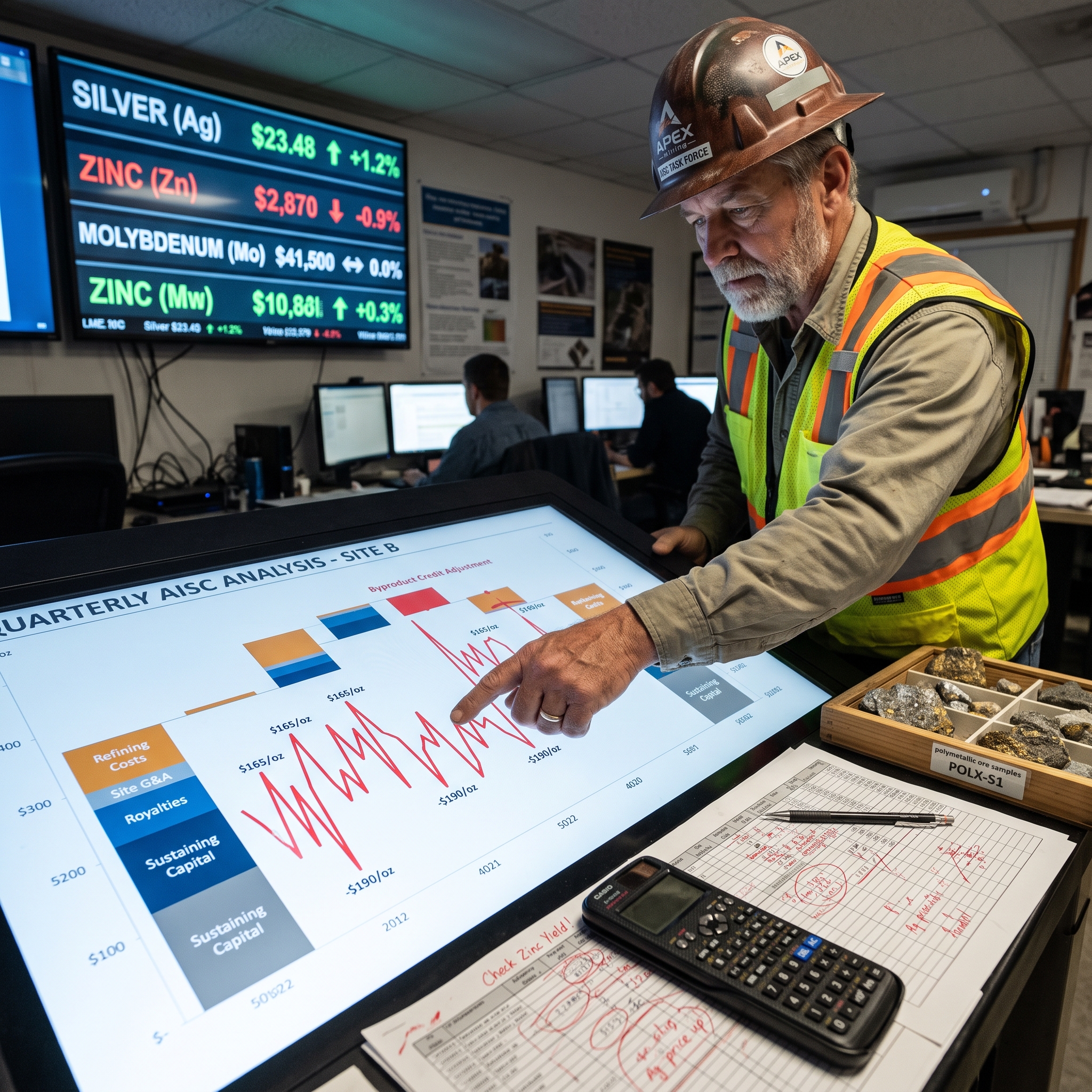
Mining activities’ financial analysis is possible only based on proper cost indicators. The important concepts in the sphere are AISC and byproduct credits. All-In Sustaining Cost is a reporting indicator showing all direct and indirect costs needed to support present production levels during the life cycle of the project (Trench et al., 2024). In turn, byproduct credits mean the income received from selling the secondary materials that appear together with the main target material, and which decrease the production costs (Pg Haji Omar Ali et al., 2025).
The move from cash cost metrics to the AISC has radically changed the financial modeling providing clear representation of real capital expenditures. Traditionally, the cash cost metrics did not consider sustaining capital, company overheads, and site rehabilitation, presenting an overly optimistic picture of the profit margin (Wilson et al., 2022). The AISC indicator includes all these expenditures helping stakeholders analyze the real financial border required for supporting the profitability of mines. As such, AISC is a useful metric for evaluating the efficiency of the process.
The inclusion of credits of the by-products in the calculation of AISC is common since the real economic cost involved in the production of the principal product can be calculated. In the case where there is production of a secondary metal in a mine, the income received from the sales of the metal acts as an offset to the overall sustaining costs, hence lowering the AISC of the company (Pg Haji Omar Ali et al., 2025). Therefore, through the use of these deductions, more profitable margins will be achieved for the products of the firm.
One of the important problems in analyzing mining activities with byproduct credits in AISC calculations is the significant volatility of the market prices of the secondary materials. As soon as the AISC value is decreased with the help of deductions from the secondary market revenues, the increasing price of the byproduct decreases the AISC and makes invisible some hidden problems related to the inefficiency of the processes. The decreasing byproduct market prices reduce the amount of the credits and increase the AISC value even if the mining and processing costs stay on the same level.
The true AISC value during the period of market volatility is found by separating the usual equation from the spot prices. The first step is finding the gross AISC without any credits for identifying the basic cost level. Instead of using volatile spot prices of the byproduct, a normalized moving average price should be used for identifying the stable value of the byproduct credit. Sensitivity analysis of different price levels will provide the dynamic cost model showing the health of the mining process independently from the volatile secondary market conditions.
Conclusively, the AISC model gives an accurate representation of costs required to sustain production operations, but its calculation involving the use of direct byproduct credits creates confusion with respect to the cost of running the operation during periods of market volatility (Trench et al., 2024). Calculation of gross AISC and application of normalized prices for byproducts enable the finance analyst to eliminate such distortions during market fluctuations.
References
Pg Haji Omar Ali, D. N. H. A., Suhaimi, H., & Abas, P. E. (2025). Membrane-Based Hydrogen Production: A Techno-Economic Evaluation of Cost and Feasibility. Hydrogen, 6(1), 9. https://doi.org/10.3390/hydrogen6010009
Trench, A., Baur, D., Ulrich, S., & Sykes, J. P. (2024). Gold Production and the Global Energy Transition—A Perspective. Sustainability, 16(14), 5951. https://doi.org/10.3390/su16145951
Wilson, R., Mercier, P. H. J., & Navarra, A. (2022). Integrated Artificial Neural Network and Discrete Event Simulation Framework for Regional Development of Refractory Gold Systems. Mining, 2(1), 123-154. https://doi.org/10.3390/mining2010008