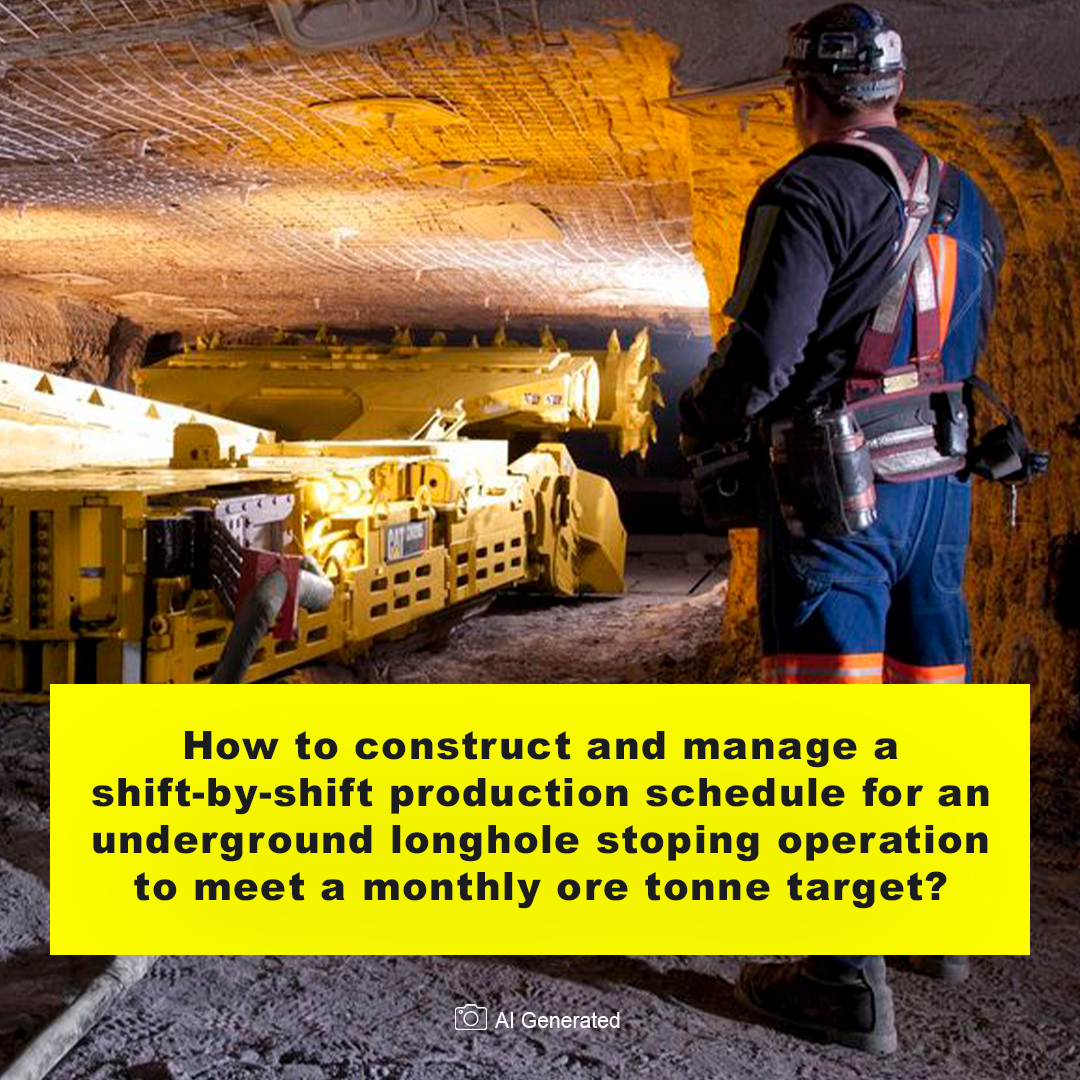
The development of shift-by-shift schedules is fundamental in meeting the monthly tonnage target. Stoping is an efficient mining method utilized in longhole stoping underground mining, where the orebody is fragmented vertically before extraction via drilling and blasting (Furtado e Faria et al., 2021). To achieve the monthly target, which is the total tonnage of valuable ore, it becomes necessary to have a production schedule.
To begin with, it is vital to collect very precise information regarding the layout of the mine. This process takes advantage of stope optimization, which involves determination of the mineable volumes according to the grade distribution and strength of the host rock (Furtado e Faria et al., 2021). The next stage involves assessment of equipment availability and cycle requirements such as drilling, blasting, and mucking among others. With this knowledge, planners can divide the target accordingly.
The process of creating the schedule requires the allocation of tasks within working areas based on precedence requirements. In other words, before mucking is performed, it is imperative to blast the entire stope, and all backfilling delays need to be reduced aggressively (O’Sullivan & Newman, 2014). The short-term scheduling involves allocating mining equipment to tasks within the period from one to two weeks. These timeframes are then divided into individual shifts (Aalian et al., 2024). Allocation of tasks allows for the effective simultaneous execution of activities in separate stopes without the creation of underground bottlenecks.
Furthermore, the process of planning needs to consider the presence of uncertainty associated with underground mining processes. The differences in rock characteristics, activity duration, etc., preclude the use of strict and unchanged schedules; otherwise, planners will have to deal with infeasible schedules created through conventional methods (Aalian et al., 2024). Modern planning techniques involve using robust methodologies like constraint programming to develop flexible shift plans.
An active form of management requires monitoring and reporting about real-time performance. For example, supervisors monitor the cycle time of work performed within shifts. They check the volume of mucked ore with respect to the predicted volume. In case there is any equipment failure, managers rearrange operations so that easily available stopes are mined so that the mill is always supplied with ore. Such management does not lead to costly delays in operations and facilitates personnel management for a whole month (O’Sullivan & Newman, 2014).
To conclude, the management of a longhole stoping operation implies the implementation of strategies at a daily level based on the analysis of various factors. With effective planning for uncertainty, proper scheduling of tasks, proper resource allocation, and the intelligent application of knowledge about stope design, steady mining operations can be achieved. Overall, the right management of shift work will ensure the achievement of ore targets each month.
References
Aalian, Y., Gamache, M., & Pesant, G. (2024). Short-term underground mine planning with uncertain activity durations using constraint programming. Journal of Scheduling, 27, 423–439. https://doi.org/10.1007/s10951-024-00808-x
Furtado e Faria, M., Dimitrakopoulos, R., & Pinto, C. (2021). Stochastic stope design optimisation under grade uncertainty and dynamic development costs. International Journal of Mining, Reclamation and Environment, 36, 81–103. https://doi.org/10.1080/17480930.2021.1968707
O’Sullivan, D., & Newman, A. (2014). Extraction and Backfill Scheduling in a Complex Underground Mine. Interfaces, 44, 204–221. https://doi.org/10.1287/inte.2013.0730