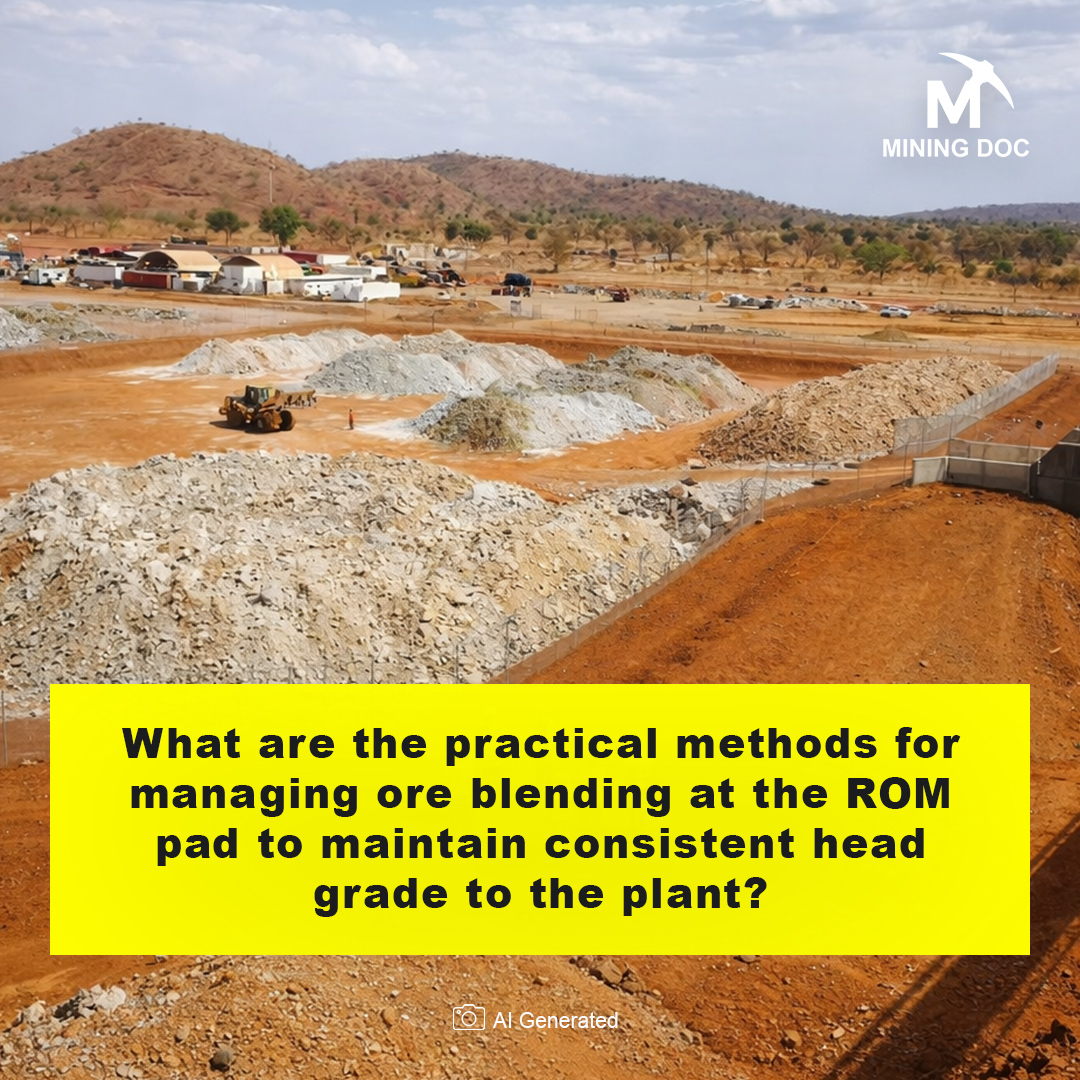
The Run-of-Mine (ROM) pad is the place allocated at the mine for temporary storage of the ore immediately after mining it and prior to processing in the treatment plant. Ore blending is the process of mixing of various ores or different grades to create an even mix. Head grade is the content of valuable minerals in the ore supplied to the beneficiation plant. The management of ore blending on the ROM pad is the key operating practice aimed at preventing variations of head grade and improving plant recovery and reagent usage as well as consistency of the plant’s metallurgical performance.
The process of ore blending does not happen at the ROM pad level alone; it begins way earlier. This is a process that entails the comprehensive tactical geometallurgical practice, which entails gathering of information relating to the geological, mineralogical and metallurgical properties to draw up an ore variability map of the ore deposit (Dominy et al., 2018). Having known the anticipated properties of the incoming ore, it becomes easy to achieve the precise ratio for the blend.
The first step after transporting the ore to the ROM pad is to segregate the ore in stockpiles or “fingers” according to the predetermined grade and metallurgical properties. Separation of high-grade, low-grade, and complex ores ensures that the loaders know where each type of material is placed. The proper design of the stockpile helps prevent contamination and enables selective reclamation of materials. This physical segregation sets the stage for blending.
Sampling is crucial to ascertain the actual grade of segregated stockpiles prior to or during the process of blending. Since the heterogeneity of mineralization may result in substantial differences compared to the model predictions, the use of thorough sampling methods, which comply with the Theory of Sampling (TOS), is vital to prevent financial losses (Dominy, 2021). With the use of such data, metallurgists will be able to change the ratio of blending in order to achieve the required feed grade of the crusher.
Blending physically entails the use of mobile machinery, like front end loaders and excavators, to retrieve certain amounts of materials from the separate stockpiles. The operators adhere to a blending schedule, retrieving the required number of buckets of materials from the various piles to feed into the primary crushing process. It requires precision to ensure continuity of the process. Although fuel consumption and maintenance of the equipment account for substantial cost in the operation, effective blending avoids inefficiencies in the plant operations (Losaladjome Mboyo et al., 2025).
In conclusion, ore blending management at the ROM pad is all about a balance between geological prediction and material handling. With proper segregation of ores, sampling and material retrieval, the mine operator can ensure a consistent head grade, which is necessary in ensuring maximum mineral extraction, processing plant efficiency, and ultimately economic viability of the mining operation.
References
Dominy, S. (2021). It does not matter what is wrong when applying TOS: it is money out of the window every time. Spectroscopy Europe, 40. https://doi.org/10.1255/sew.2021.a41
Dominy, S., O’Connor, L., Glass, H., & Xie, Y. (2018). Geometallurgical study of a gravity recoverable gold orebody. Minerals, 8, 186. https://doi.org/10.3390/min8050186
Losaladjome Mboyo, H., Huo, B., Mulenga, F. K., Mabe Fogang, P., & Kaunde Kasongo, J. K. (2025). Distribution of operating costs along the value chain of an open-pit copper mine. Applied Sciences, 15, 1602. https://doi.org/10.3390/app15031602