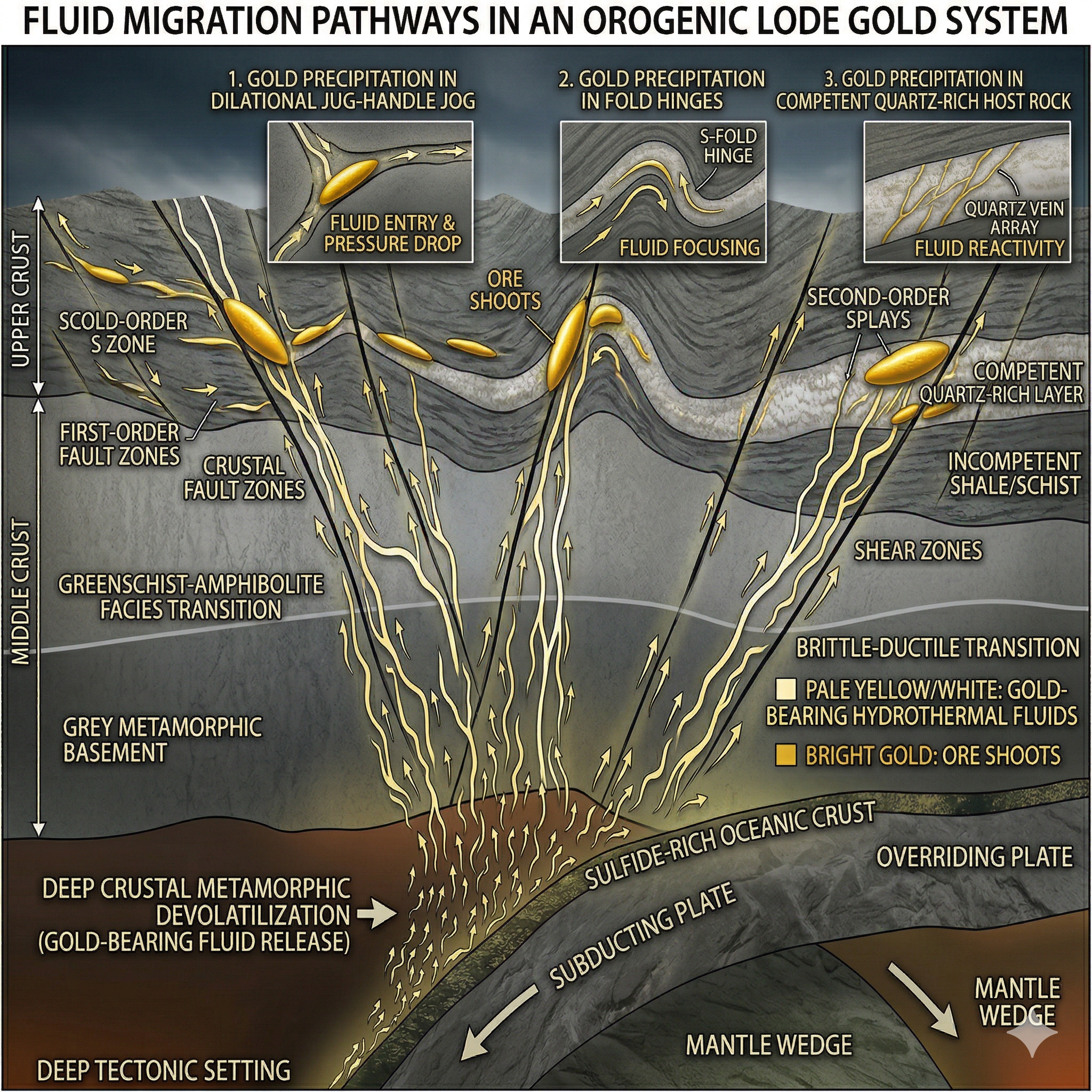
Orogenic gold deposits, which account for nearly a third of the world’s gold reserves, are forged during the intense crustal-scale deformation events that occur at convergent plate margins (Hou et al., 2022). These systems are typically found within metamorphic terranes, ranging from ancient Precambrian greenstone belts to Cenozoic sequences, where gold is concentrated through a sophisticated harmony of structural, lithological, and metamorphic factors.
The most vital control on orogenic gold is the structural framework of the crust. These deposits are almost always associated with regional, crustal-scale shear zones. While these massive structures serve as the primary “highways” for deeply sourced, gold-bearing hydrothermal fluids, the gold itself is rarely found within them (Morey et al., 2007).
Instead, mineralization is typically localized within second- or third-order faults and splays. These smaller branches provide the necessary permeability for fluids to pool and react. Depending on the depth and pressure, these “traps” manifest as brittle fractures, ductile shear zones, or fold hinges. A key mechanism here is the “fault-valve” process: as seismic events trigger sudden shifts in fluid pressure, the system essentially “breathes,” leading to the episodic precipitation of gold within quartz veins (Groves et al., 1998).
If structures are the pathways, lithological competency acts as the gatekeeper. Mineralization often clusters where rocks of different physical properties meet; such as the contact between rigid mafic volcanics and more pliable sedimentary units. These zones of “mechanical contrast” are prone to shattering or opening under stress, creating the physical space required for ore bodies to form (Morey et al., 2007).
Metamorphism further shapes these deposits through a dual-action process:
- Generation: hydrothermal fluids are often liberated by the dehydration of crustal rocks during prograde metamorphism, specifically when rocks transition from greenschist to amphibolite facies (Hou et al., 2022).
- Deposition: most significant deposits are hosted within greenschist-facies rocks. Here, the combination of lower temperatures and chemical triggers—such as the sulfidization of iron-rich host rocks; forces the gold out of solution and into the rock (Groves et al., 1998).
Modern research has expanded our view beyond the upper crust, suggesting that lithospheric architecture plays a foundational role. Evidence indicates that “crust-mantle decoupling” creates vertical conduits that allow heat and mantle-derived melts to rise (Hou et al., 2022). This implies that orogenic gold systems are not merely shallow crustal anomalies but are the surface expression of profound, deep-seated geodynamic shifts.
References
Groves, D. I., Goldfarb, R. J., Gebre-Mariam, M., Hagemann, S. G., & Robert, F. (1998). Orogenic gold deposits: A proposed classification in the context of their crustal distribution and relationship to other gold deposit types. Ore Geology Reviews, 13(1-5), 7–27. https://doi.org/10.1016/S0169-1368(97)00012-7
Hou, Z., Wang, Q., Zhang, H., Xu, B., Yu, N., Wang, R., Groves, D. I., Zheng, Y., Han, S., Gao, L., & Yang, L. (2022). Lithosphere architecture characterized by crust–mantle decoupling controls the formation of orogenic gold deposits. National Science Review, 10(1). https://doi.org/10.1093/nsr/nwac257
Morey, A. A., Weinberg, R. F., & Bierlein, F. P. (2007). The structural controls of gold mineralisation within the Bardoc Tectonic Zone, Eastern Goldfields Province, Western Australia: Implications for gold endowment in shear systems. Mineralium Deposita, 42(6), 583–600. https://doi.org/10.1007/s00126-007-0125-7