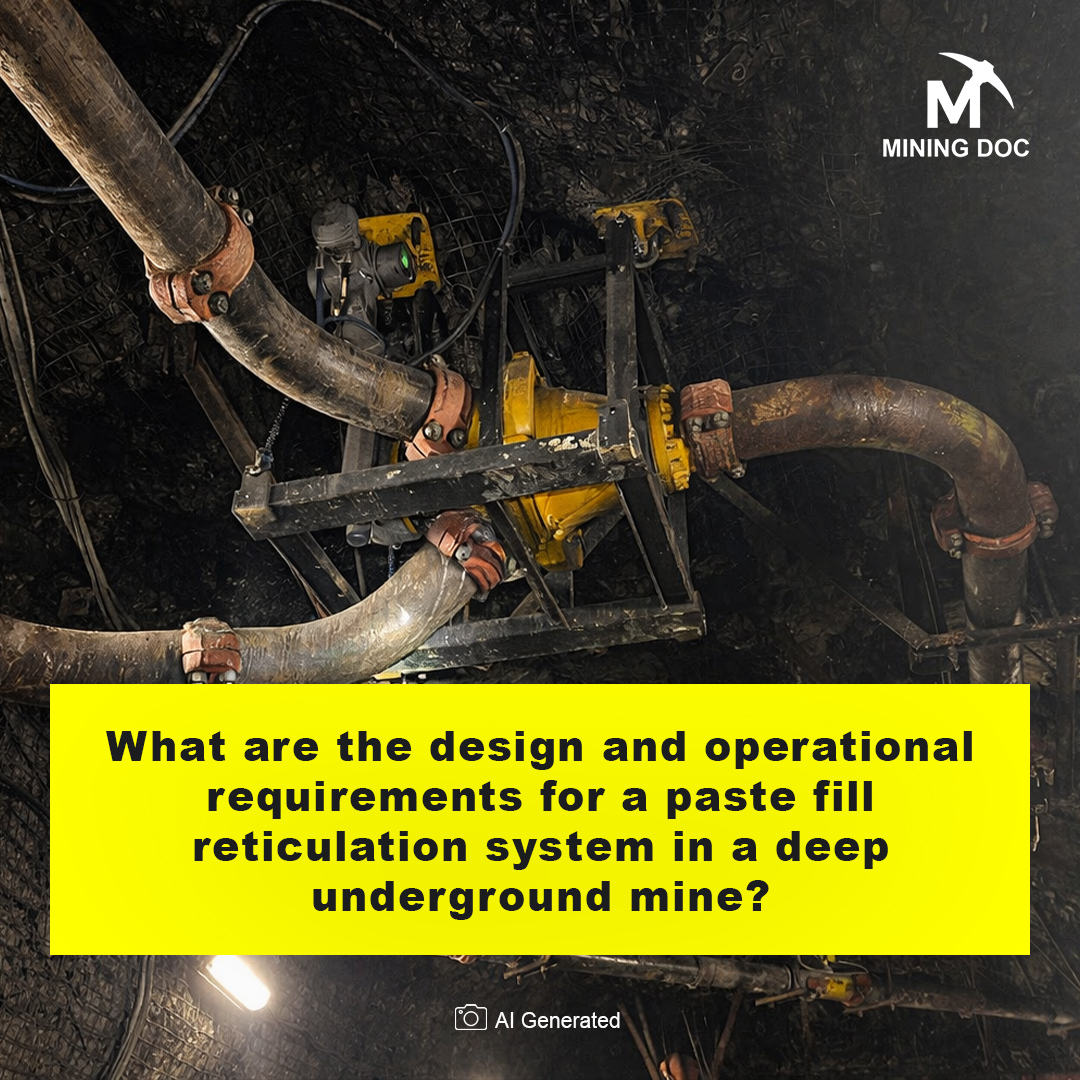
Cemented paste backfill (CPB) is essential in the process of deep underground mining where it acts as a method of rock confinement and tailings disposal. First and foremost, it is important to define some basic concepts. CPB refers to an artificial product which consists of dewatered tailings, water, and binders. A paste fill reticulation system refers to the network of pipelines used for conveying paste down to underground stopes.
This process calls for taking into consideration great depths and complicated routing. It will be necessary to use durable materials such as high-pressure steel pipe to resist stress. Complicated routing involves deep boreholes used to transport material between levels and horizontal piping used within tunnels. The management of elevation differences that exceed 1.5 km necessitates a design that will avoid excessive flow velocities while allowing continuous flow (Coulton, 2023).
The other main aspect of designing paste systems is hydraulic control. Gravity head energy and friction losses must be balanced in order to optimize flow. Gravity head from excessive vertical drops results in slack flow, where paste flows at high velocities causing pipeline wear (Coulton, 2023). This means that slack flow should be modelled and pressure dissipators should be incorporated.
On the operational end, close control of the paste rheology is essential. Paste rheology is continuously observed using slump tests. High paste viscosity poses an increased risk of pipe over-pressurization and the subsequent shutdown of the operation. Low paste viscosity contributes to slack flow and settling of solids within the pipes, compromising the stope filling process (Coulton, 2023; Pornillos, 2009).
The resilience of the operational cycle also relies on efficient flow loss management. Flow loss occurs when there is rock failure in the boreholes or when paste sets early. In cases where flow loss occurs, it is a common practice to flush pipes with water to restart the operation; instead of using air (Griffiths, 2019).
In conclusion, paste fill reticulation for deep mines involves engineering and operational excellence. Through hydraulics that do not allow slack flow and paste rheology control, operators are able to feed continuously. This technology enables mining operations to mine more ore while leaving fewer waste products at the surface.
References
Coulton, D. (2023). Pressure instrument slack flow detection – three methods to determine flow status of a paste reticulation system. Proceedings of the International Seminar on Paste and Thickened Tailings, 170-186. https://doi.org/10.36487/acg_repo/2355_12
Griffiths, M. (2019). Underground paste fill reticulation management of system flow-loss. Proceedings of the International Seminar on Paste and Thickened Tailings, 541-550. https://doi.org/10.36487/acg_rep/1910_41_griffiths
Pornillos, E. (2009). Paste Fill Plant Designs for Underground Mines — A Comparison of Batch Process and Continuous Process. Proceedings of the International Seminar on Paste and Thickened Tailings, 364-374. https://doi.org/10.36487/acg_repo/963_40