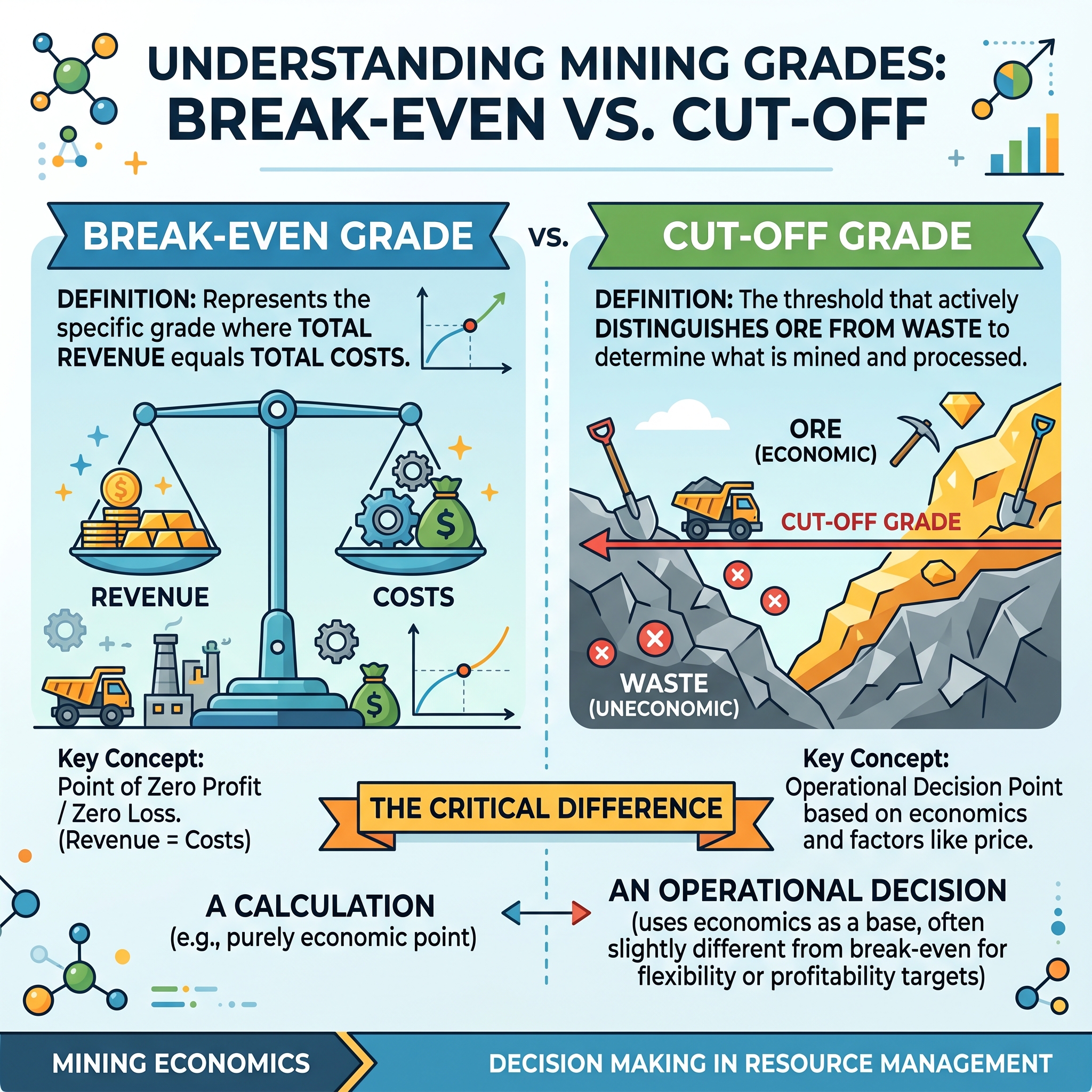
The cut-off grade represents the economic threshold between the profitable ore and unprofitable waste in the mineral deposit. Traditional ore evaluation usually relies on the simple break-even calculation, where the expected income equals the total cost of mining and processing. Recent developments in mining engineering suggest that traditional break-even calculations are insufficient to achieve the maximum value from the asset. First, traditional break-even models do not consider capacity limitations, opportunity cost, and time value of money. Second, break-even criteria are static and ignore the variability of metal recovery and price changes throughout the life of a mine. This research explores the transition from traditional static break-even metrics to dynamic optimization of the cut-off grade.
Break-even cut-off grade is the minimal material grade that can be extracted and processed without a loss of operations. It is assumed that each mined ton is profitable after the processing. However, using break-even calculations creates significant financial risks. Incorrect allocation of fixed cost, volatility of commodity price, and asymmetry of grade distribution can convert marginally profitable ore blocks into unprofitable blocks. Moreover, incorrect computation of the break-even cut-off grade may create the additional source of value errors.
Kenneth Lane explained how cut-off grades are based on the innate capabilities of three inter-related systems, namely, mine, concentrator and refinery. These systems are subject to different operating costs, different capacity and consequently different limit cut-off grade. The appropriate method includes applying gradually lower cut-off grades throughout the lifetime of the mine. In the early years of operation, high-grade ores are sent to the processing plant to facilitate rapid cost recovery and NPV generation. Over the course of operation, cut-off grade is lowered towards the break-even level in order to process low-grade resources and extend the lifetime of the mine.
The recommendations by professional associations, such as Canadian Institute of Mining, Metallurgy and Petroleum, stress the need for careful documentation of cut-offs. Cut-offs must be consistent with realistic technical considerations such as mining dilution, metallurgical recovery and operational costs. Additionally, thorough mine planning requires block modeling and sensitivity analysis for validation of economic feasibility before mineral reserves are declared.
Mine valuation in contemporary times calls for a shift from break-even analysis to an optimization process of cut-off grade. The incorporation of constraint-based capacities, cost analysis, and discounted cash flow is aimed at optimizing the economic value of a mineral deposit. Technical personnel ensure that projects are protected from fluctuations in the market by replacing simple calculations with optimization models. Dynamic cut-off grade approaches provide for sustained capital generation, proper risk management, and good resource management.