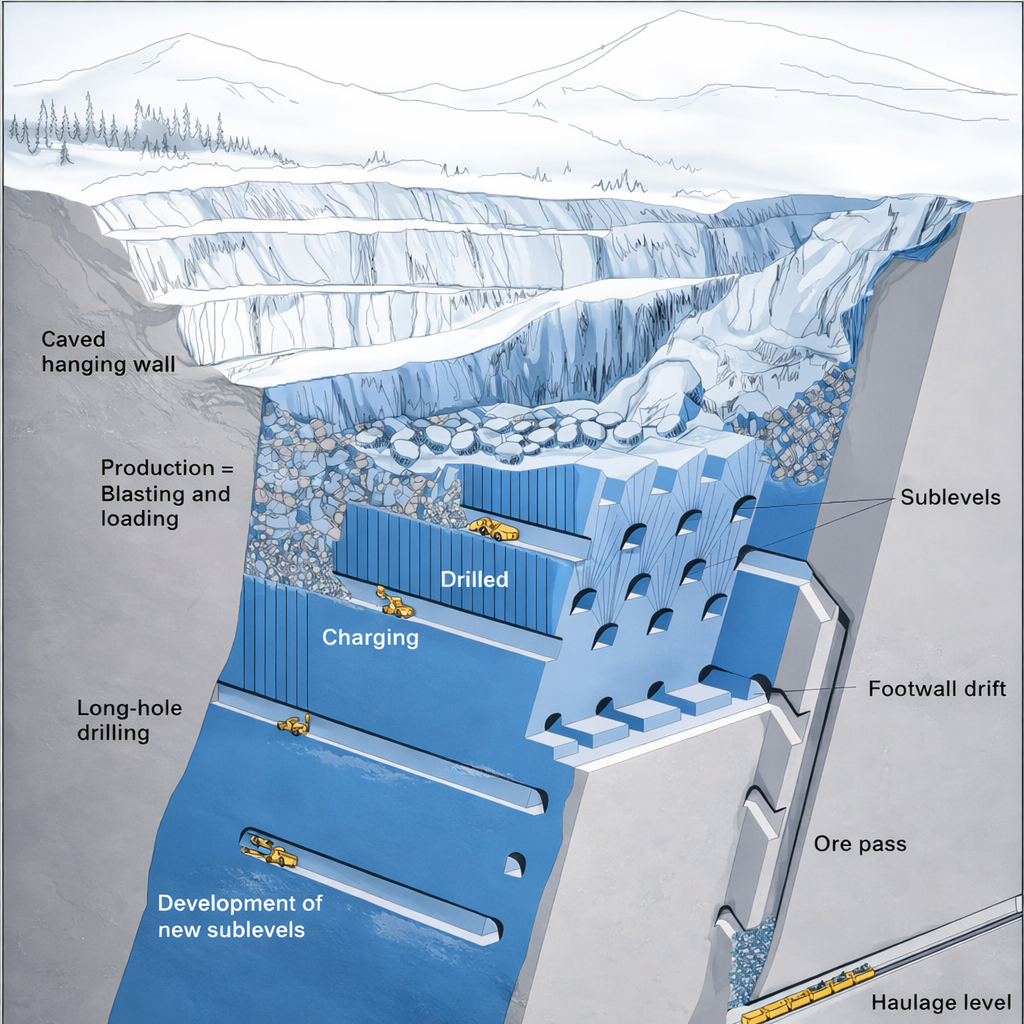
Underground mining entails a well-defined material flow process; thus, an appreciation of the vocabulary is critical to this discussion. Sublevel caving (SLC) is a top-down mass mining technique involving gravity-based movement of blasted materials with cave-in of overburdened waste rock. The term “drawpoint” describes the opening through which fragmented materials are recovered. “Dilution,” on the other hand, represents any material from outside the ore that reduces its profitability (Campbell, 2022).
An effective material flow process is characterized by strong draw management techniques. In this case, the strategy provides instructions on how much material should be drawn from each draw point, as well as when to stop the process. Since this cannot be reversed, miners should apply draw techniques to enhance ore extraction without exceeding total dilution costs (Shekhar et al., 2020).
The active monitoring of grades from the drawpoint helps act as a key control mechanism during this process. Mining operations that lack active measurement methods are required to apply volume-based extraction rates for the static calculation of ore grades. However, mines make use of visual estimation techniques or physical markers or even more advanced methods through sensors to determine the grade of ores in the muckpile (Shekhar et al., 2020).
A correct loading and drawing sequence can also prevent waste from becoming diluted prematurely. With loading compliance, there is an assurance that the waste will be extracted from drawpoints following a timetable and meeting tonnage goals each day (Nyarela et al., 2023). With proper draw sequencing for adjacent drawpoints, the engineers make sure that an even interaction zone is maintained. The interactive draw makes sure that there will not be uneven paths followed by the waste material to dilute prematurely into the extraction horizon (Heslop, 2010).
In conclusion, effective SLC mining requires the application of such controls at the extraction horizon. With the use of grade monitoring systems, loading compliance, and shut-off strategy, gravity flow can be managed. Managing these controls ensures suppression of waste dilution, prolongs mine life, and meets production targets.
References
Campbell, A. (2022). A global review of recovery, dilution and draw control in sublevel caving mines. Caving 2022: Fifth International Conference on Block and Sublevel Caving, 909–926. https://doi.org/10.36487/acg_repo/2205_62
Heslop, T. (2010). Understanding the flow of caved ore and its influence on ore recoveries and dilution in a block cave. Proceedings of the Second International Symposium on Block and Sublevel Caving, 539–551. https://doi.org/10.36487/acg_rep/1002_37_heslop
Nyarela, M. S., Khumalo, R. B., & Nemathithi, R. C. (2023). Drawpoint loading optimization strategies in block caving: A case study of Palabora Mining Company. Journal of the Southern African Institute of Mining and Metallurgy, 122, 1–8. https://doi.org/10.17159/2411-9717/1664/2022
Shekhar, G., Gustafson, A., Jonsson, K., Martinsson, J., & Schunnesson, H. (2020). Development of an optimal draw control strategy for a sublevel caving operation at Malmberget mine. Mining Technology, 129, 104–112. https://doi.org/10.1080/25726668.2020.1775432