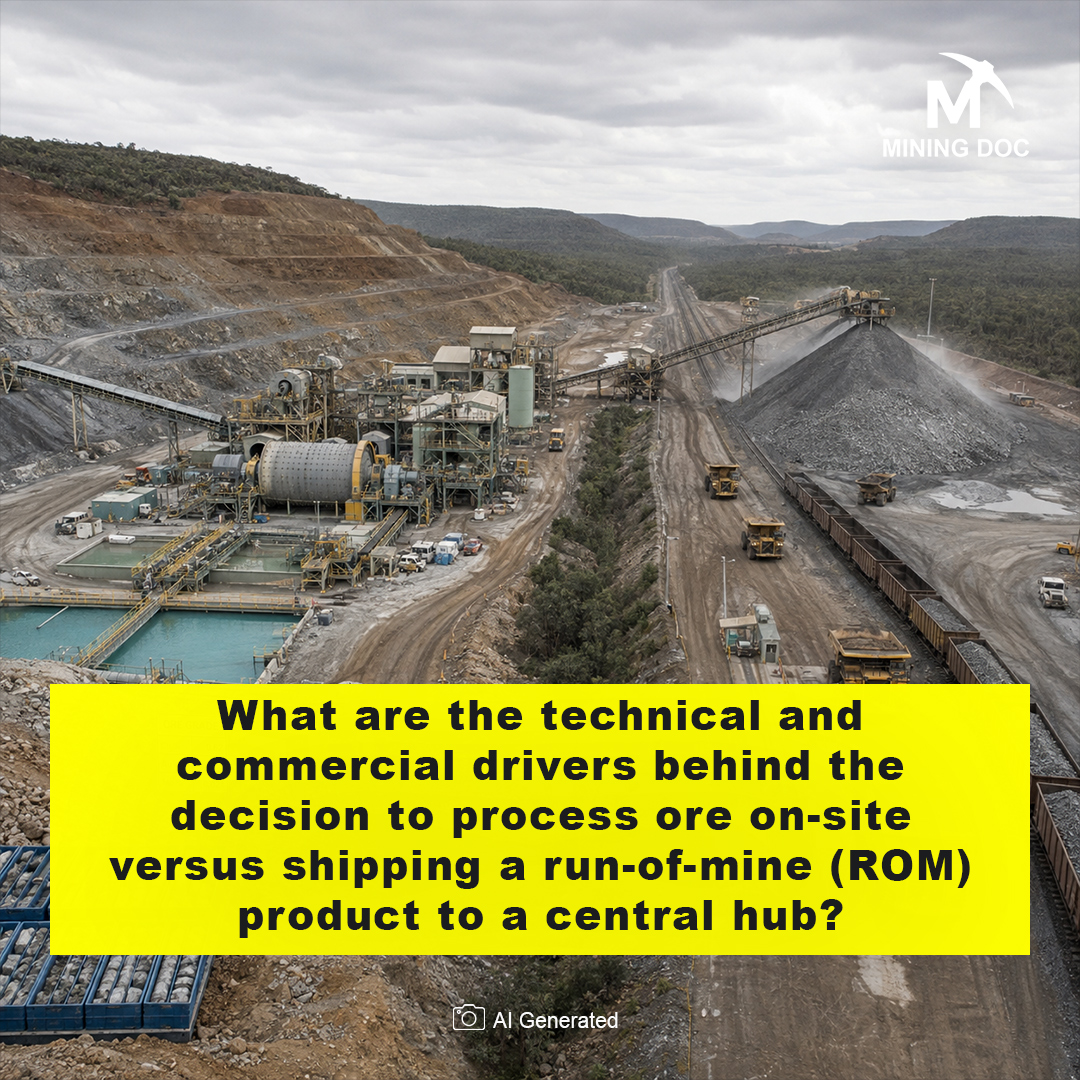
The mining industry needs some definitions in order to optimize its supply chain. Run of Mine (ROM) is the name of the unrefined ore that comes out of the earth in raw form; it has valuable minerals as well as the barren waste. In-situ processing includes establishing the processing plant in situ at the mining site in order to immediately process the ore. Central hub processing refers to the transport of the ROM ore to a common center.
The commercial criterion to choose the path is the compromise between the logistics and the CAPEX involved. It is costly to transport bulk ROM ore because huge masses of waste have to be transported for a considerable distance. However, it is expensive to establish the customized processing plants at each of the mining sites. The solution to that problem is the establishment of the central hub because it will allow cost benefits due to economies of scale (Wilson et al., 2022).
Technically, grade determines transportation feasibility. Low-grade ores have too much waste to make hauling of raw ores viable over distances. For that reason, the process of intermediate pre-concentration is employed by mine operators. Using sensor-based ore sorting while transporting ROM allows discarding barren material early, reducing transportation mass and increasing effectiveness of central mills (Robben & Wotruba, 2019).
Another technical consideration is infrastructure limitation. Ore processing requires considerable volumes of water, a functioning power network, and tailing dumps capable of operating within environmental safety regulations. If there is no access to the electricity grid and water sources in a remote location, processing of the ore becomes technically unfeasible. It becomes necessary to transport raw materials to the centralized processing facility located close to industrial infrastructure.
Moreover, the mine life expectancy greatly influences such business decisions. It is simply not worth investing a huge sum of money into a local mine mill if the mine has only a limited life. The central hub solves the issue through using feedstock from several satellite mines which have short lifespans but ensure long-term operation of the plant.
In conclusion, the decision regarding processing or transportation of materials to the central hub is quite a complex task for companies. It requires them to consider logistics costs along with capital costs, taking into account the existing restrictions on the infrastructure at each particular site. In addition, as the technology changes, hybrid methods are being used more often.
References
Robben, C., & Wotruba, H. (2019). Sensor-Based Ore Sorting Technology in Mining—Past, Present and Future. Minerals, 9, 523. https://doi.org/10.3390/min9090523
Wilson, R., Mercier, P. H. J., & Navarra, A. (2022). Integrated Artificial Neural Network and Discrete Event Simulation Framework for Regional Development of Refractory Gold Systems. Mining, 2, 123-154. https://doi.org/10.3390/mining2010008