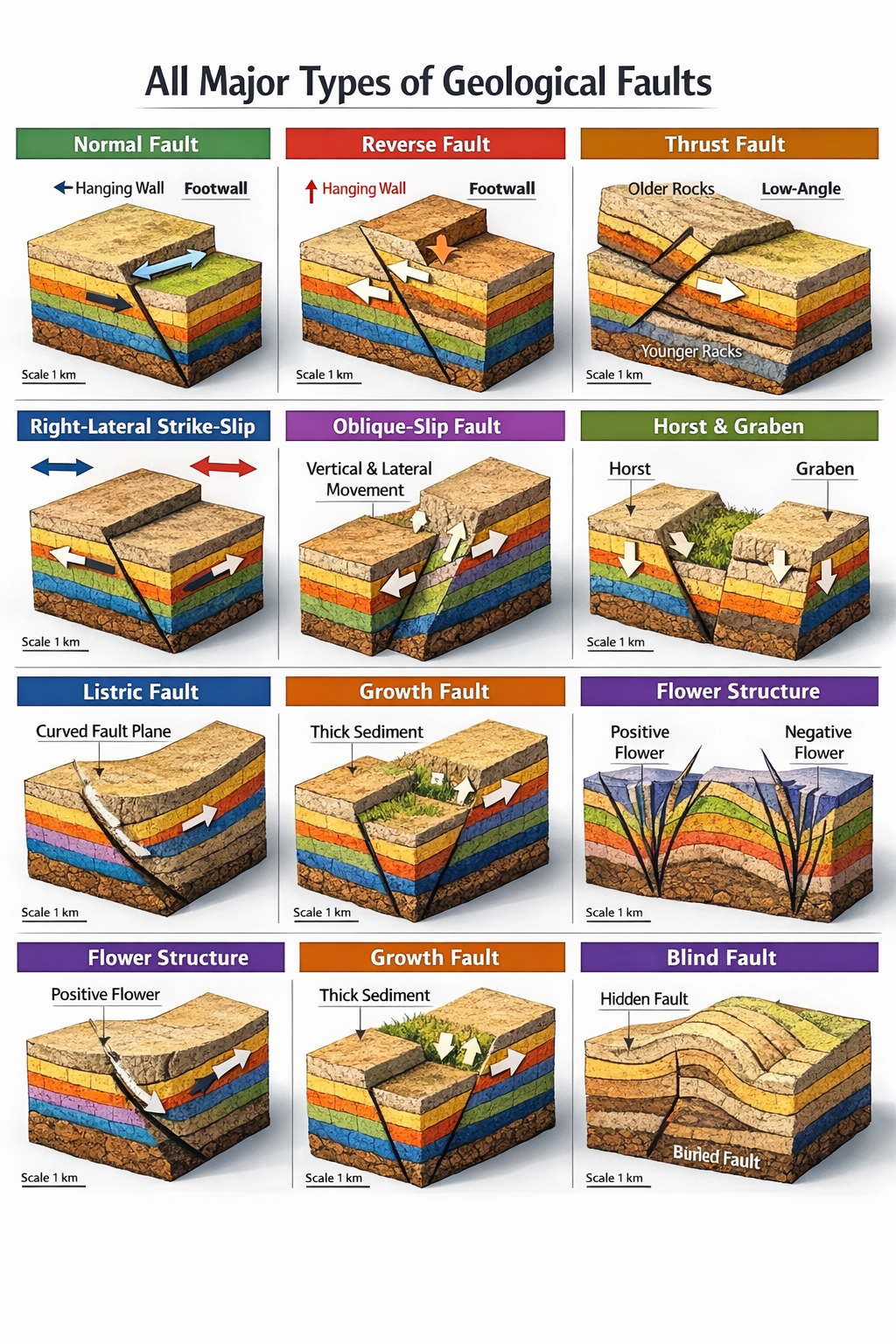
A geological fault is a planar fracture or discontinuity in rock where significant displacement has occurred. Faults form due to tectonic stresses within the Earth’s crust and are classified by the direction of movement along the fault plane. Let’s describe the different types of geological faults.
Normal fault
Normally, normal faults are caused by tensional stress. They are faults where the hanging wall is pushed downwards in relation to the footwall. Normal faults are normally observed in areas where the earth’s crust is being pulled apart. An example is the Rift Valley in East Africa.
Reverse fault
Caused by compressional stress, reverse faults are faults where the hanging wall is pushed up relative to the footwall. Reverse faults are located at convergent plate boundaries and are responsible for the creation of mountain ranges such as the Himalayas and the Rockies.
Thrust fault
A variant of the reverse fault with a low angle, less than 45°, thrust faults enable older rocks to move over younger rocks over long horizontal distances. These are characteristic of orogenic belts, which are regions of intense mountain-building activity.
Strike-slip fault
In this type of fault, movement is largely horizontal. The blocks involved tend to slide past each other. The famous fault of this kind is the San Andreas Fault, California. Strike-slip faults are further of two types: right-lateral (dextral) and left-lateral (sinistral).
Oblique slip fault
An oblique slip fault has both dip slip and strike slip movements at the same time. It is neither a pure dip slip nor a pure strike slip fault, as the net result of the movements is a raking motion along the fault plane. Such faults occur in environments characterized by a non-horizontal stress field, in which the stress axes are tilted in relation to the fault surface, or in faults that are reactivated in a non-horizontal stress field. Oblique slip faults are very common in nature, and pure strike slip or dip slip faults are relatively rare.
Horst & Graben
A horst is a block that has been raised up by faults on both sides, while a graben is the block that has been lowered by faults on both sides. These two features always go together in conjugate pairs. It is not possible to have one without the other. The most spectacular example of this feature is found in the Basin and Range Province of western North America, where the entire crust has been stretched out and thinned so that there are mountain ranges (horsts) alternating with desert valleys (grabens) in Nevada, Arizona, and Mexico.
Listric fault
A listric fault is a type of normal fault with a unique geometry, described as concave upwards. This fault type dips steeply close to the surface but becomes less steep with depth, eventually becoming sub-horizontal as it joins a décollement plane. The geometry of the listric fault has significant implications. The hanging wall does not simply translate down and out along the curved fault plane as the fault moves, as it would if the fault were planar. It rotates and deforms internally as it moves down and out along the curved fault plane, resulting in a rollover anticline in the hanging wall.
Growth fault
A growth fault is also known as a synsedimentary fault or syn-depositional fault and is defined as a normal fault that was still actively moving at the same time as the deposition of the rock units in the hanging wall basin. The key identification factor of this type of fault is the thicker strata found in the hanging wall than in the footwall because the hanging wall is still subsiding and therefore always fills up with rock units.
Flower structure (positive & negative)
Flower structures are developed in strike-slip fault systems, which are also known as transcurrent fault systems, where a vertical fault at depth branches into several faults at shallower depths, forming a fan-like structure, hence the name flower structure.
A positive flower structure is developed in a transgressional environment, i.e., an environment with strike-slip motion accompanied by compression. In this case, the fault strands splay outwards and upwards, forming a core that is pushed upwards, forming a ridge.
On the other hand, the negative flower structure, which is also known as the tulip structure, is developed in an environment with transtension, i.e., an environment with strike-slip motion accompanied by extension. In this case, the fault strands splay outwards and downwards, forming a core that has been pulled down, forming a basin.
Blind fault
A blind fault is one which never actually breaks the Earth’s surface but instead dies out at depth with its tip buried beneath un-faulted layers of sedimentary rock. Rather than having the surface expression of a fault or scarp, the blind fault is characterized by the surface expression of folding of the overlying rock as this rock must accommodate the slip by bending or buckling. This is known as a fault propagation fold or fault bend fold.