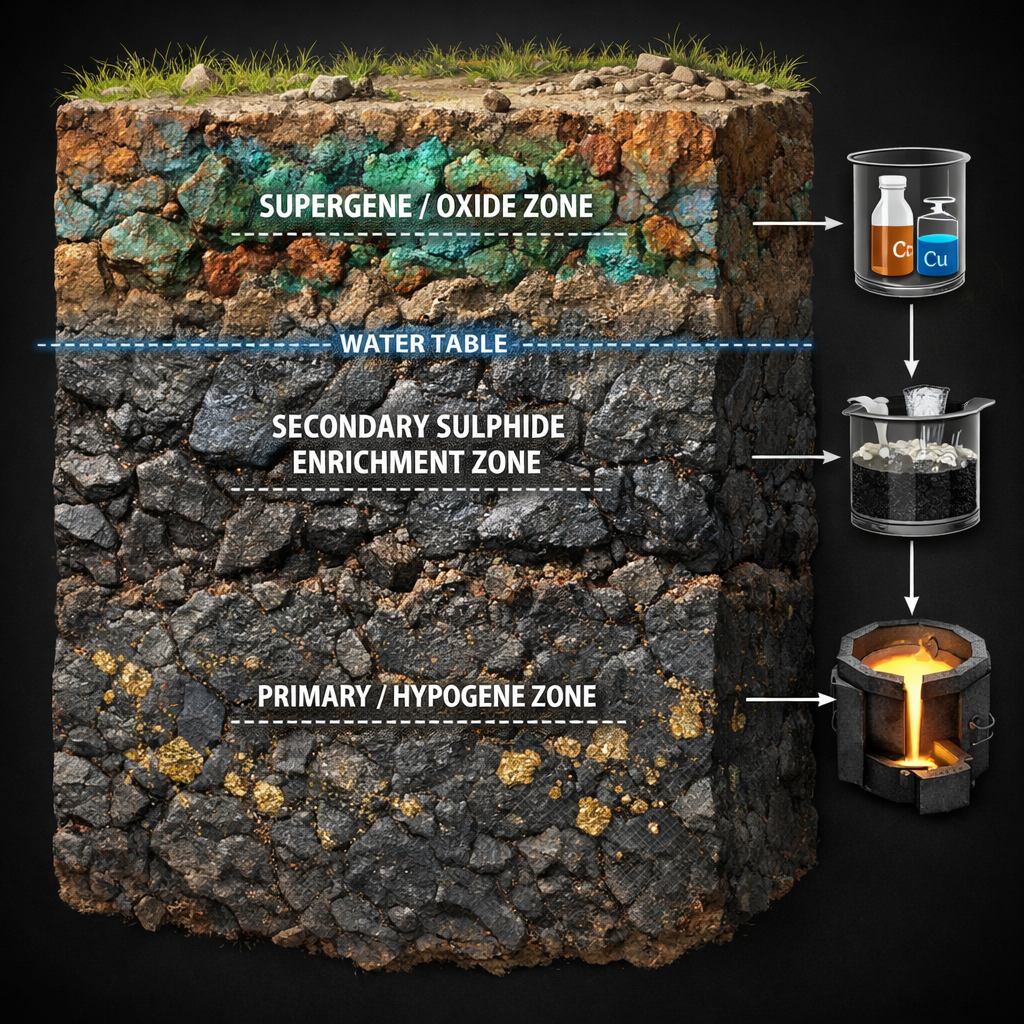
The primary stage of mineralization is an early stage of ore formation due to the rising of hot aqueous fluids deep underground and results in the formation of hypogene ore minerals. The secondary mineralization is a subsequent stage wherein the earlier formed ore minerals are subjected to alteration and redeposit by fluid circulation closer to the surface; this is often referred to as supergene mineralization or supergene enrichment.
Simply put, primary ore refers to unaltered deposits containing mostly sulfide compounds of the primary minerals, such as chalcopyrite, pyrite, sphalerite, and galena, among other similar minerals. Secondary ore formation involves the reformation of minerals through chemical processes, resulting in different ores, like chalcocite, covellite, bornite, malachite, azurite, cerussite, and anglesite.
Supergene mineralisation normally occurs in a weathering profile situated above and adjacent to the water table level. Oxygenated water oxidises sulfides at the upper horizon, liberates metal ions that migrate downward until reduction conditions occur, allowing precipitation in the enriched horizon below the oxidation horizon. The enriched horizon is significantly enriched with payable metal content compared to the initial ore because of metal enrichment in a small horizon from the larger rock mass.
Primary mineralisation versus supergene mineralisation is significant because of their distinct behaviour in processing operations. Primary sulfides may be processed using conventional crushing, grinding, and froth flotation techniques, while supergene minerals such as oxides and enriched sulfides may be subjected to heap leaching, among other processes. In the case of copper, oxide minerals and enriched minerals in some cases may be readily processed through leaching techniques.
Processing control depends on mineralogy rather than on grade. If secondary minerals increase the grade, liberate the ore, or make it more leachable, they increase recoveries. However, secondary minerals can also affect adversely the processing of an ore by making it mixed oxide-sulfide or metallurgically complex because of supergene oxidation despite its upgrade. Thus, special procedures will have to be adopted for such deposits, including special treatment routes or blending operations.
To sum up, while primary mineralization refers to the original ore formation at the depths below surface, supergene mineralization is referred to as near-surface mineralization caused by weathering or groundwater action. It should also be mentioned that primary ores are usually treated via sulfide processing, whereas supergene ores are more valuable for processing by leaching.