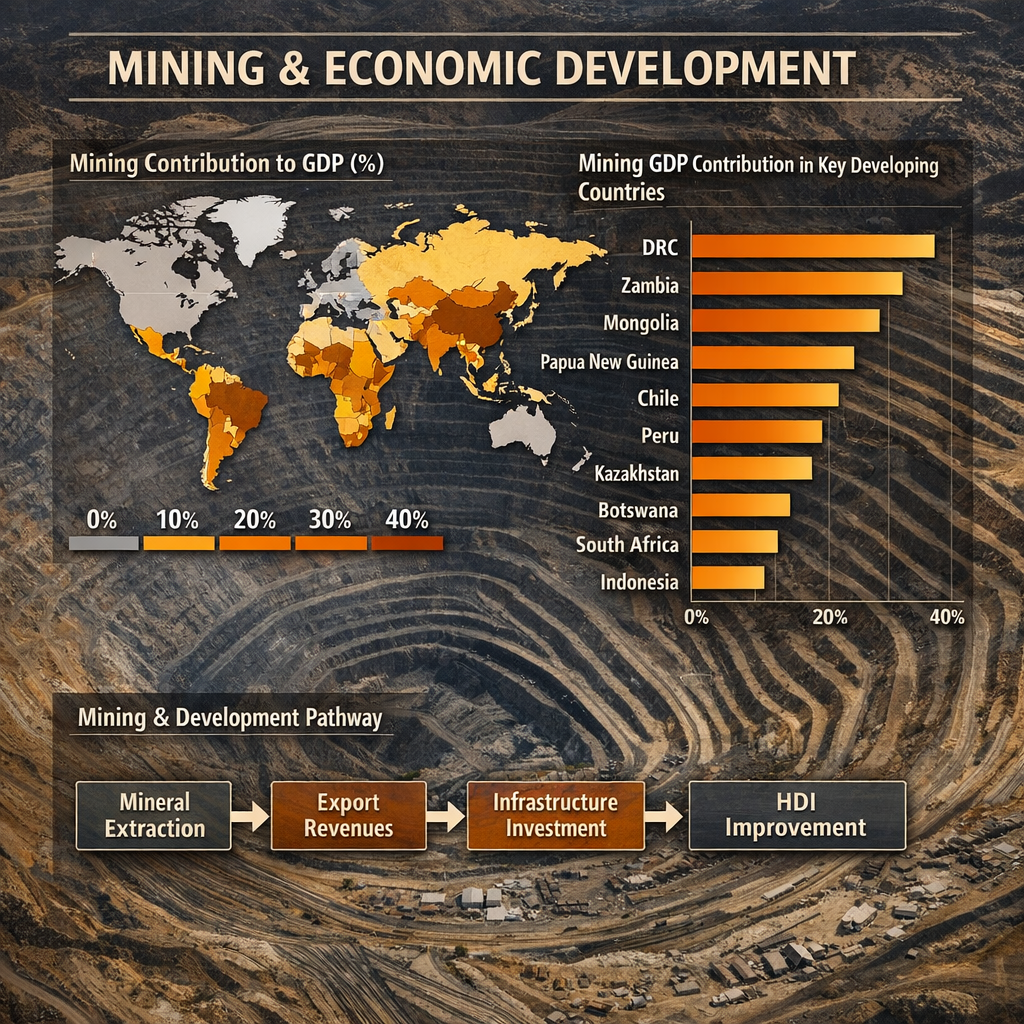
Mining sector’s direct contribution to the global gross domestic product is usually reported in low single digits or low double digits of global GDP, but its actual proportion is determined by whether the calculation only considers mining itself or mining in combination with other related sectors. One report in the mining industry claimed that the direct contribution of the global mining sector was around 6.9 percent of global GDP in 2019, and according to a World Bank report, the actual impact of mining on GDP is much higher if all related economic activities were considered.
The reason why the GDP shares are different is that many statistical measurements do not take into consideration the fact that economic activities extend beyond the mine gate after extraction occurs since the value chain extends well past that point. According to the World Bank report, mining’s real contribution cannot be observed in normal GDP calculations since much of the value of mining activities falls into the category of manufacturing and other economic sectors instead of mining.
Mining is essential for developing nations due to its potential contribution of foreign exchange income, taxation, royalties, and exports, which tend to be scarce within economies with small tax bases and narrow industrialization. According to the World Bank, the proper development of the mineral sector will contribute to the stimulation of depressed areas, increase technical skills, and serve as a seed for wider economic development. In several developing and middle-income nations, it has been observed that mineral-based economic growth contributes to human development, provided there exist adequate linkages and collaboration between the private and public sectors.
Mining may help with employment in extraction activities and indirectly with procurement, infrastructure, maintenance, transportation, and other local services. As per the World Bank’s socioeconomic study, mining employment was extremely high in several sample countries with well-developed linkages even before considering multiplier and fiscal impacts. It is pertinent to note that for developing economies, employment alone is inadequate; it is also necessary for the economy to have sufficient domestic linkages and skill generation.
Projects in mining may justify investments in roads, ports, power transmission lines, railroads, and water supplies that can also support agriculture, manufacturing industries, and settlements. According to the World Bank, the effect of mining becomes much more pronounced where there is positive infrastructure development and strong links between mining and other industries, including domestic sourcing. It is because of these reasons that mining can help promote diversification rather than merely generating exports.
However, this does not mean that mining itself is always a good thing, as mining projects can result in little backward linkage and rely on imports for their needs, exposing their host economies to commodity price shocks. The World Bank argues that mineral exporting projects had become less integrated into host economies than global markets. Besides, there is a lot of discussion in international literature that commodity price instability and significant investment needs can result in unbalanced growth cycles.
For developing countries, the crux of the matter is not whether mining takes place, but how successful their government is in capturing and recycling the gains. Typically, good results hinge on mining regulations, revenue handling practices, environmental considerations, localization strategies, and investment in infrastructure, education, and industries. Once this is achieved, mining will yield much more than what its GDP contribution might suggest.