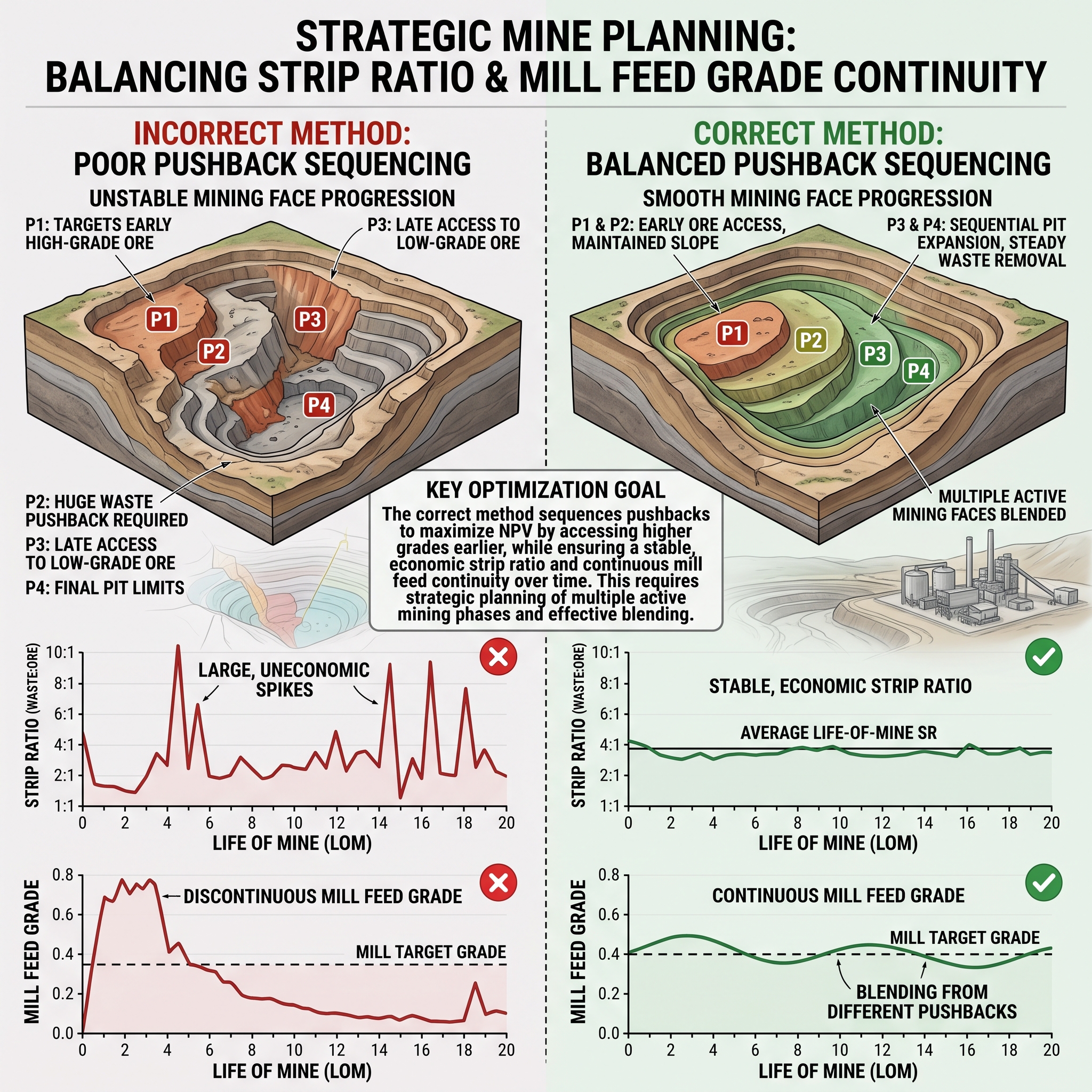
In open-pit mining, the economic feasibility is dependent on the extraction strategy, which is achieved through an optimal pushback design. A pushback or a phase is an extraction strategy that breaks down the ultimate pit to manageable units and regulates the production of both ore and waste (Consuegra & Dimitrakopoulos, 2010). Strip ratio is the quantity of waste that has to be stripped to gain access to one unit of the ore. Meanwhile, mill feed grade continuity refers to providing a continuous flow of high-quality ore blend to the processing plant. The problem of mine scheduling involves balancing the strip ratio with grade continuity.
The conflict between the two metrics is due to the physical nature of the orebody. For instance, in order to gain quick access to high-grade ores and maximize cash flows, there is a tendency of ignoring the stripping of waste materials initially. Ignoring the strip ratio initially would result in unsafe and steep pit slopes and, consequently, would require extensive stripping campaigns to be conducted later resulting in shortage of ore supply for the mill plant. The optimal pushback strategy should focus on balancing waste removal throughout the life of the mine and avoiding big variations in the mill-grade supply.
Traditionally, deterministic algorithms were used to create nested pits, which are then assembled into pushbacks. Although useful in many respects, these methods do not satisfy production goals or estimate NPV since they are built on a single static estimation of the orebody (Consuegra & Dimitrakopoulos, 2010). Since deterministic approaches ignore geological uncertainties, there are great chances for variations in mineral and grade composition of the orebody and, therefore, disturbance in mill feed continuity and unplanned waste stripping.
Stochastic integer programming (SIP) is the appropriate and economically efficient technique of sequencing pushbacks. Stochastic approach incorporates geostatistical simulations to incorporate geological uncertainties and thus, to analyze the different spatial configurations of the orebody (Goodfellow & Dimitrakopoulos, 2013). Evaluating the behavior of the sequence in all possible geological scenarios, stochastic optimization would minimize the risk of missing production goals and maintaining the strip ratio under the capabilities of existing machinery.
The implementation of the stochastic approach requires integration of various sophisticated algorithms. The algorithms used to change the pushback limits, and the pushback sequence are called metaheuristics, especially simulated annealing. Such algorithms attempt to minimize the deviations from the targeted tonnages and grades across all geological scenarios (Goodfellow & Dimitrakopoulos, 2013). Besides, the modern sequencing algorithms simultaneously optimize both the sequence and ramps/roads construction to allow safe access to the ore for the processing plant (Cutler & Dimitrakopoulos, 2024).
Balance between strip ratio and continuity in mill feed grade requires complex algorithmic structure based on stochastic optimization. Mining operations gain in value and stability due to deterministic nested pits model and mathematical optimization accounting for geologic uncertainty.
References
Consuegra, F. R. A., & Dimitrakopoulos, R. (2010). Algorithmic approach to pushback design based on stochastic programming: method, application and comparisons. Mining Technology, 119, 88–101. https://doi.org/10.1179/037178410×12780655704761
Cutler, J., & Dimitrakopoulos, R. (2024). Joint stochastic optimisation of open-pit mine production scheduling with ramp design. International Journal of Mining, Reclamation and Environment, 38, 480–495. https://doi.org/10.1080/17480930.2024.2335709
Goodfellow, R., & Dimitrakopoulos, R. (2013). Algorithmic integration of geological uncertainty in pushback designs for complex multiprocess open pit mines. Mining Technology, 122, 67–77. https://doi.org/10.1179/147490013×13639459465736