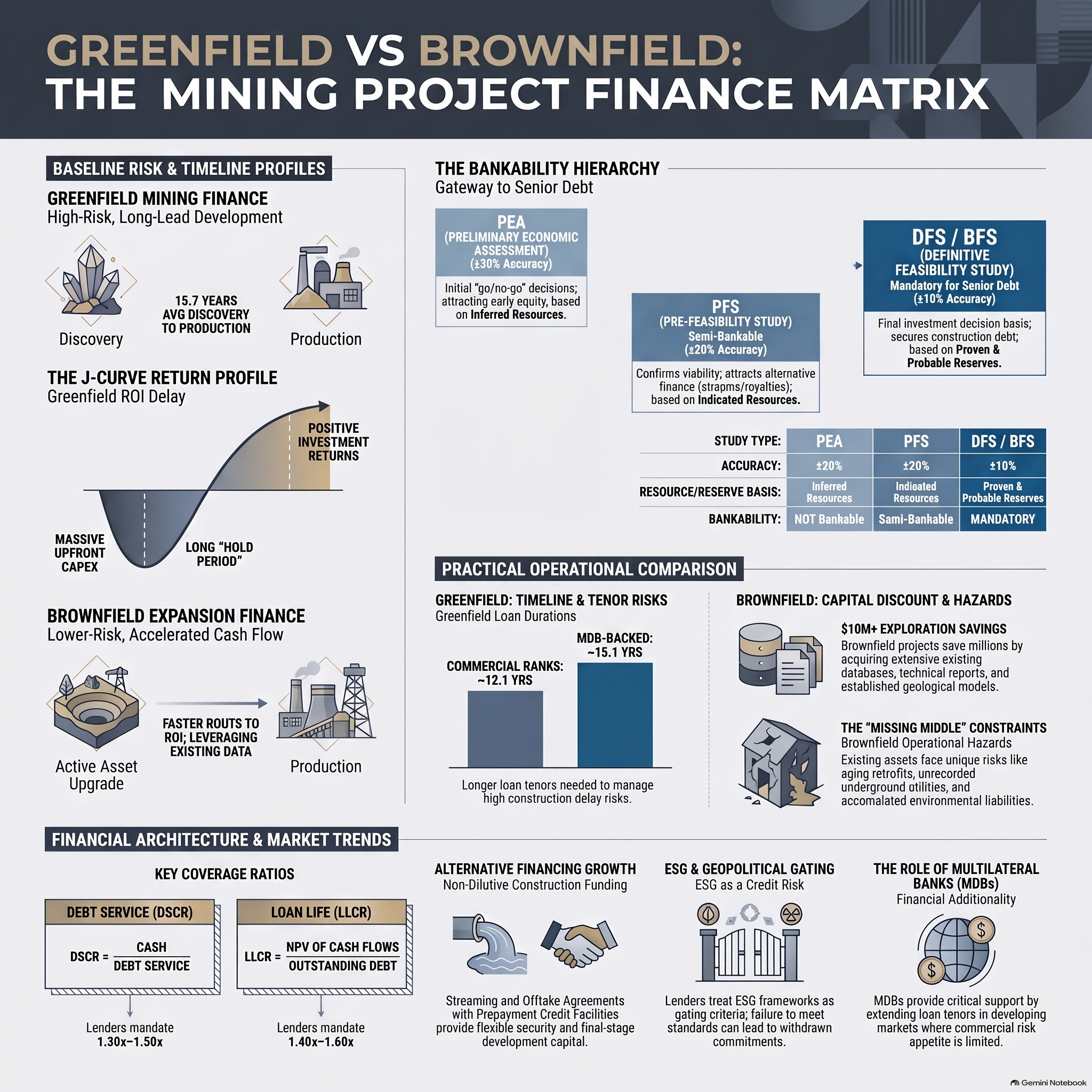
The demand for minerals across the globe has led to a choice of either greenfields or brownfields by mining companies as one of their primary strategies. Greenfield projects in mining consist of developing entirely new extraction and processing facilities, while brownfield projects consist of developing existing facilities further through upgrading them. Recent industry trends show that major mining companies spend more than sixty percent of the total exploration budget on brownfields as compared to only twenty-nine percent in 2016. It is due to a strategy which involves protecting oneself from any financial or other risks associated with mining operations. Greenfield developments have a great deal of volume potential; however, it comes with a lot of cost associated with it. Brownfield development allows for quicker achievement of revenue stream, although with various environmental risks.
Risk assessments for operations and geology are clearly differentiated between greenfield mines and brownfield plants that expand operations. Greenfield projects follow a typical J-curve cash flow, which necessitates significant investments before earning any income from the project. The developer of the project faces a high degree of uncertainty associated with construction, land purchase, and permitting, since there is no previous operational experience. Conversely, brownfield operations benefit from geological knowledge and experience, existing processing plants, and metallurgy information, where the existing base makes technical uncertainties and upfront investment significantly lower. However, expansion of brownfields brings its own physical risks in the form of ore dilution in underground stopes, equipment wear, and more difficult waste management. Furthermore, mine expansion projects continue under low media attention while being operated, an approach called “the missing middle” despite social and environmental problems emerging in the process.
The stacking of capital for a particular project is in accordance with its development level and inherent risks associated. Exploration during the early stages of a greenfield project is in the high-risk “Valley of Death” where the developer relies on high-cost equity financing, flow-through shares, or private placements. Debt financing is made possible for greenfield projects only after thorough technical feasibility studies have been done and offtake contracts have been signed. Brownfield expansion projects can access structured debt and commercial banking facilities much more easily since production exists and acts as collateral. There is the utilization of alternative forms of financing by financiers for brownfield projects. These include net smelter return royalties, streams, and offtake prepayments. Moreover, the BOAT approach can be used for non-core infrastructure to get off-balance-sheet financing for the project.
There are strict bankability criteria observed by the lenders that influence the availability of loans and conditions on different typologies of projects. For greenfield projects, senior lenders insist on having a Definitive Feasibility Study (DFS) for which the cost estimates need to be highly accurate, the reserves of minerals should exist, and governance systems must be in place. Loan tenors for greenfield projects are limited in commercial banks due to the existence of construction and political risks associated with such projects in developing regions. The key contribution is made by MDBs and DFIs through the provision of long-term loans, political risk insurance, and blended finance arrangements to facilitate the availability of project debt from the private sector. On the contrary, brownfield projects have stable income sources that allow for longer loan tenors and lower margins from commercial banks.
The developers and financial institutions have different trade-offs in evaluating the greenfield investments as compared to brownfield investments. While greenfield investments have transformational capacity for increasing supply and are characterized by long-life assets, they need high levels of equity cushioning, long lead times, and are very bankable. Brownfield investments offer quick ways of making money and less capital intensive due to availability of the site facilities, but they call for good management of old facilities as well as the cumulative environmental impact. The allocation of funds should match the investment mix comprising of equity, senior debt, and alternatives, with the particular development stage and geological profile of the mining resource.