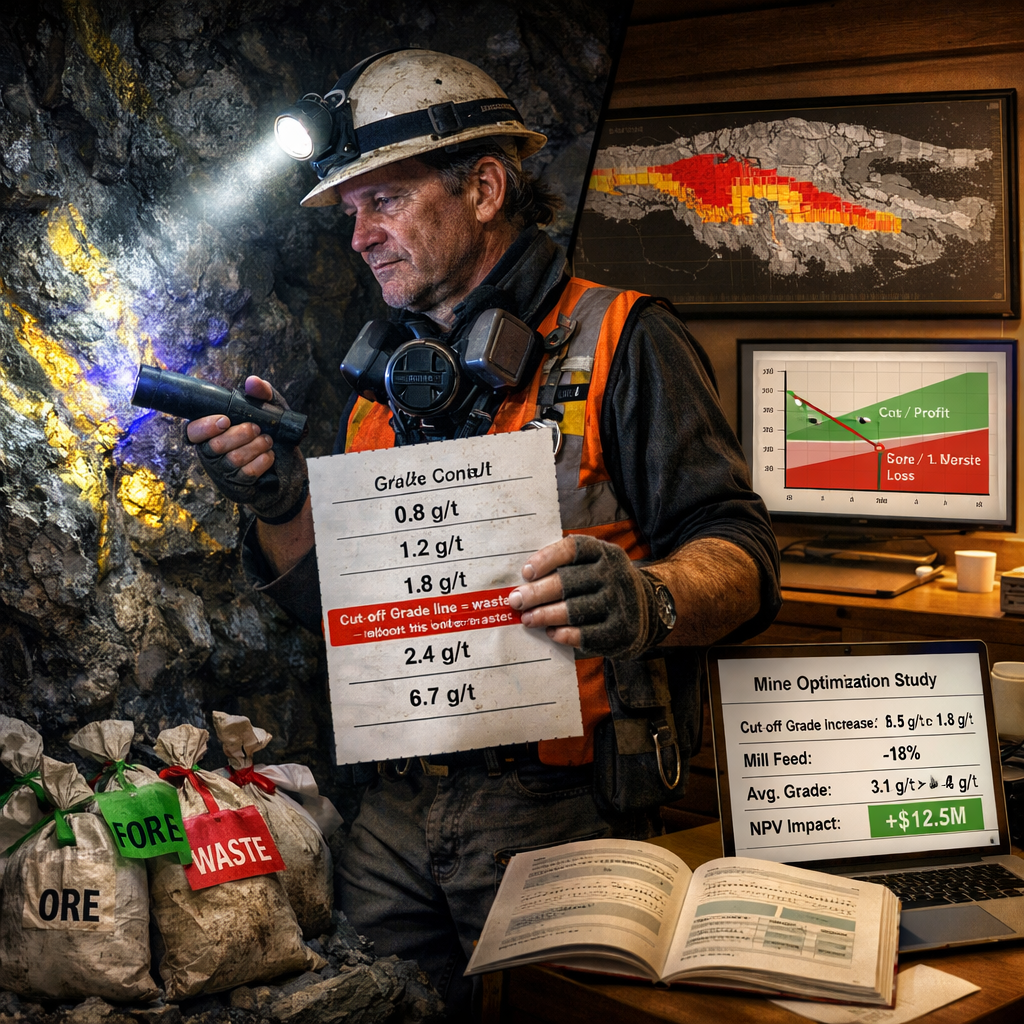
One of the most important factors in mine planning that directly determines a project’s economic viability is the cut-off grade, or the threshold that distinguishes ore from trash. According to recent research, it is a dynamic lever that needs to be managed to maximize Net Present Value (NPV) in reaction to operational restrictions and market conditions rather than being a static statistic.
At its core, the cut-off grade determines the flow of material through the mining supply chain. A block of material is classified as ore only if its grade exceeds the cut-off, promising to generate profit after covering mining, processing, and refining costs (Khan & Asad, 2021). This classification directly impacts the size of the mineral reserve; lowering the cut-off grade can transform what was once waste into economically viable ore, thereby increasing the resource base and extending mine life (Khalifi et al., 2025).
The primary goal of cut-off grade optimization is to maximize NPV. Studies consistently demonstrate that moving beyond simple break-even calculations yields substantial financial benefits. For instance, implementing an optimized cut-off grade policy at a base metals operation was shown to unlock over $1.0 billion in NPV (AMC Consultants, 2023). Similarly, an iterative optimization algorithm applied to a gold mining project increased NPV by 40% while simultaneously reducing the mine life from 23 to 16 years, proving that a higher-grade, shorter mine life can be more profitable than a longer, lower-grade one (Nieto & Muncher, 2021).
Furthermore, the cut-off grade is not independent of processing capacity. Balci & Kumral (2024) highlight the critical interdependence between cut-off grade selection and capacity planning, showing that economies of scale and the distribution of grade within the deposit are vital consideration. A flexible strategy might involve lowering the cut-off in the short term to utilize spare processing capacity, then raising it later when the operation is at full capacity to ensure only the highest-grade material is processed.
Contemporary research expands the cut-off grade model to include new variables. The integration of pre-concentration systems, for example, allows for a lower cut-off grade by rejecting waste early, leading to significant increases in both resource utilization and NPV (Mousavi, 2020). Additionally, external factors are becoming increasingly relevant. Rijsdijk & Nehring (2022) demonstrated that introducing a carbon price can increase operating costs, which in turn necessitates a change in the cut-off grade to maintain economic viability. Grade estimation uncertainty also plays a role, with Birch (2022) noting that adjusting the cut-off grade downwards by up to 22% can optimize profit when accounting for the risk of misclassifying ore as waste.
To sum up, the cut-off grade is an effective tactical instrument. It has a significant impact on mine economics, influencing anything from daily material routing to an operation’s multibillion-dollar long-term value.
References
Balci, M., & Kumral, M. (2024). Impacts of Grade Distribution and Economies of Scale on Cut-off Grade and Capacity Planning. Mining, Metallurgy & Exploration, 41(3), 1171–1193. https://doi.org/10.1007/s42461-024-00982-8
Base Metals Cut-Off Grade Strategy Case Study. (2023, October 30). https://www.amcconsultants.com/vale-base-metals-cut-off-grade-strategy-case-study
Birch, C. C. (2022). Optimizing cut-off grade considering grade estimation uncertainty—A case study of Witwatersrand gold-producing areas. Journal of the Southern African Institute of Mining and Metallurgy, 122(7), 337–346. https://doi.org/10.17159/2411-9717/1403/2022
Khalifi, H., Elghali, A., Taha, Y., & Benzaazoua, M. (2025). A mathematical model for optimizing cut-off grade and stockpiling policies in open pit mines with grade engineering. Resources Policy, 109, 105716. https://doi.org/10.1016/j.resourpol.2025.105716
Khan, A., & Asad, M. W. A. (2021). A mixed integer programming based cut-off grade model for open-pit mining of complex poly-metallic resources. Resources Policy, 72, 102076. https://doi.org/10.1016/j.resourpol.2021.102076
Mousavi, F. S., M. Nehring, M. Kizil, P. Knights, A. (2020, November 10). A new cut-off grade method to maximise resource utilisation of underground metalliferous mining operations. OneMine. https://www.onemine.org/documents/a-new-cut-off-grade-method-to-maximise-resource-utilisation-of-underground-metalliferous-mining-operations
Nieto, A., & Muncher, B. (2021). An applied economic assessment and value maximisation of a mining operation based on an iterative cut-off grade optimisation algorithm. International Journal of Mining and Mineral Engineering, 12(4), 309. https://doi.org/10.1504/IJMME.2021.121330
Rijsdijk, T., & Nehring, M. (2022). The effect of carbon pricing on cut-off grade and optimal pit limits in a high grade copper-cobalt deposit. Journal of Cleaner Production, 356. https://agris.fao.org/search/en/records/65de2d3d63b8185d9ca75fb1