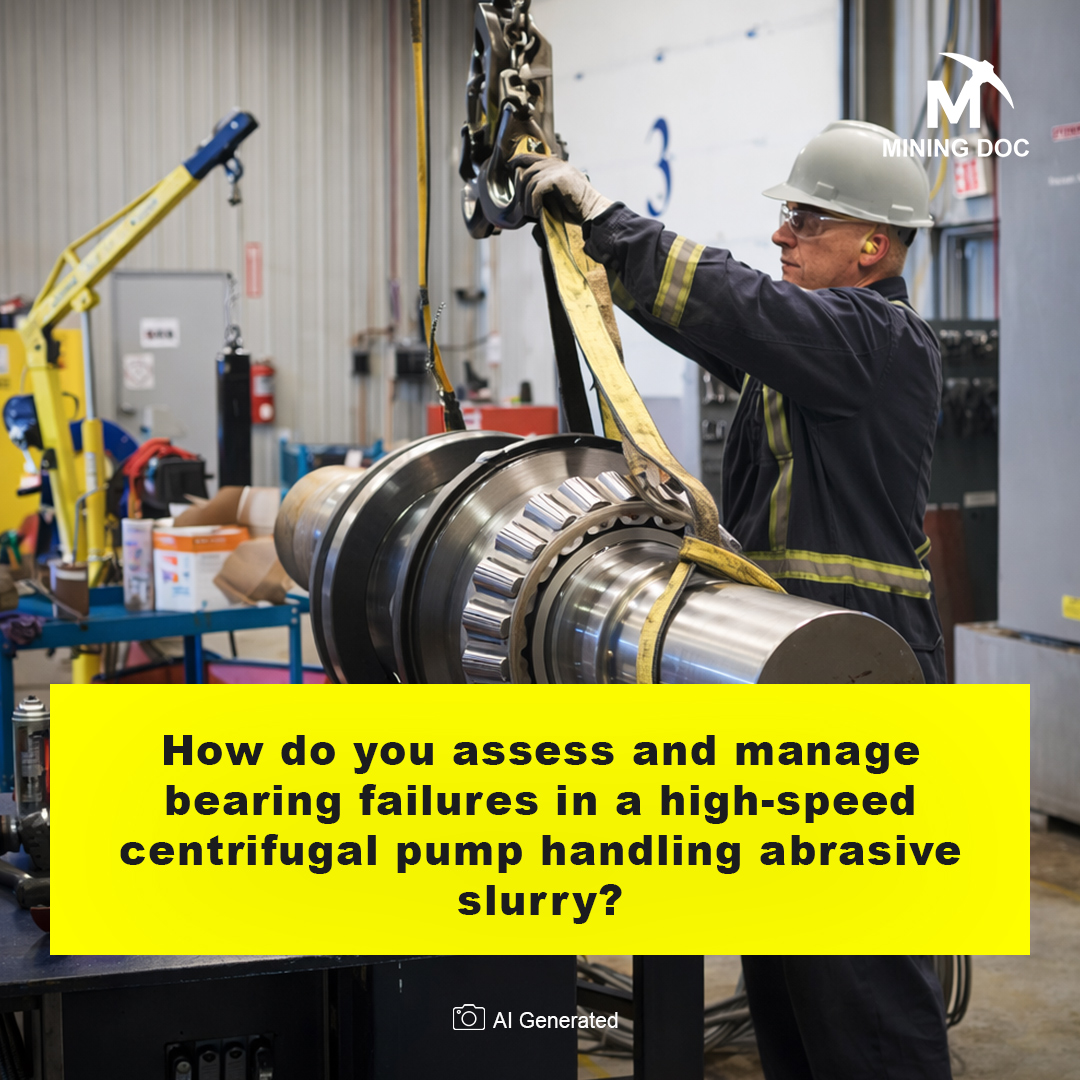
Abrasive slurry high-speed centrifugal pump is used for fluid transfer of fluid containing large amounts of solid particles. Within the current framework, abrasive slurry leads to an increase in the rate of component damage due to hydro abrasive wear. The destruction of the bearings is caused by the loss of their working capacity due to increased mechanical loading, contamination, or material fatigue. An adequate knowledge of the discussed fundamentals is critically important for the maintenance of equipment reliability in harsh working conditions.
The process of pumping abrasive slurry is inherently harmful to the integrity of the whole system. The hydro abrasive wear causes uneven degradation of the impeller, which results in significant imbalance on the drive shaft, and the generated dynamic load and low-frequency oscillations affect the bearing assemblies (Aleksandrov & Avksentiev, 2016). Increased radial and axial loads lead to increased fatigue and rapid wear of the bearing rolling elements.
The proper way to diagnose bearing health relies entirely on condition monitoring approaches. Condition monitoring through vibration diagnosis is used mainly to detect any physical faults such as dynamic unbalance and certain raceway defects in bearings before a major breakdown occurs (Aleksandrov & Avksentiev, 2016). In addition, modern approaches based on artificial intelligence such as artificial neural networks and machine learning classifiers are also widely used for recognizing vibration patterns during fault diagnosis (Akangah & Wang, 2007). All these systems allow diagnosing mechanical degradation at an early stage of operation by mathematical calculations.
The solution to such issues requires a transition from corrective to preventive maintenance. In the current situation, the main emphasis should be placed on condition-based maintenance, when the life expectancy of the bearing is estimated according to the diagnostics’ outcome (Mandelli et al., 2023). The difference between the total number of hours used and the estimated time of failure can help determine the timing of carrying out maintenance. This will prevent mechanical breakdowns caused by the destruction of bearings.
The practical management of the system should include strict control and isolation from the environment. Because the ingress of the abrasive particles has an extremely negative impact on moving elements, the use of the latest sealing techniques will ensure that the lubricant for the bearings remains absolutely clean. At the same time, operating the pump close to its best efficiency point reduces hydraulic turbulence and shaft deflection inside the unit. It is essential to minimize such deflections since they increase the mechanical load on the bearings exponentially. The proper alignment and lubrication of the equipment will help mitigate these destructive factors.
The protection of the centrifugal slurry pumps against bearing failures is dependent on a good understanding of the phenomena involved in the hydro-abrasive wear and its effects mechanically on the equipment. Through the use of modern techniques for condition monitoring, industries are able to identify bearing failures in advance before they result in process interruption (Akangah & Wang, 2007).
References
Akangah, P., & Wang, K. (2007). Intelligent condition monitoring of rotating machinery. Journal of Science and Technology (Ghana), 26. https://doi.org/10.4314/just.v26i3.69757
Aleksandrov, V. I., & Avksentiev, S. Y. (2016). Vibration-based Diagnostics of Slurry Pump Technical State. Indian Journal of Science and Technology, 9. https://doi.org/10.17485/ijst/2016/v9i5/87590
Mandelli, D., Wang, C., & Hess, S. (2023). On the Language of Reliability: A System Engineer Perspective. Nuclear Technology, 209, 1637–1652. https://doi.org/10.1080/00295450.2022.2143210