Sign In


Forgot Password?

Don't have account, Sign Up Here

Forgot Password

Lost your password? Please enter your email address. You will receive a link and will create a new password via email.


Have an account? Sign In Now

Sorry, you do not have permission to Add a Post, You must login to Add a Post.


Forgot Password?

Need An Account, Sign Up Here

Sorry, you do not have permission to add Article.


Forgot Password?

Need An Account, Sign Up Here

Please briefly explain why you feel this Post should be reported.

Please briefly explain why you feel this Comment should be reported.

Please briefly explain why you feel this user should be reported.

Mining Doc Logo Mining Doc Logo Mining Doc Logo
Sign InSign Up

Mining Doc

Mining Doc Navigation

  • Home
    • About
    • Contact us
  • Mining articles
  • Online Courses
Search
Sign up

Mobile menu

Close
join for free
  • Home
  • Online courses
  • Case study
  • Mining Community
  • Solutions listing
    • Lase Solutions
    • O-PitBlast Solutions
    • Continuous Mining
    • Longwall mining
    • Geosight Scanners
    • LoopX AI
    • Terafil solutions
    • Blasting solutions
    • Geotechnical
    • Submersible Pumps
    • Mine rescue system
    • Ore sorting
    • Whittle Consulting Solutions
  • Add Blog
  • Feed
  • User Profile
  • Posts
    • New Posts
    • Trending Posts
    • Must read Posts
    • Hot Posts
  • Polls
  • Badges
  • Home
    • About
    • Contact us
  • Mining articles
  • Online Courses

Mining Doc Latest Posts

Mining Doc
  • 0
  • 0
Mining DocTeacher
Added: May 19, 20262026-05-19T06:29:11-04:00 2026-05-19T06:29:11-04:00In: Fixed Plant

How are fixed plants being decarbonized?

  • 0
  • 0

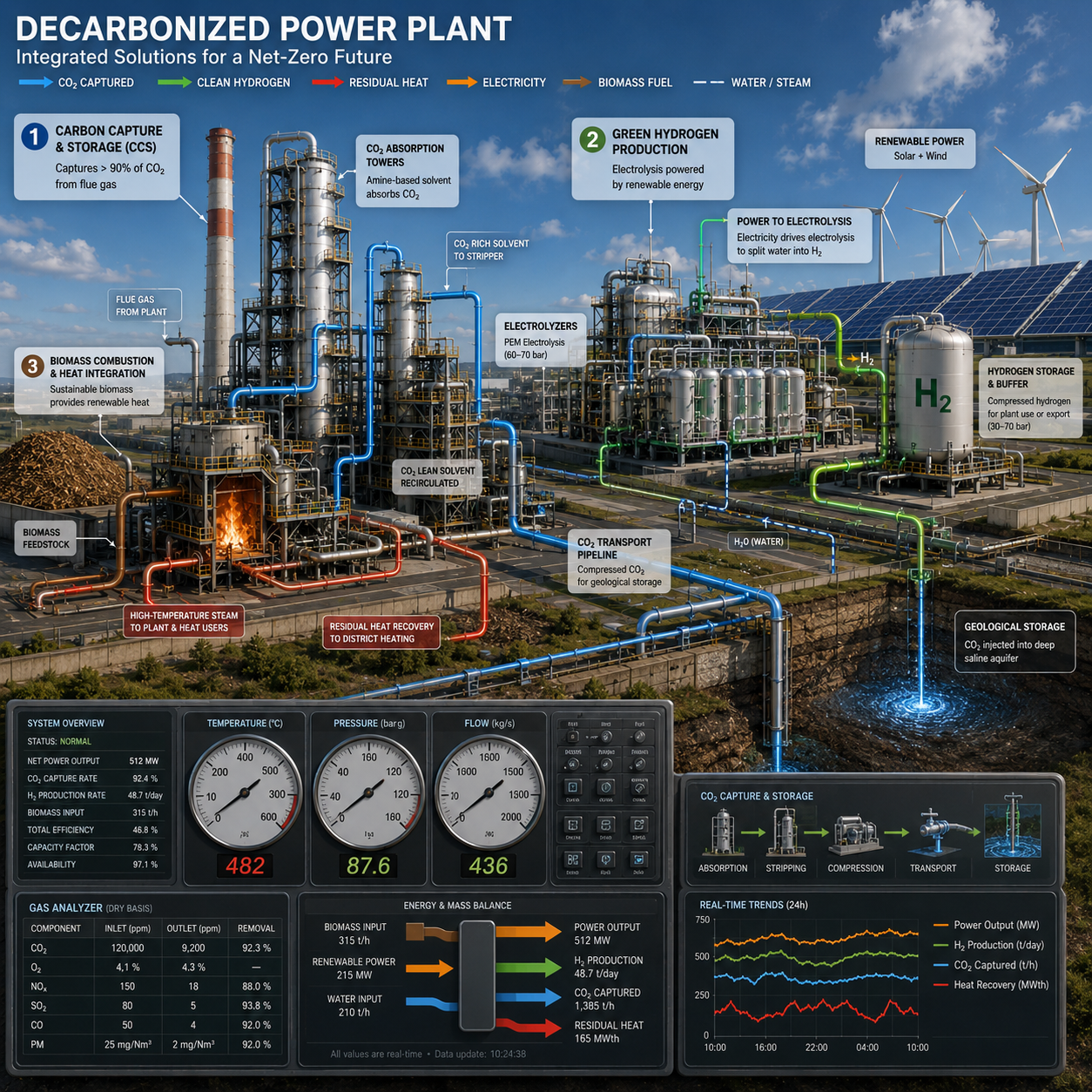
Decarbonization of stationary or fixed industrial plants involves a range of actions combining energy efficiency, fuel-switching (electrification and low-carbon fuels), carbon capture and storage/utilization (CCS/CCUS), bio-based inputs, and process changes like material substitution and circular approaches.

First and most important is energy efficiency: heat recovery, better boilers/burners, variable speed drives, process integration (using pinch technology), and digital energy management systems are all applied to decrease fuel consumption and thus direct CO2 emissions due to fuel burning. This action lowers the costs of further decarbonization since a reduction in thermal energy reduces the need for either electrification or CO2 capture equipment.

Electrification and fuel switching entail electrifying processes or substituting fossil fuels with cleaner options such as electric resistance heating, heat pumps, hydrogen (green H2 via electrolysis), and biofuels/renewable fuels where appropriate, in line with the carbon footprint of electricity and fuels produced throughout their life cycle. Adoption by industry would favor those processes capable of using electric or hydrogen heating at higher temperatures, with harder to electrify processes being candidates for more specialized approaches.

Point source carbon capture technologies have been widely deployed or are feasible in three main forms, including post combustion, pre combustion and oxy-fuel systems, along with transport and storage options such as pipelines/ships, and geological storage sites or utilization purposes (such as enhanced oil or gas recovery or industrial applications); capture rates above 85-95 percent are possible and a complete carbon capture system is estimated to cut CO2 emissions from plants by up to 80-90 percent, although with additional energy use (10-40 percent higher energy demand from power plants).

Large scale carbon capture has been realized in projects such as Sleipner, Weyburn and In Salah, and is still seen as the main solution for highly emitting, harder-to-electrify processes like cement, steel and some chemical operations.

Bio-based pathways and negative emission technologies are applied where possible, by substituting fossil fuel feedstocks with sustainable biomass feedstocks or using biomass conversion combined with carbon capture and storage (BECCS), which allows achieving net-negative CO2 effects at plant level. Industrial carbonation (mineralization) and carbon utilization in durable goods are other methods of carbon sequestration that do not have sufficient feedstock availability, energy efficiency, or scalability yet.

Finally, systemic and policy enablers are key components, such as availability of low-carbon power supply, transportation and/or storage of hydrogen and CO2, carbon price signals and/or incentives, clustered industrial facilities sharing the same utilities and pipelines, and regulatory regimes for carbon storage and monitoring. Otherwise, even technologically feasible solutions may become economically unfeasible or stranded.

How are fixed plants being decarbonized?
0
  • 0 0 Comments
  • 22 Views
  • 22 Reactions
  • 0 Followers
  • 0
    • Report
  • Share
    Share
    • Share on Facebook
    • Share on Twitter
    • Share on LinkedIn
    • Share on WhatsApp

Related Posts

  • How are digital twins being used in mining processing plants?
  • How does high-pressure grinding roll (HPGR) technology compare with conventional crushing in terms of energy efficiency?
  • What are the causes of liner wear in grinding mills and how can liner life be extended?

You must login to add an Comment.


Forgot Password?

Need An Account, Sign Up Here
aalanaalan

Sidebar

  • Recent
  • Small Concrete Batching Plants Sale and the Advantages of Portable Concrete Production in Mining Fields
    • On: May 19, 2026

    Small Concrete Batching Plants Sale and the Advantages of Portable ...

  • How a Cobblestone Crusher Reduces Material Waste and Improves Resource Utilization
    • On: May 18, 2026

    How a Cobblestone Crusher Reduces Material Waste and Improves Resource ...

  • Training for the Unexpected: The Role of Simulations in Mining Autonomy
    • On: May 18, 2026

    Training for the Unexpected: The Role of Simulations in Mining ...

    • On: May 15, 2026

    Certifications and Control Architecture Define Global Asset Value for Mobile ...

  • Requirements of Peruvian Concrete Producers for Aggregate Crushing
    • On: May 15, 2026

    Requirements of Peruvian Concrete Producers for Aggregate Crushing

  • Small Footprint, Big Impact: A Practical Guide to Mini Stone Crushers
    • On: May 15, 2026

    Small Footprint, Big Impact: A Practical Guide to Mini Stone ...

  • AI-Powered Mine Safety Systems: Can Computer Vision Prevent Mining Accidents?
    • On: May 15, 2026

    AI-Powered Mine Safety Systems: Can Computer Vision Prevent Mining Accidents?

Go to Home page to view more

Top Members

Olena Skyba

Olena Skyba

  • 150 Posts
  • 2 Comments
Pundit
Marcial

Marcial

  • 91 Posts
  • 0 Comments
Enlightened
Jean Marais (Sanodea Group)

Jean Marais (Sanodea Group)

  • 25 Posts
  • 0 Comments
Beginner
Trending on Mining Doc

Trending Communities

Fixed Plant General Information Geology Mining Case Studies Mining Doc Documentary Mining Engineering Mining Events Mining Finance and Economy Mining Human Resources Mining Industry Research Mining Operations Mining Software Solutions Mining Sustainability Mining Technology Solutions Mobile Plant Equipment

Explore

  • Home
  • Online courses
  • Case study
  • Mining Community
  • Solutions listing
    • Lase Solutions
    • O-PitBlast Solutions
    • Continuous Mining
    • Longwall mining
    • Geosight Scanners
    • LoopX AI
    • Terafil solutions
    • Blasting solutions
    • Geotechnical
    • Submersible Pumps
    • Mine rescue system
    • Ore sorting
    • Whittle Consulting Solutions
  • Add Blog
  • Feed
  • User Profile
  • Posts
    • New Posts
    • Trending Posts
    • Must read Posts
    • Hot Posts
  • Polls
  • Badges

Footer

Mining Doc

Join our community and connect with other people in the Mining industry for knowledge sharing.

Legal Stuff

  • Privacy Policy
  • Terms of Service

Help

  • Support
  • FAQs
  • How to add new content and how to promote a content
  • Compliance and guidelines
  • Subscribe to Mining Doc

Follow

© 2026 Mining Doc. All Rights Reserved