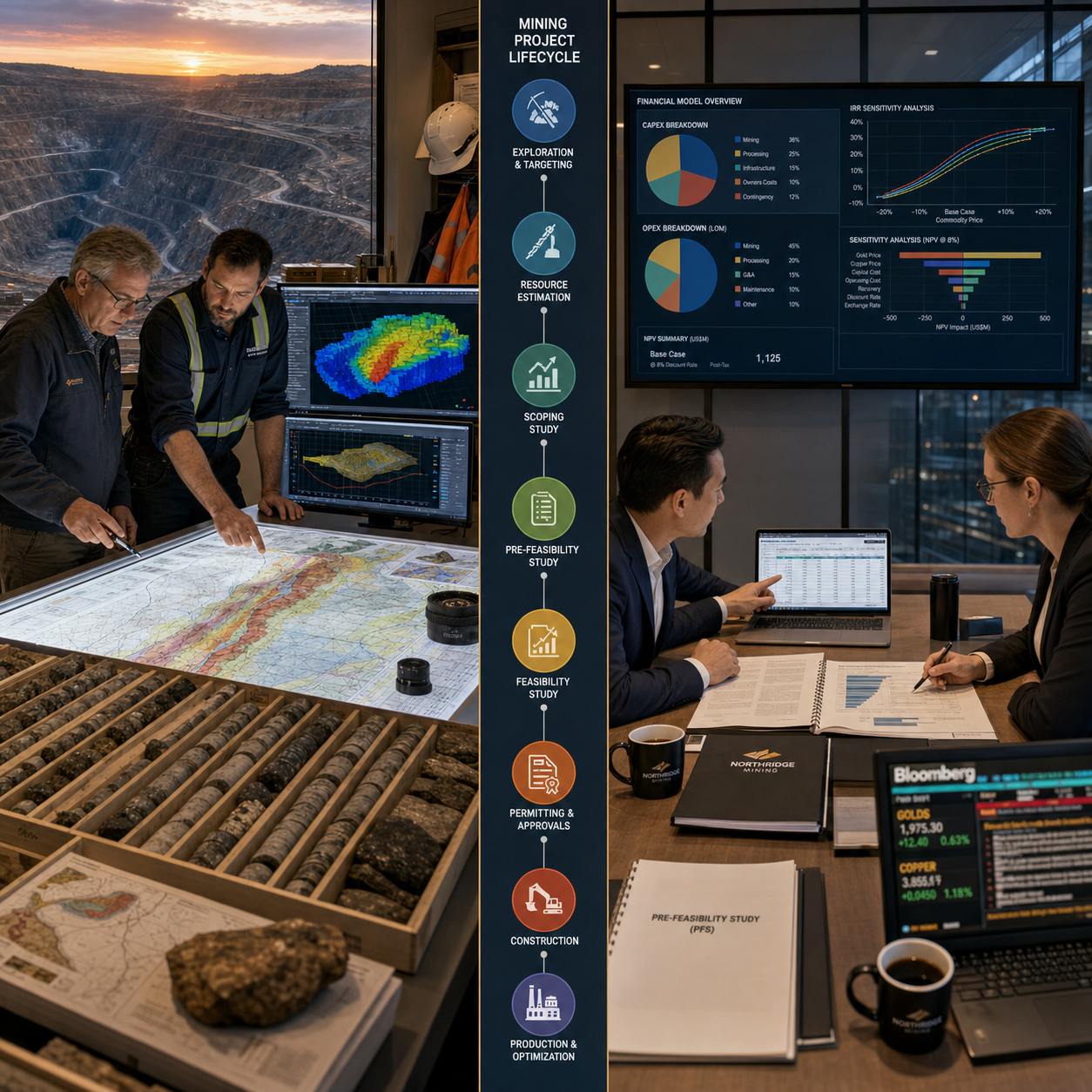
New mine developments are carried out using a systematic approach involving various stages of analysis that start from scoping, followed by pre-feasibility and feasibility studies. The engineering studies are extensively employed for evaluating new developments from technical and economic viewpoints, respectively, where increasing depths of investigations are involved during successive phases of analysis.
Technical issues begin with geology and the assessment of resources; defining the orebody, evaluating the grades and tonnage, and assessing the variation and uncertainty in the deposit. As indicated by mining project evaluation literature, technical risk issues within a mining project include uncertainties about the ore-body model, grade distribution, ground conditions, capacity of the machinery, work force estimates, and plant performance, all of which have direct implications for project model quality. It should also be noted that an otherwise appealing project may lose its attraction due to poor estimates of resource model, recoverability, and production schedule.
After defining and estimating the resource base, alternative ways to exploit and process the orebody are considered. At this stage, a preliminary comparison between different approaches such as open pit and underground mining is conducted, and it allows checking how feasible the exploitation of such an orebody is from the engineering point of view. At this stage, the selected mining approach is checked against ore body geometry and production goals.
Process Plant
Process plant is yet another crucial technical screening parameter, as the recovery rate, throughput, and level of complexity will significantly affect the economics. According to the feasibility study guide, metallurgy, plant design, and process performance are fundamental elements that require careful consideration in a feasibility study as metallurgical testing provides information on recovery rate, reagent consumption, and size reduction. In general, the plant selection depends on whether it is capable of processing the required quantity of material and producing the required quality of product within an affordable range.
In this step, the technical model is monetized by generating the cash flows associated with the mining project. This process employs the discounted cash flow analysis, using net present value, internal rate of return, and payback period as the key financial metrics and estimating capital expenses, operating expenses, taxes, royalties, and cash flow based on mine and process plant plans. According to a research paper on mining economic evaluation, the discounted cash flow method is the most popular technique employed within the mining industry, and NPV and IRR are widely favored in investment decision-making.
Because mining operations are highly capital-intensive and expose companies to extended periods of operation, evaluations need to consider uncertainties. As indicated in the technical literature, mineral deposits are subject to various sources of uncertainty such as reserves, ore grade, commodity price, exchange rate, environmental concerns, and political/legal conditions. Hence, apart from discounted cash flow analysis, other techniques like decision trees and Monte Carlo simulation are used to gauge the effects of uncertainties in commodity price, ore grade, recovery, and cost changes. It should be noted that uncertainties make it such that while the “best case” project may not be the “base case” project.
Ultimately, any mining project will be successful when the technical considerations are realistic and the economic benefits remain robust under uncertainty. The evaluation process, therefore, seeks to determine whether it is possible to develop a mine and process mineral deposits with the support of adequate infrastructure and whether the cash flow generated justifies the investment. That explains why successful projects tend to be consistent across resource modeling, mine design, and plant efficiency as well as the financial forecast.