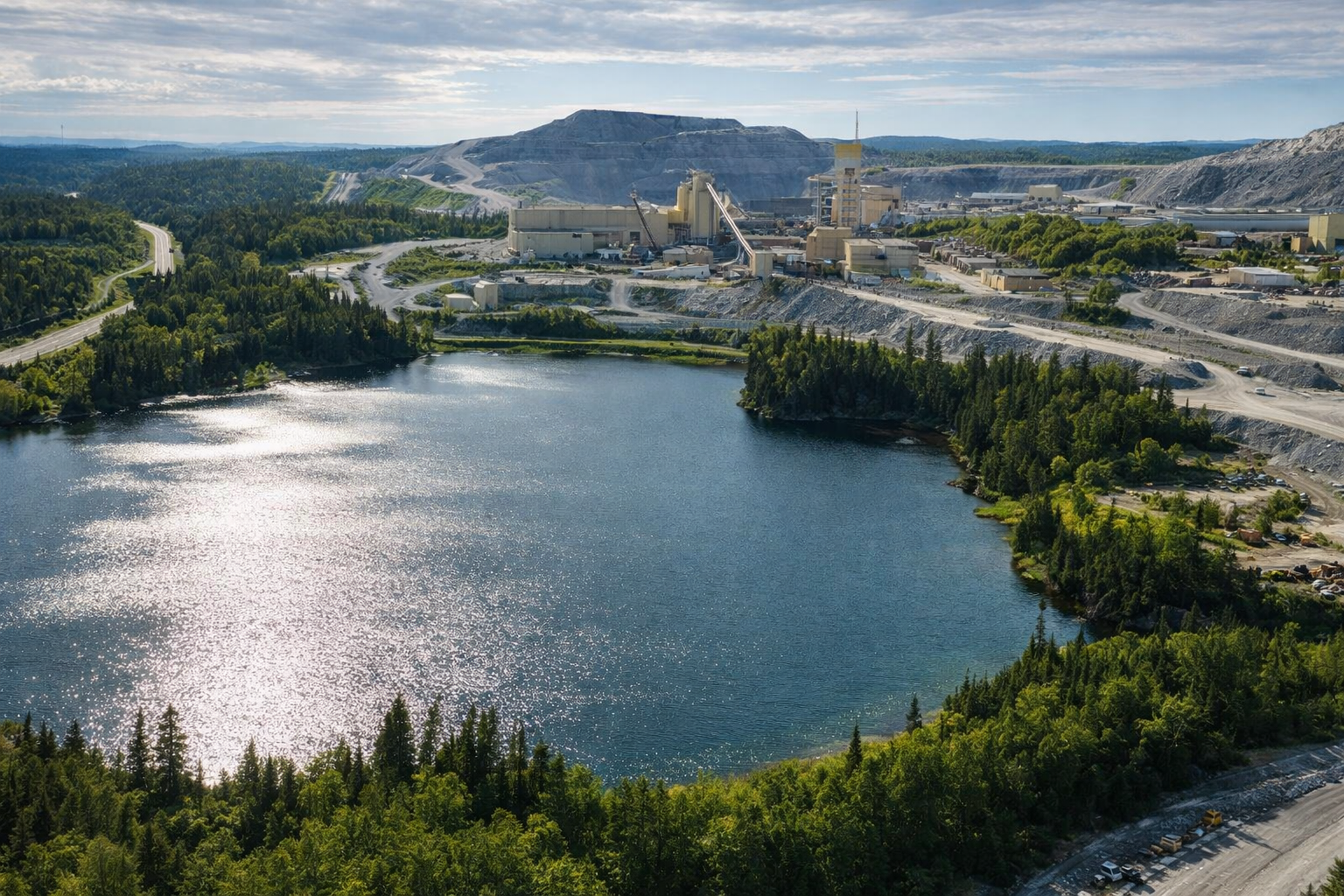
Hemlo Mine, which incorporates both the historical Williams and David Bell deposits, is known as one of Canada’s leading underground gold mines. Situated in Ontario, 247 kilometers east of Thunder Bay, the mine was acquired by Hemlo Mining Corp. from Barrick Gold in November 2025 at a cost of $1.09 billion, marking a turning point in the mine’s operations. Hemlo Mining Corp.’s control over the high-grade breccia and orogenic gold deposits will serve the company well in view of growing worldwide demand for gold.
Hemlo Mine’s geology comprises high-grade breccia-hosted and orogenic gold mineralization, a characteristic common to the Superior Province’s Archean greenstone belts. Underground mining is employed at the mine because of the high-grade and narrow nature of the ore.
During 2025, production was quite successful with 4.5 tonnes of gold being extracted from 1.29 million tonnes per annum (Mtpa) of ore mining activities. The reserves are quite sufficient with total proven and probable gold reserves being 34.2 tonnes having an average grade of 5.16 g/t Au which is expected to last for several years.
Resource potential of the mines can be seen in their Measured, Indicated, and Inferred reserves, having a total of 130.6 tonnes of gold reserves with an average grade of 2.51 g/t Au.
| Category | Gold (t Au) | Average Grade (g/t Au) |
| Proven & Probable Reserves | 34.2 | 5.16 |
| M&I + Inferred Resources | 130.6 | 2.51 |
On-site processing capacity is 2.2 Mtpa using gravity separation combined with CIP cyanidation. The process results in an excellent 94% recovery rate, turning the refractory material into gold doré bars with little waste.
On a financial level, Hemlo had a very low AISC of US$1,845/oz in 2025 at a time when gold was selling for more than US$2,500/oz. The purchase price also shows faith in the company’s ability to manage costs and exploit reserves, especially considering that Hemlo Mining Corporation is automating its operations.
At Hemlo Mining Corp., production expansion aims for 5-6 tonnes per year through efficient underground development and milling debottlenecking. In terms of environmental impacts, emphasis continues to be placed on tailings management and Indigenous relations, which correspond to regulations of Ontario. As a key player in Canada’s gold industry, Hemlo is an example of how legacy resources continue to prosper after the transition period.