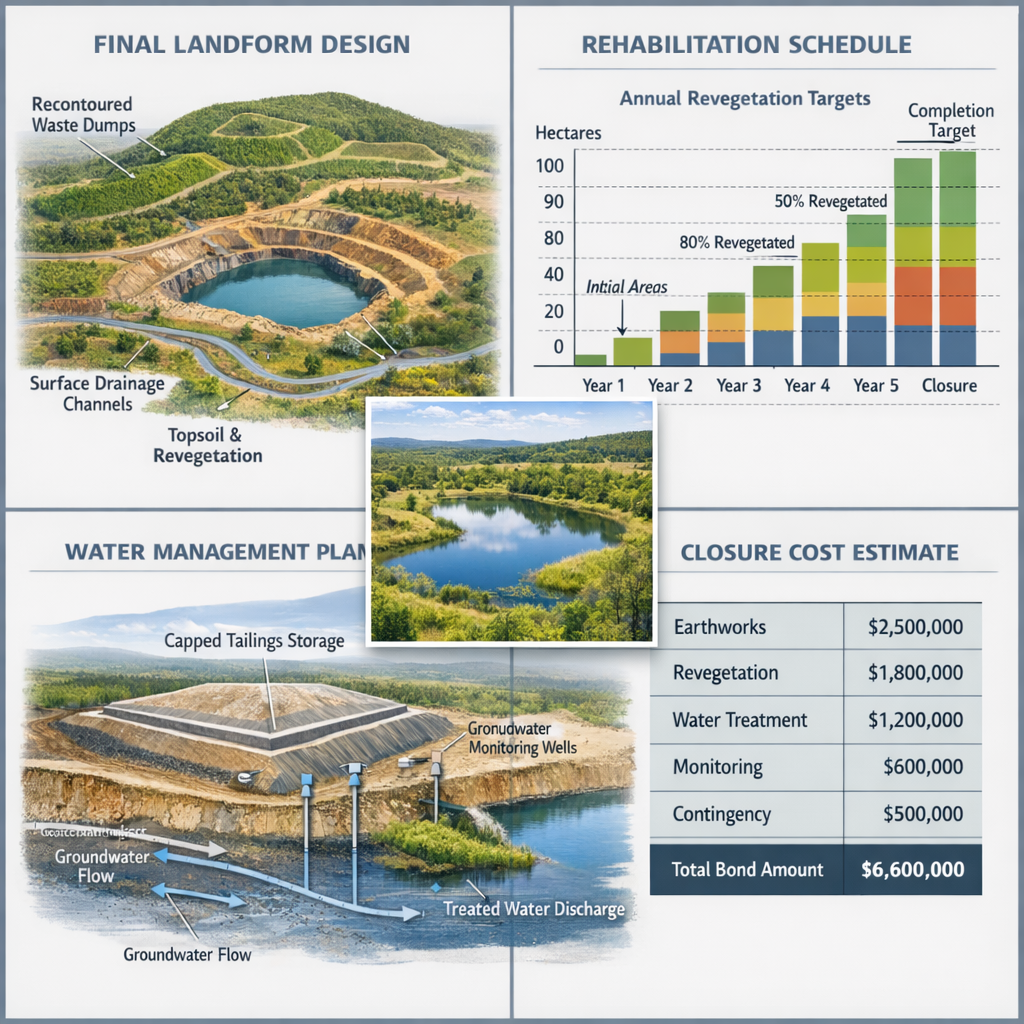
Mining is fundamentally a temporary use of land, but its effects can linger for centuries if left unmanaged. To prevent modern operations from becoming permanent environmental burdens, the Mine Closure Plan (MCP) has evolved into a cornerstone of responsible resource management. Far from being a mere “end-of-life” checklist, the MCP is a dynamic, “living document” that begins during the pre-feasibility stage—well before the first ton of ore is even extracted (Oliveros-Sepúlveda et al., 2025).
The anatomy of a closure plan
At its core, a closure plan outlines how a company will decommission facilities, stabilize the landscape, and rehabilitate the local ecosystem. According to Tones et al. (2021), a successful plan balances several critical objectives:
- Physical and geotechnical stability: ensuring that massive structures like tailings dams and waste rock piles are engineered to resist erosion and collapse over the long term.
- Geochemical safety: implementing measures to prevent Acid Mine Drainage (AMD) or the leaching of heavy metals into regional groundwater.
- Ecological restoration: moving beyond simple “greening” to restore biodiversity and “cultural ecosystem services”—the aesthetic and recreational values that local communities rely on (Musando & Cáceres, 2023).
Why regulators demand a plan?
In the past, many mining projects were simply abandoned when they ceased to be profitable, leaving behind “orphaned” sites that posed significant public risks. To combat this, most global jurisdictions now mandate an approved MCP as a legal prerequisite for a mining license. This regulatory shift is driven by three main factors:
Governments now require companies to provide financial assurance, such as bonds or bank guarantees, that cover the full cost of reclamation. This ensures that if a company faces bankruptcy, the funds required for cleanup are already secured, protecting taxpayers from inheriting the bill (Oliveros-Sepúlveda et al., 2025).
By making the MCP a legal requirement, regulators force mining companies to view environmental stewardship as an operational cost rather than an externalized liability. This encourages better waste management practices throughout the mine’s active life, as smarter waste handling reduces the eventual cost of closure (Oliveros-Sepúlveda et al., 2025). A mine’s closure often signals a traumatic economic shift for nearby towns. Modern regulations, therefore, emphasize the social transition. Effective planning helps diversify the local economy and ensures that the post-mining landscape can support new, sustainable industries (Lamb & Coakes, 2012). Through these rigorous frameworks, a Mine Closure Plan ensures that while the minerals are extracted for today’s needs, the land remains a viable asset for future generations.
References
Lamb, K., & Coakes, S. (2012). Effective social planning for mine closure. Proceedings of the International Conference on Mine Closure, 627-639.
Musando, A. A., & Cáceres, F. (2023). Best Practices in Mine Closure: A Case Study of Cultural Ecosystem Services in the Kenyan Mining Sector. The School of Public Policy Publications, 16(1).
Oliveros-Sepúlveda, D., Bascompta-Massanés, M., & Franco-Sepúlveda, G. (2025). Environmental and Closure Costs in Strategic Mine Planning, Models, Regulations, and Policies. Resources, 14(3), 41.
Tones, A., Howe, L., & du Plooy, J. (2021). Knowledge makes the work go round: Knowledge management in mine closure planning. Proceedings of the International Conference on Mine Closure, 189-204.