Mines in ultra-high-grade ore bodies operate differently from mines in regular ore zones because the intensity of the source term itself will be different: gamma rays, radon or radon progeny, and radioactive dust will be present, even waste rock or tailings will have enough radioactivity. The operational difficulty in such a situation does not consist so much in ore extraction, but rather in maintaining strict control over exposure for workers, equipment, and subsequent ore processing.
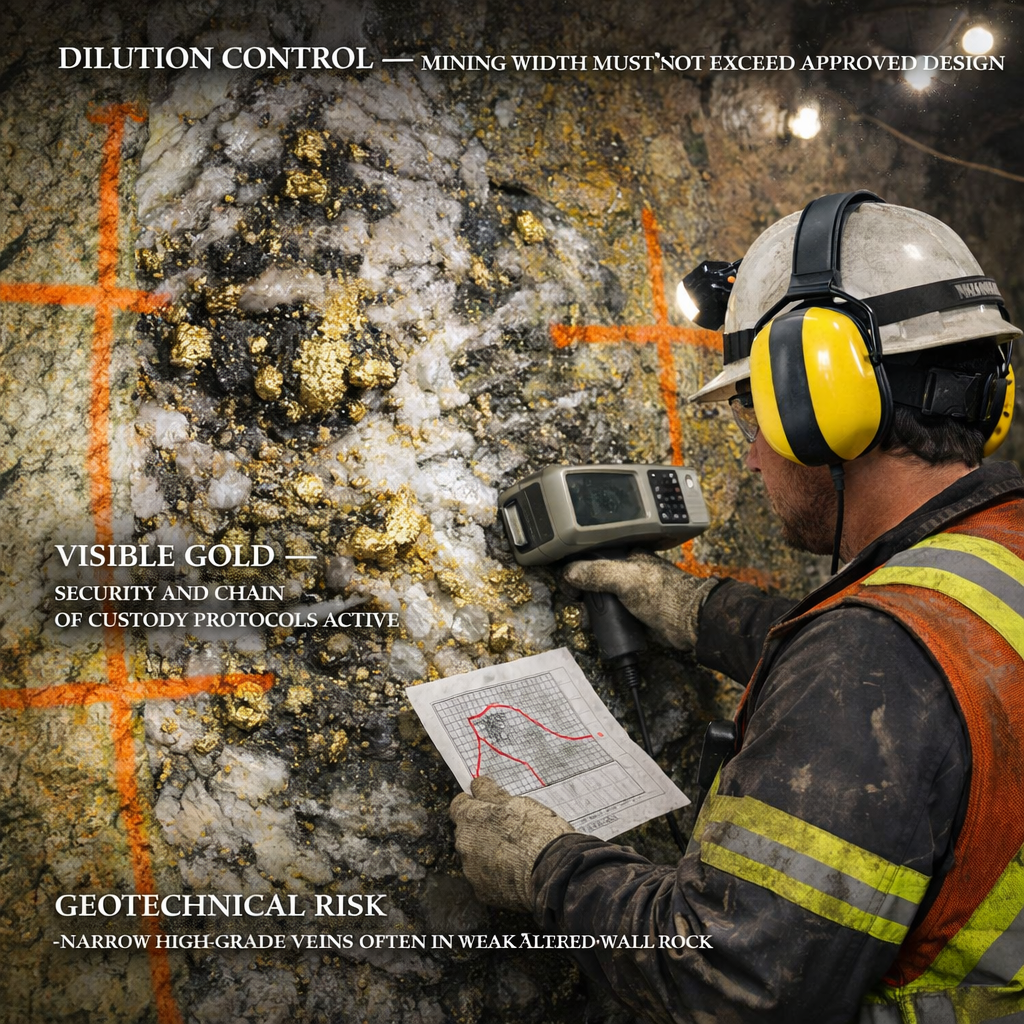
First of all, greater selectivity both in geological studies and in mining work is required: since the ore grade is very high, any inaccuracies in the construction of stopes, drilling, blasting, or digging lead to dilution with waste and loss of the valuable product. This is necessary because high-grade ore gives economic feasibility to selective extraction provided that there is no dilution.
Secondly, radiations exposure management becomes another important operational challenge. As per the IAEA, due to amplification of the exposure pathway in high-grade uranium mines, it is difficult for the operator to employ the use of administrative controls alone, and other forms of controls such as time, distance, shielding, and remote operation become necessary in order to prevent exposure. Practically, non-entry approach wherever possible, shotcreting or shielding using clean waste rocks, and layout designs become important for limiting exposure to the ore.
Lastly, underground ventilation and radon management can become complex. High-grade uranium ores produce large amounts of radon progeny. The IAEA highlights that ventilation becomes an important control measure in such cases, especially the provision of designed air flows, negative pressure where necessary, and prompt responses to ventilation upsets. In some instances, ground freezing and grouting operations can also become important for controlling water inflow into the workings and preventing radon transport.
Secondly, managing radiations exposure becomes a significant operational challenge. As stated by IAEA, because of the increase in the exposure route in high grade uranium mines, it would not be practical for the operator to rely on the administration of controls only; but other types of control, including time, distance, shielding, and remote operation, may be required in order to avoid exposure. In actual fact, the non-entry method whenever practical, the shotcreting or shielding by clean waste rock, and layout design become important in minimizing exposure to the ore.
Thirdly, the issue of underground ventilation and radon control becomes a significant challenge. High grade uranium ores result in large quantities of radon progeny. According to IAEA, in these situations, ventilation plays a key role as a control measure, particularly designing airflow, negative pressure where necessary, and fast responses to ventilation upset. At times, the issues of ground freezing and grouting become important for control purposes.
Finally, it all comes down to how management responds and the way in which planning is integrated into the operation. In order to effectively manage high-grade ore zones, there must be radiation protection built into the mine design because any missteps made at the start will become increasingly difficult to change once the mine is in use. An effective strategy for management in dealing with high-grade ores would be a gradient management system.