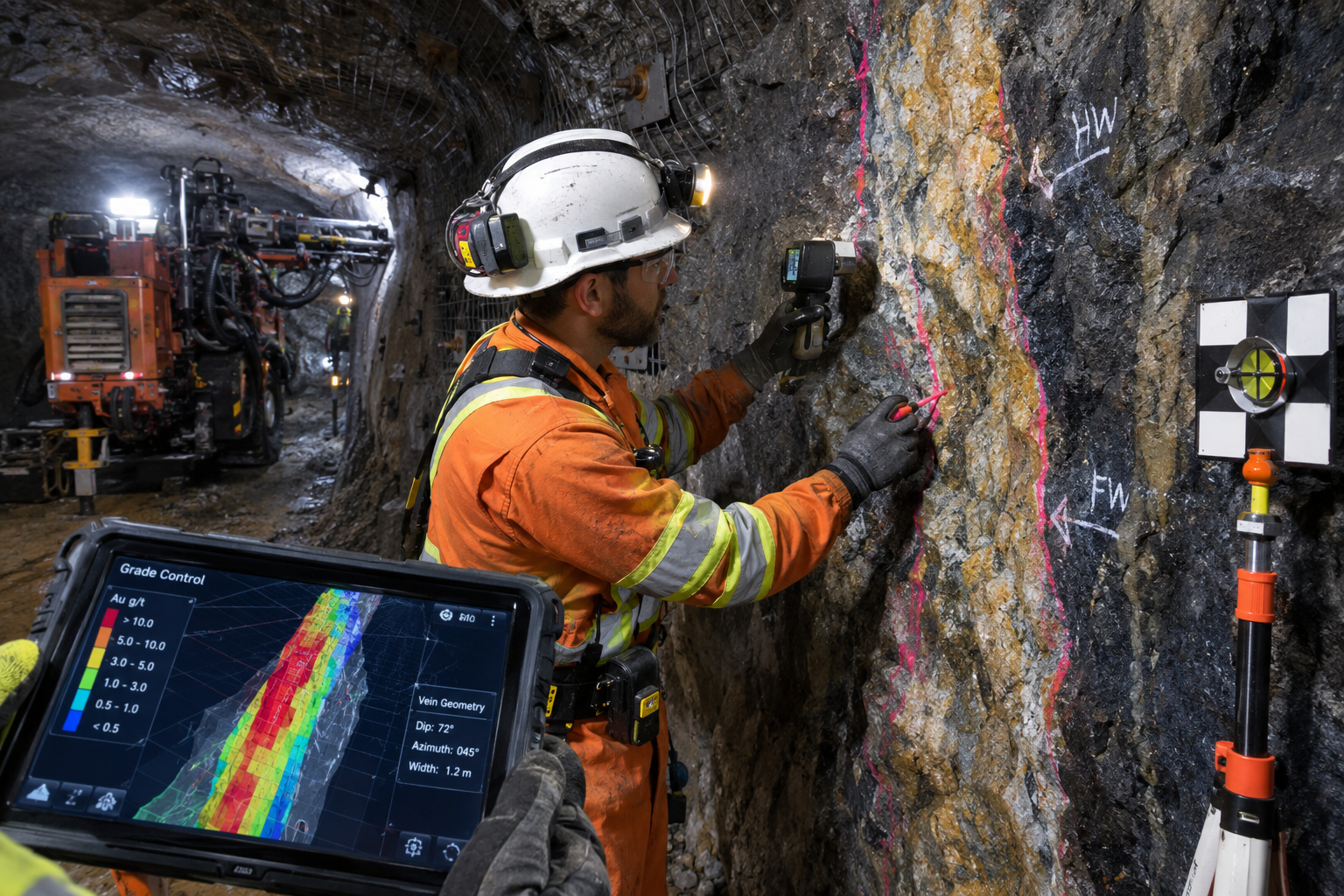
Narrow vein stoping is one of the underground mining techniques that target the extraction of thin and steep dipping mineral deposits. In such mines, one of the major concerns during the extraction process is managing the “dilution” which is understood to mean the contamination of high-grade ore with poor or barren waste rock (Delentas et al., 2021). Dilution is of two types, namely; dilution that is planned due to minimum possible mining width, and unplanned because of overbreak and sloughing. Developing ways on how to mitigate dilution is of great importance.
Dilution greatly influences the economics of mining due to higher costs incurred in loading, haulage, and mill processing of useless waste rock. It is essential to begin with the establishment of realistic standards for the stoping width of the individual ore body when tackling uncontrolled dilution. Previous studies suggest that calculation of expected stoping width through accounting for the standard longhole drilling pattern such as staggered stoping and inline stoping would be of much help in identifying both dilutions (Stewart et al., 2007).
It is one of the core best practices to make geomechanical evaluation before mining of the stopes. The conventional empirical method of stability analysis through stability graphs and ELOS parameters provides early warning signs of stope stability depending on rock mass properties (Delentas et al., 2021). At the same time, nowadays narrow-vein mining operations often use sophisticated numeric methods of analysis. Back-calculation by means of finite element models helps geotechnicians understand stress redistribution and optimize artificial support and cable bolts for preventive waste rock intake (Cordova et al., 2022).
The accuracy of drilling and blasting works will be the key operational method of avoiding unnecessary dilution. In a typical situation, blasting process causes destruction of the delicate rock surrounding the narrow veins. Thus, application of controlled blasting technology becomes a must. Controlled blasting with the appropriate amount of explosive loading and optimization of spacing ratios help to control excessive fracturing. Furthermore, cavity monitoring systems after blasting are useful to align actual dimensions of a stope with the planned one.
However, in case geomechanical characteristics prove to be poor, changes in stope geometries and technological solutions become essential. The use of reduced total area of the stope reduces the total hanging wall surface and thus decreases the possibility of the sloughing process. Also, application of underground pre-concentrators, for instance automated sorting, acts as additional defense. Through waste rejection during the very beginning stages of mining operation, underground concentration systems make the effect of inevitable dilution much less damaging to the mill cut-off grade; only valuable ore needs costly processing (Sotoudeh et al., 2024).
To conclude, successful management of dilution in narrow vein stoping calls for multidisciplinary efforts from the part of a mining enterprise. The definition of proper stoping width limits and usage of modern modeling techniques for stability calculation, implementation of precision blasting technology, and adaptation of stope sizes are all indispensable for efficient dilution management. By merging these methods of geological engineering, operation, and technology, mining companies can achieve an immense reduction of unplanned wastage. Therefore, control of dilution is crucially important for maximization of resource utilization and elimination of unnecessary costs.
References
Cordova, D. P., Zingano, A. C., & Gonçalves, Í. G. (2022). Unplanned dilution back analysis in an underground mine using numerical models. REM – International Engineering Journal, 75(4), 379–388. https://doi.org/10.1590/0370-44672021750093
Delentas, A., Benardos, A., & Nomikos, P. (2021). Analyzing Stability Conditions and Ore Dilution in Open Stope Mining. Minerals, 11(12), 1404. https://doi.org/10.3390/min11121404
Sotoudeh, F., Nehring, M., Kizil, M., Knights, P., & Mousavi, A. (2024). The effect of stope size and cut-off grade on the design and scheduling of an underground mining operation in the presence of a pre-concentration system. International Journal of Mining, Reclamation and Environment, 39, 110–122. https://doi.org/10.1080/17480930.2024.2387989
Stewart, P., Trueman, R., & Lyman, G. (2007). Development of benchmark stoping widths for longhole narrow-vein stoping. Mining Technology, 116, 167–175. https://doi.org/10.1179/174328608×318270