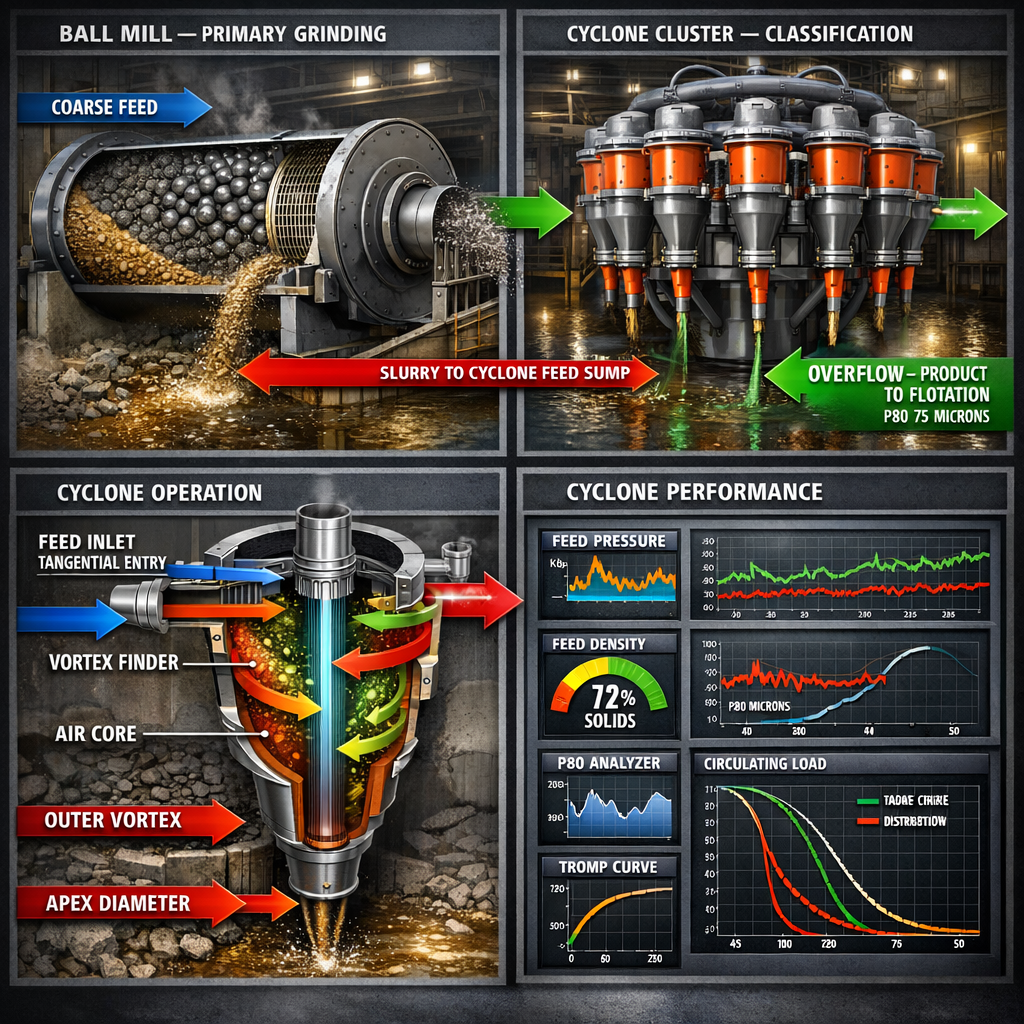
In mineral processing, the grinding stage represents one of the most energy-intensive operations in the entire concentrator flowsheet. To manage this energy demand efficiently while achieving the target product fineness, plant designers configure grinding mills in what is known as a closed circuit — a setup where a classifier continuously separates ground material by particle size, returning oversize particles to the mill for further comminution while directing the adequately ground fraction downstream. At the heart of this closed-circuit configuration sits the hydrocyclone cluster, a parallel arrangement of multiple hydrocyclone units that together handle the volumetric throughput demands of large-scale industrial operations. The hydrocyclone is a classifying device that utilises centrifugal force to accelerate the settling rate of slurry particles and separate them according to size, shape, and specific gravity, and it is extensively used in closed-circuit grinding operations (Wills & Finch, 2016). Understanding the precise role of the cyclone cluster in this circuit is essential for any practicing metallurgist or plant manager seeking to optimise both throughput and product quality.
The primary function of the cyclone cluster is size classification. The purpose of classification in a grinding circuit is to remove material that meets the product size requirements from the circuit and recycle oversize material back to the grinding mill for further comminution (Wills & Finch, 2016). In industrial practice, the slurry discharged from the ball mill is pumped into a common feed distributor from which it is distributed equally across all active cyclones in the cluster. Under the effect of pressure, the slurry enters the shell through the feeding pipe in a worm-shaped direction and undergoes circumnutational motion; coarse or dense particles are driven to the periphery by centrifugal force and exit via the spigot as underflow, while fine particles remain in the central rotating flow and exit as overflow through the vortex finder (Yantai Huize, 2025). In a large copper concentrator, for example, the SAG mill trommel undersize is combined with the ball mills’ discharge and pumped to two parallel packs or clusters of twelve 660 mm diameter cyclones, with the cyclone underflow from each line reporting to a ball mill while the cyclone overflow is directed to the flotation circuit (Wills & Finch, 2016). This arrangement ensures that only adequately liberated particles proceed to downstream concentration, protecting flotation circuits from excessively coarse feed.
A second — and critically important — role of the cyclone cluster is governing the circulating load, which directly determines grinding efficiency and mill capacity. The circulating load can be defined as a process flow of a given material that returns to a unit operation after failing to fulfil some selection criteria, and in closed-circuit grinding, the circulating load is, in some cases, 400 times the ratio of the weight of the hydrocyclone oversize returning to the mill to the weight of new feed entering the circuit in the same time interval (Moraga et al., 2014). Managing this circulating load is therefore indispensable. Research has shown that applying volume split control in the hydrocyclone enables stabilising the reduced efficiency curve of separation, allowing a grinding circuit to be operated across a wide range of circulating loads while the high solids content in the hydrocyclone underflow results in a minimum circulating load with less overgrinding (Neesse et al., 2004). In industrial plants processing ores of variable hardness, where the mill discharge becomes progressively coarser, the cyclone cluster also acts as a buffer that absorbs fluctuations and maintains circuit stability.
The classification efficiency of the cyclone cluster has a profound impact on both grinding energy consumption and downstream metallurgical performance. Although hydrocyclones are relatively simple to operate, their associated classification performance is generally low, resulting in a high recirculation of fines through the circuit and consequently overgrinding the product (Salomao de Oliveira & Tavares, 2024). This misclassification of fine particles back into the mill represents wasted energy — a major concern given that comminution already accounts for the bulk of plant energy costs. Recent pilot-scale studies have quantified this impact dramatically: fines reporting to the underflow increase the circulating load and thus reduce the capacity of the grinding circuit and the overall tonnage rate able to be processed (Jokovic et al., 2025). Moreover, from a modelling standpoint, industrial sampling campaigns at a plant employing two ball mills and two cyclone clusters demonstrated that element tracking and model development along the comminution circuit are key to capturing the complex interactions between mill performance and cyclone classification (Goktas et al., 2023).
The operational management of the cyclone cluster thus extends beyond simple particle separation. In modern plant practice, the ability to switch individual cyclones in or out of service within the cluster provides a powerful additional manipulated variable for process control. A continuous-time grinding mill circuit model incorporating a hydrocyclone cluster as the primary classifier has demonstrated that a hybrid non-linear model predictive controller can use switching of hydrocyclones as an additional manipulated variable, yielding increased controller stability (le Roux et al., 2012). Furthermore, industrial grinding circuits in the mining industry are almost always configured in a closed configuration with hydrocyclones, where the underflow is circulated back to the mill while the overflow is the circuit’s final product (Salomao de Oliveira & Tavares, 2024). In my three decades of experience across copper, gold, and iron ore processing plants on three continents, I have consistently observed that plants that invest in understanding and optimising their cyclone cluster operation — through proper sizing, maintenance of vortex finders and spigots, and active control of feed pressure and density — invariably achieve superior throughput, reduced specific energy consumption, and better liberation for downstream metallurgical processes.
References
Goktas, I., Altun, O., Toprak, N. A., & Altun, D. (2023). Element based ball mill and hydrocyclone modelling for a copper ore grinding circuit. Minerals Engineering, 198, Article 108077.
Jokovic, V., Cottrill, T., & Revell, P. (2025). Benefits of semi-inverted hydrocyclones in closed grinding circuit: A pilot scale study. Minerals Engineering.
le Roux, J. D., Olivier, L. E., Naidoo, M. A., Padhi, R., & Craig, I. K. (2012). Analysis and validation of a run-of-mine ore grinding mill circuit model for process control. Minerals Engineering, 43-44, 121-134.
Moraga, S. V., Villa Sierra, M., Peres, A. E. C., & Montalvo Nicolas, C. A. (2014). Circulating load calculation in grinding circuits. Rem: Revista Escola de Minas, 67(2).
Neesse, T., Dueck, J., & Minkov, L. (2004). Hydrocyclone control in grinding circuits. Minerals Engineering, 17(11-12), 1237-1240. https://doi.org/10.1016/j.mineng.2004.06.033
Rocha, B. K. N., Campos, T. M., Alves, L. P., & Tavares, L. M. (2026). Multicomponent simulation of an industrial closed-circuit ball mill in size reduction of an iron ore. Minerals Engineering, 235, Article 109825.
Salomao de Oliveira, A., & Tavares, L. M. (2024). Comparing the performance of hydrocyclones and high-frequency screens in an industrial grinding circuit: Part I – Size separation assessments. Minerals, 14(7), 707.
Wills, B. A., & Finch, J. A. (2016). Wills’ mineral processing technology: An introduction to the practical aspects of ore treatment and mineral recovery (8th ed.). Butterworth-Heinemann.