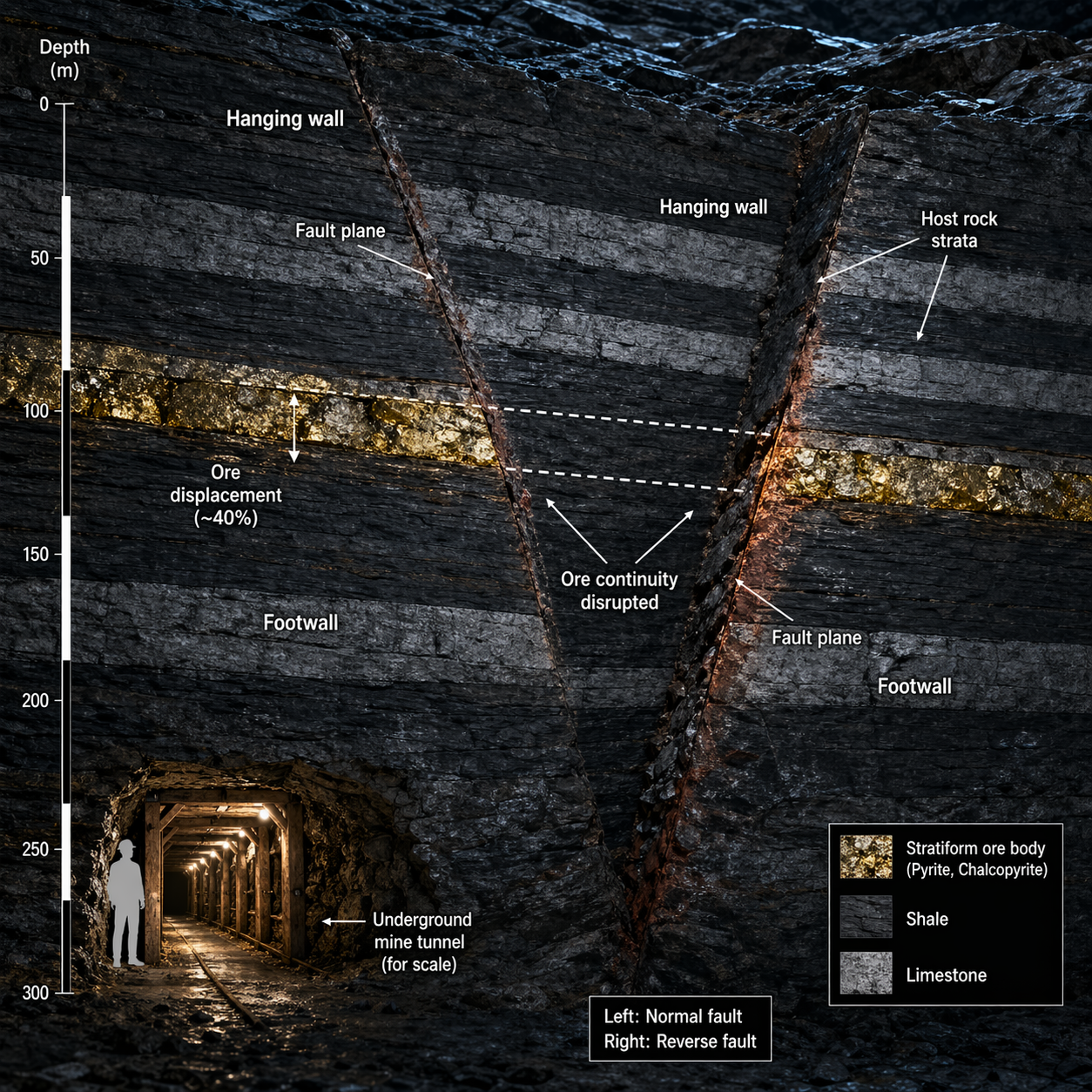
Stratiform ore bodies are defined by their tabular, sheet-like geometry, extending laterally over significant distances in a manner conformable with the layering of their host rocks (Vokić et al., 2026). These deposits, which include major sources of copper, lead, zinc, and gold, are often critical for global mineral supply. However, the continuity of these “reef” or “blanket” deposits is frequently disrupted by post-genetic tectonic activity, specifically fault displacement. Understanding this impact is essential for both resource estimation and the selection of mining methods.
Fault displacement fundamentally alters the spatial predictability of stratiform mineralization. In many sediment-hosted or volcanogenic massive sulfide (VMS) deposits, fault arrays act as the primary mechanism for ore body compartmentalization. Research indicates that fault segmentation is ubiquitous in these environments; larger-scale fault segments and intervening “relay ramps” define the boundaries of distinct orebodies within a single deposit (Kyne et al., 2019). When displacement occurs, it physically breaks the lateral continuity of the ore horizon, shifting blocks of mineralized rock relative to one another. This “hard linking” of fault segments can create isolated blocks that require separate access in underground mining, significantly increasing development costs.
Beyond simple physical offset, faulting influences the internal “grade continuity” of the ore. Low-displacement faults and fractures can act as “Perkins Discontinuities”—planar boundaries that abruptly terminate mineralization or create asymmetric grade distributions (Cowan & Hobbs, 2025). These features occur when minor permeability contrasts across a fault or fracture block the flow of mineralizing fluids, even if the physical displacement of the rock units is negligible (Cowan & Hobbs, 2025). Consequently, an ore body that appears continuous based on host-rock lithology may have abrupt terminations in mineral grade due to these structural barriers.
The suitability of modern mining techniques, such as the Narrow Reef Mining (NRE) method, is highly sensitive to fault-induced disturbances. Thin stratiform bodies (often <1.7 m thick) face extreme operational challenges when faulting introduces dip variations or excessive dilution (Vokić et al., 2026). Large-scale displacements can shift a gently dipping ore body into a steeply inclined or vertical orientation, necessitating a complete change in extraction technology.
In summary, fault displacement transforms a simple, continuous stratiform layer into a complex 3-D mosaic. By analysing the kinematic evolution of fault arrays and identifying discontinuities, geologists can better predict the “broken” nature of the ore and optimize recovery strategies (Kyne et al., 2019).
References
Cowan, E. J., & Hobbs, B. E. (2025). Perkins Discontinuities: Structurally controlled grade patterns diagnostic of epigenetic gold mineralisation at the deposit-scale. Australian Journal of Earth Sciences, 72(5–6), 660–700. https://doi.org/10.1080/08120099.2025.2514701
Kyne, R., Torremans, K., Güven, J., Doyle, R., & Walsh, J. (2019). 3-D Modeling of the Lisheen and Silvermines Deposits, County Tipperary, Ireland:Insights into Structural Controls on the Formation of Irish Zn-Pb Deposits. Economic Geology, 114(1), 93–116. https://doi.org/10.5382/econgeo.2019.4621
Vokić, E., Šoštarić, S. B., Bohanek, V., & Pleše, P. (2026). The Suitability of Stratiform Ore Deposits for the Narrow Reef Mining Equipment Method: Geological, Morphological, and Economic Criteria. Minerals, 16(3). https://doi.org/10.3390/min16030250