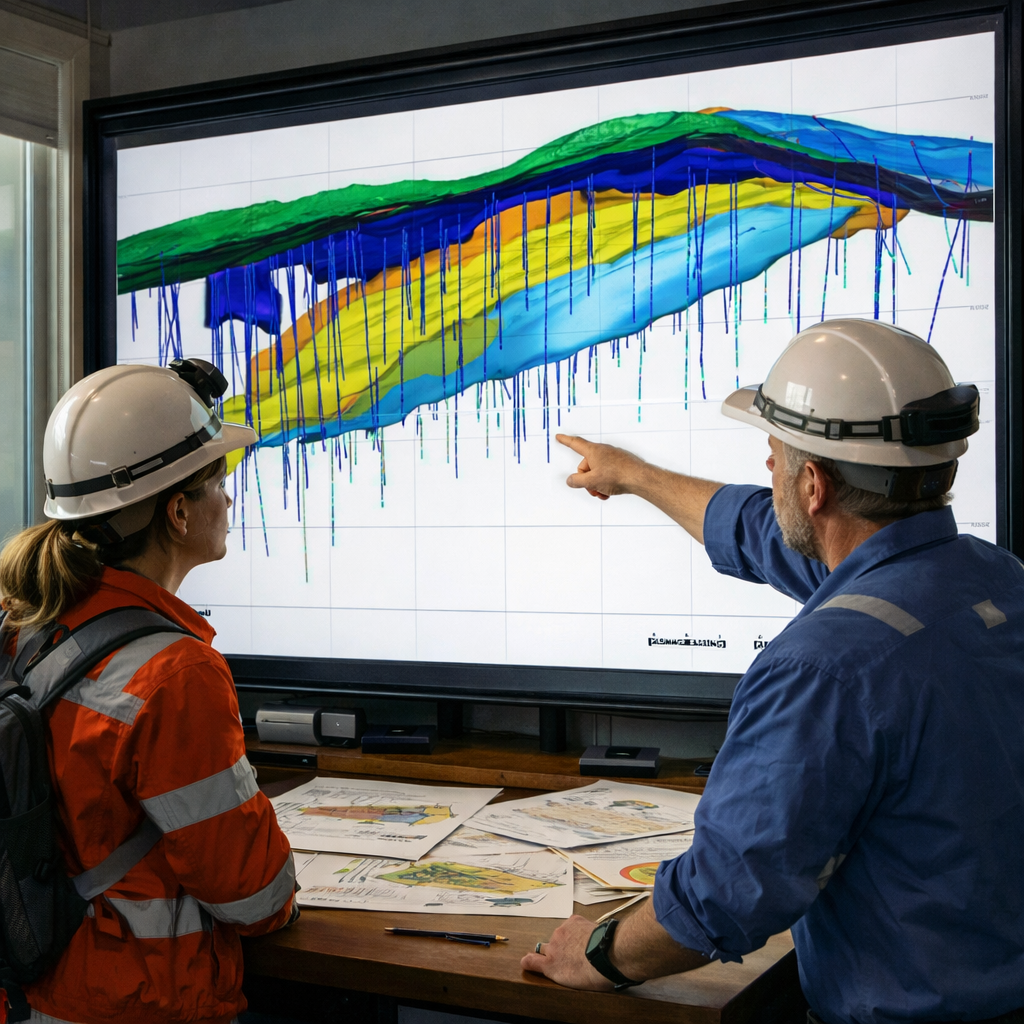
In the complex environment of underground mining, structural geology serves as the primary scientific framework for predicting the three-dimensional geometry and spatial distribution of ore bodies. Since mineralizing fluids are often transported through highly permeable zones created by crustal deformation, the resulting ore bodies are frequently hosted within faults, shear zones, and fold hinges (Blenkinsop et al., 2020). Understanding these structural controls is essential for accurate mine planning, grade control, and economic risk mitigation.
The prediction of ore body geometry begins with a rigorous geometrical analysis. This process involves measuring and defining the physical attributes of an ore body; such as strike, dip, and plunge, and relating them to controlling structures like splays or lithologic contacts (Peters, 2001). By systematically analysing these elements, geologists can determine the “plunge” of the mineralization, which refers to the orientation of its central axis (Peters, 2001).
Complementing this is kinematic analysis, which focuses on the movement history of the rock mass. By studying deformation zones, geologists can identify where permeability was created during mineralizing events (Blenkinsop et al., 2020). This is particularly vital in hydrothermal systems where “dilatant zones” (areas where rocks have pulled apart due to structural stress) act as the primary receptacles for ore (Peters, 2001).
Modern underground mine planning increasingly relies on innovative visualization tools to bridge the gap between raw structural data and 3D models. One such technique is X-ray plunge projection, which uses Maximum Intensity Projection (MIP) to render grade data in a way that reveals the underlying structural architecture of a deposit (Cowan, 2014). Because metallic constituents are often mobilized along deformation-induced pathways, these grade patterns mimic the significant structures that controlled fluid flow (Cowan, 2014).
Beyond simple discovery, structural geology is integrated into the entire lifecycle of an underground mine. It is the only means by which ore bodies can be accurately measured for reserve estimation and mine layout (Peters, 2001). Furthermore, understanding the “incipient structural fabric”; the subtle, often incoherent internal patterns of the rock, is necessary to ensure ground stability as mines reach greater depths (Carter et al., 2015). By unravelling these fabrics, engineers can predict potential rock mass failures and design safer, more efficient extraction sequences.
References
Blenkinsop, T. G., Oliver, N. H. S., Dirks, P. G. H. M., Nugus, M., Tripp, G., & Sanislav, I. (2020). Chapter 1: Structural Geology Applied to the Evaluation of Hydrothermal Gold Deposits. Applied Structural Geology of Ore-Forming Hydrothermal Systems, 1-23. https://doi.org/10.5382/rev.21.01
Carter, T., Rogers, S., Taylor, J., & Smith, J. (2015). Unravelling structural fabric — a necessity for realistic rock mass characterisation for deep mine design. Proceedings of the International Seminar on Design Methods in Underground Mining, 317-338. https://doi.org/10.36487/acg_rep/1511_19_carter
Cowan, E. J. (2014). ‘X-ray Plunge Projection’— Understanding Structural Geology from Grade Data. Project Generation Services. [Research Paper].
Peters, S. G. (2001). Use of structural geology in exploration for and mining of sedimentary rock-hosted Au deposits. Open-File Report, (01-151). https://doi.org/10.3133/ofr01151