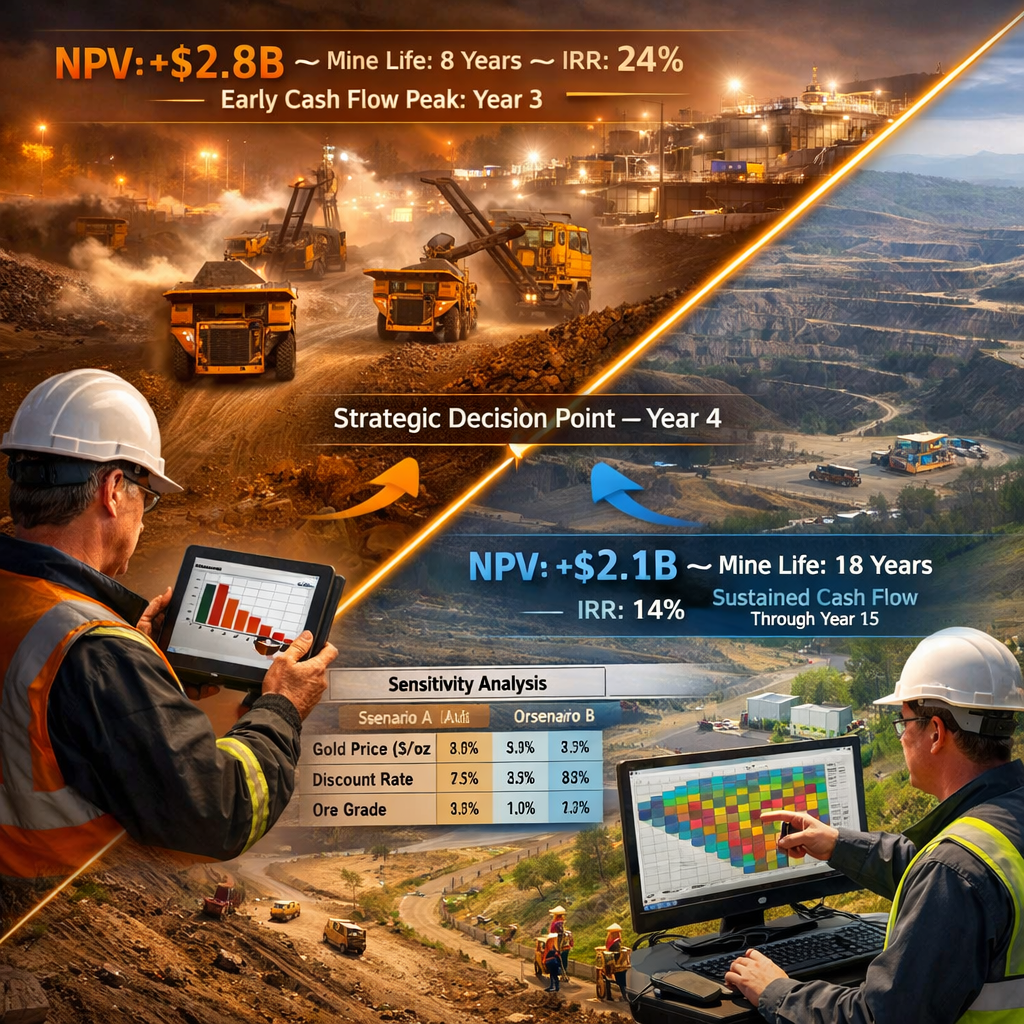
Although increasing production rates will help in improving the short-term financial flows, this is typically going to require even more money both in terms of capital investment and operating expenditures to enable the mine to work at such rates. These may include such expenses as upgrading mills, buying more trucks and load-haul dumps, employing more staff, increasing energy and water consumption, among others. However, on the one hand, a mine would produce revenues earlier and more intensively than before, but, on the other hand, there could be increases in unit costs since the capacity of existing infrastructures or ore deposits is exceeded.
An important impact on finance is that the life cycle of a mine will become much shorter because of increased production, thus meaning that reserves will last for less time. In other words, without adequate activities related to exploration and development of reserves or conversion thereof, a mine will deplete itself earlier and have fewer cash flow opportunities from mining operations.
Mine-life extensions, on the other hand, will have an opposing nature to these two factors, which is the ability to reduce annual production initially but increase or maintain overall value creation by prolonging cash flows for a longer period. This is possible because cash flows in mining operations are discounted, thus delaying cash flows to a future point in time would lessen their present value; however, it may still add value if it leads to the extraction of ore that may not have been recovered otherwise.
From an accounting and valuation perspective, the speeding up of operations may improve current income figures but might as well lead to a high sustaining capital intensity and future impairments owing to rapid depletion of the mineral reserve base. The short mine life would raise concerns among investors because of increased susceptibility to interruptions and volatile commodity prices since the mine is closer to depletion. On the other hand, a long mine life provides better grounds for a favourable valuation due to creation of sustained cash flows and greater chances of recovering investments.
Nevertheless, increasing mine life is not “cost-free.” Ongoing exploration, further development, stripping, optimization, or low-grade mining to sustain mine life could lead to additional cost and delays in recovery. In case the increase relies on marginal ores or costly capital expenditures, the extended years would be less worthwhile compared with using the same amount of capital to invest in more profitable opportunities. Therefore, the economic benefit of sustaining mine life rests on the question of how much net present value will be generated through the additional effort.
Within the context of mining economics, the optimal decision should be one which creates the maximum net present value regardless of whether the option generates higher cash flow in the current period or is longer-lived. An accelerated production profile can prove to be an economically beneficial choice if the infrastructure, mineral resources, and prices are favourable for generating profit through accelerating output. Sustaining mine life becomes more viable when there is potential to expand the mineral reserve or when the outlook is unclear.