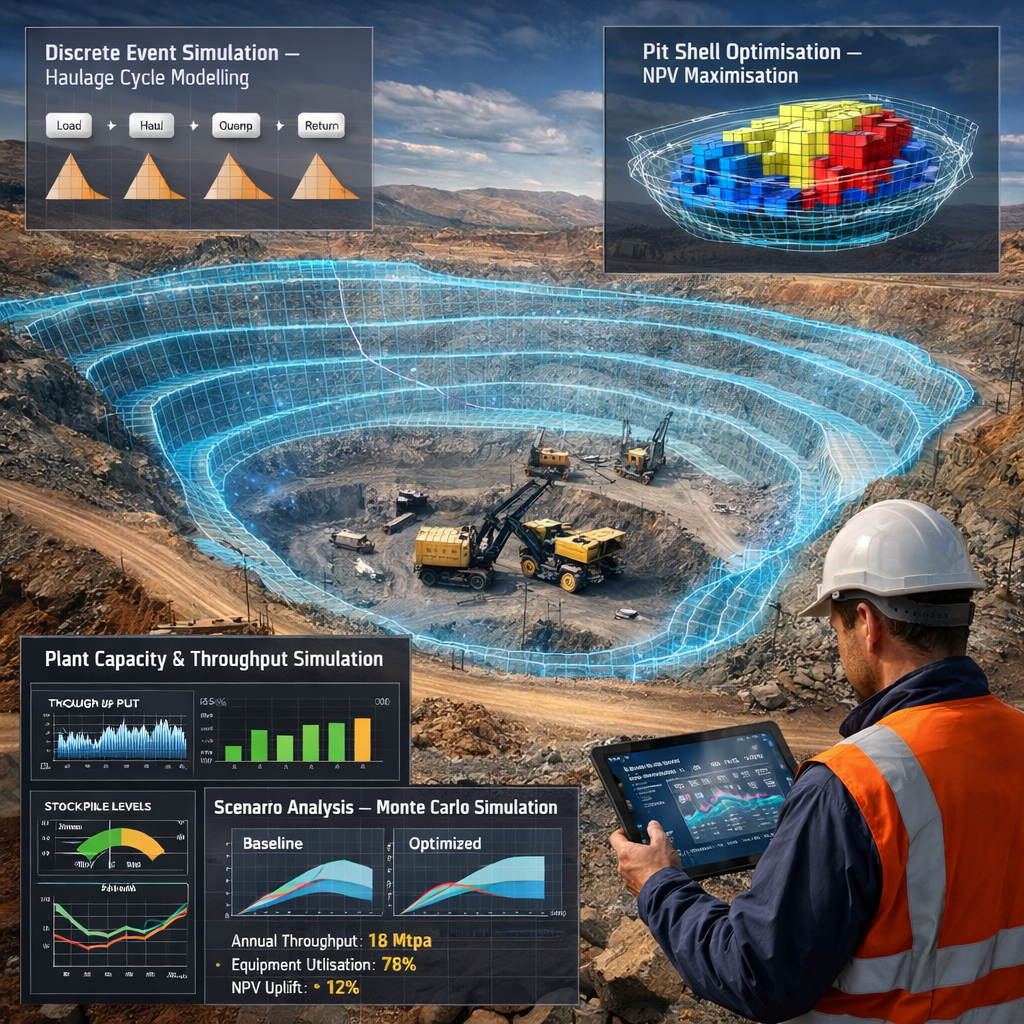
Simulation models enable mining engineers to consider various designs, plans, and operational assumptions without spending capital resources, thereby decreasing the probability of designing a mine plan which will not work practically. Moreover, simulation models play an important role in strategic mine planning by considering alternative scenarios regarding mine pit slope, scheduling, production scale, fleet size, and extraction level, as well as by identifying the impact of such alternatives on value, risk, and mine life.
An important application area of simulation is capacity planning. In order to estimate bottlenecks, production capacity, utilization levels of various assets and equipment, and maximum achievable production capacity, trucks, shovels, conveyors, drawpoints, stopes, crushers, and stockpiles can be modelled as part of a larger system. Such simulations are very helpful not only for open-pit mines but also for underground mines where the real production capacity usually does not match the designed production capacity due to various factors.
Moreover, simulation enables mine design through testing the effects of different decisions made on physical characteristics and operations prior to construction or ramp-up. For instance, using computerized models, one could analyze the effects of altering stop dimensions, haulage route, conveyor capacity, and material handling methods on flow, downtime, and meeting the targeted output level. Hence, the task of mine design involves not only geometrical issues but also becomes a system issue where mining, processing, and logistics are integrated.
Additionally, simulations allow analysing the effect of uncertainties associated with grade variability, geotechnical conditions, equipment reliability, fuel costs, and operating conditions on the mine operation. For instance, in order to evaluate the sensitivity of the mine design to these factors, many simulations need to be carried out, which is why simulation techniques are usually applied to assess the base-case plan alongside other scenarios and determine the assumptions impacting NPV, IRR, production stability, and risk.
Simulation modelling is also applicable for mine plan implementation in addition to design. According to planning studies, value is sometimes lost when translating the strategic mine plan into a workable schedule. Thus, the simulation process provides an accurate representation of the link between the two processes by considering real-world factors such as data flows. This has practical implications for improving dispatch procedures, maintenance scheduling, stockpiling strategies, and coordination between mining and processing operations.
In summary, the simulation approach to modelling provides engineers with a safe and quantitative basis for mine capacity design, production scheduling, and risk management. Unlike static calculations, simulations provide a comprehensive analysis of the entire mine system under various scenarios, thus helping in making informed decisions regarding equipment configuration, sequencing, infrastructure development, and ramp-up strategy. The use of simulation models is currently considered an integral part of decision-making for mining projects.